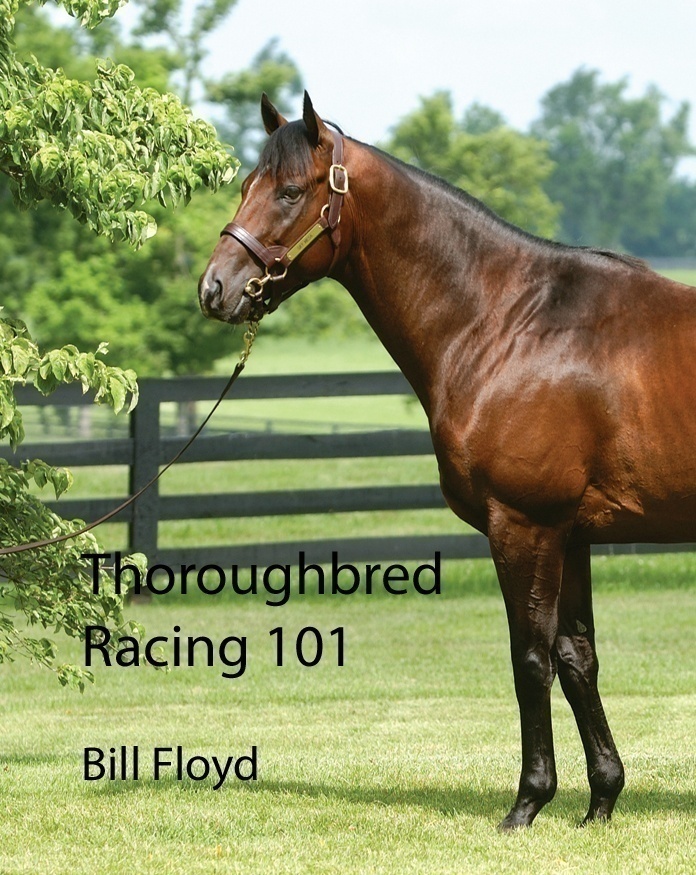
Front Cover Photo: Sky Mesa, used with permission of Three Chimneys Farm
In 1955 I discovered the “Black Stallion” series by Walter Farley and a few weeks later, it was Kentucky Derby time. This coincidence led me into a sport that has always been my favorite, but I never really took the opportunity to get fully involved. This book is written with the hope that you, the reader, will not make that same mistake and spend over 50 years without getting thoroughly immersed in the Greatest Show on Earth”, the wonderful world of the Thoroughbred Racehorse.
ABOUT THE AUTHOR:
Mr. Floyd is an entrepreneur, businessman and retired government executive. He has started three businesses, including a CPA firm and a Software Developer and has served with such organizations as Arthur Andersen, Medical Services of America and the SC Department of Commerce. He wrote the auditors training manuals for Associated Regional Accounting Firms that were used as the main training programs for over 100 CPA firms and has written many other short business publications.
The author with Tinners Way at Old Friends © 2011 Bill Floyd
Tinners Way is one of the few surviving offspring of the immortal Secretariat. He is retired from breeding and lives at Old Friends, a retirement horse farm near Georgetown, Kentucky.
Thoroughbred Racing 101
An Introduction to and Brief History of
Thoroughbred Racing in the United States
By Bill Floyd
©2012 All Rights Reserved Worldwide
“Weep no more my lady,
O’ weep no more today,
We will sing one song for my old Kentucky home
For my old Kentucky home – far away”
Stephen Foster
Introduction
From the time I read the first of “The Black Stallion” books in the early 1950’s I’ve been hooked on the sport of thoroughbred horse racing. Many of the facts about horse racing and the ways of the businesses it supports were a mystery to me for most of the intervening 55 years.
If you live in a state with legal horse racing, the following will seem impossible – otherwise, you’ll know what I mean!
Coincidently, I read the book in late April, just before the 1955 Kentucky Derby. But there just wasn’t that much press coverage of the sport in the mainstream media and each year, only during the week leading up to the running of the Kentucky Derby did my local newspaper, the Richmond (VA) Times Dispatch, begin to mention horse racing. Five weeks later, with the running of the Belmont Stakes, it was over. Horse racing went away for 47 weeks a year as far as the paper was concerned. They covered the Triple Crown races, as if that was the entire sport, and that was it.
There were no additional stories on any of the other races, at least until 1973 when Secretariat was at the height of his career. There was a little early coverage in the Roanoke (VA) Times where I then lived. That year, there was some coverage specifically on him losing the Wood Memorial before the Derby but still not much else until Derby Week.
Today, little has changed in that regard. If anything, there is even less coverage in the print media. Even the major papers outside the racing states now limit the coverage to a single article during Derby Week with some mention in the Sunday papers of the results. This day, November 6, 2011, there was a half page on the results of the Breeders Cup in The State (Columbia, SC). It’s the first newspaper racing coverage I’ve seen since the Belmont Stakes in June.
Even with the advent of 24/7 sports casting on ESPN and such, except for the Triple Crown, Breeders Cup and a few other key events, there is still little coverage outside of the dedicated racing channels. These appear to be available only through a single satellite dish provider.
This book is an attempt to help new fans learn some of the stuff it took me years to discover and it also includes a lot of summaries from my historical research into American horse racing that might be of interest to even long-time fans.
Even more important, it will give you easy internet links and references of where to get current racing information in abundance and on a timely basis. And a lot of it is free and the rest is very reasonably priced!
This book is dedicated to the memory of
Easy Goer (1986-1994) the “Mostest Hoss” I ever saw
Easy Goer
Photo provided by Claiborne Farms – used with permission of Dell Hancock
TABLE OF CONTENTS
Chapter I A True Horse Tale
Chapter 2 A Primer on the Language of the Sport
Chapter 3 A Very Brief History of the Roots of the Sport
Chapter 4 About that Secretariat Movie – Let’s Keep the Real History
Chapter 5 A Great Horse Success Story in a Great Horse Year
Chapter 6 Some Great Racing Rivalries
Chapter 7 The Tracks and the Races
Chapter 8 The Horse Farms and the Owners
Chapter 9 The Jockeys and Trainers
Chapter 10 Ten Most Important Horses to American Racing
Chapter 11 The Phalaris Lines – 99% of the Breed
A. Native Dancer, Atan and the Raise a Native Lines
B. The Nearco Lines
1. Neartic and the Northern Dancer Lines
2. The Minor Nasrullah Lines and the Bold Ruler Line
3. Royal Charger, Turn-To and the Hail to Reason Lines
C. The Tom Fool Lines
Chapter 12 The Fair Play Influence and the Man ‘o War Line
Chapter 13 Other Surviving Small Families of Thoroughbreds
Chapter 14 The Sorrows of Racing
Chapter 15 Secretariat’s Legacy and the Grandsons of Secretariat
A. The Racing Legacy – His Sons and Lady’s Secret
B. Three Super Grandsons – Storm Cat, AP Indy & Gone West
Chapter 16 Some Truly Great Horses and Some that Simply Can’t Be
Forgotten (Remaining Triple Crown Winners, Dr. Fager, Majestic Prince, Cigar, Easy Goer, Sunday Silence, Sham, Charismatic and Seabiscuit)
Chapter 17 The Mares & Fillies
Chapter 18 The Geldings (Phar Lap, Kelso, Forego, John Henry
& Funny Cide)
Chapter 19 The Greatest Racehorses of the 21st Century (So Far…)
Epilogue The Greatest Show on Earth!
APPENDIX
Acknowledgements
First and foremost, I want to thank the wonderful people and publications that helped me with so much of the research in this book. They include:
Charlie Brown (a real one) and all the folks at Old Friends for my very informative tour of that wonderful place and Popcorn Deelites, the “actor” who played Secretariat for his friendliness. Horses like Popcorn make you realize there is a whole ‘nother aspect to the sport, the wonderful supporting cast.
Chris Young of Overbrook Farms who gave me a tour of the farm, some insights into the sport and introduced me to the Great Storm Cat, a major inspiration to keep going on a project that seemed to have no end.
The management and staffs of Claiborne, Lanes End, Three Chimneys, and other farms that contributed time, photos and information to my efforts.
Blood-Horse Magazine, the publishing arm of the Thoroughbred Owners and Breeders Association. Many dozens of their weekly issues over the years and their other publications such as the annual Stallion Register and their website Bloodhorse.com, the best place to get into the heart of the industry and get constant information based on your chosen criteria.
Wikipedia, for much of my first-line research so I could hone in on more definitive sources
Youtube for the hundreds of videos I watched to fill in cracks in my memory about the competitors and the in-race lead changes, and other information not otherwise readily available.
Brisnet, for the racing charts, especially those on the major races
KentuckyDerby.com for the vast history it maintains on its premier races
TBHeritage.com for their wonderful records of the breeding lines, broodmare lines and other historical information
PedigreeQuery.com for their unparalleled database of Thoroughbred horses and their racing records. All horses can be easily traced from today to the Foundation Sires in the early 1700’s.
The late Walter Farley who introduced me to the sport through his 20 plus books on horse racing, especially the fictional “Black Stallion” series that hooked me at a very early age and his extraordinary historical novel “Man ‘o War”
Laura Hillenbrand and her tremendous historical novel “Seabiscuit” which was later made into a motion picture.
Elizabeth Mitchell and her inspiring historical work “Three Strides Before the Wire”, the true story about a horse (Charismatic) nobody wanted and a jockey (Chris Antley) nobody trusted and their shot at the Triple Crown. It fell short as the horse broke his leg just a few hundred feet before the finish line in the third of the Triple Crown races, the 1999 Belmont Stakes. As of this writing, this very fortunate well-bred stallion stands at stud in Japan. Chris Antley died in 2000 of a likely overdose or in what may well have been an unsolved murder.
Many of the great horses and their races are available for viewing on Youtube.com. If you see a horse that interests you in reading this book, just look for a video on him/her on their search page. I doubt I have mentioned any horse born after Man ‘o War in 1917 that won’t have at least one race there. For a few races, I have included the link. However, this may change from time to time, so the name and the word “horse”, or the name of a race and the year of the race will find almost anything there. There appears to be an entire cottage industry devoted to posting horse races, so even some very minor ones are often available as well as virtually every important race since at least 1980. Some date back to the 1910’s.
My horse “heroes” over the years not otherwise mentioned in these acknowledgements including Nashua, Venetian Way, Riva Ridge, Secretariat, Seattle Slew, Alydar, Winning Colors, Unbridled, Strike the Gold, Barbaro, Quality Road and Zenyatta.
I also want to especially thank the late great Easy Goer, the horse whose memory inspired me to really get serious about writing this book. I can seldom watch a race without seeing Easy Goer at the wire.
Chapter One – A True Horse Tale
We think of thoroughbred racing as the game of kings and of course, queens – and it was and still is. Queen Victoria was an avid owner, breeder and fan. Queen Elizabeth II is a major owner and attended the Kentucky Derby on at least two of her infrequent trips to the US and went to Lexington Kentucky on another trip to visit horse farms.
In the US, it’s long been the province of leading bankers and business tycoons, as well as in recent years especially, Hollywood stars, pop musicians, sports heroes and other entertainment celebrities. So, you might still think of it as the “sport of kings”. It does require some big bucks – at least most of the time. This is a time when it did not. Anyone with the desire can actually get into the business!
Breeding Matters – Sometimes it takes a while to show up –
In September 2007, a wannabe 73 year-old trainer named Tom McCarthy attended the September Fasig-Tipton Keeneland Horse Sale. It is generally “the” US sale of the year. He wanted to really get into racing, a sport he had long enjoyed. He wanted to buy as good a horse as possible for $20,000 or less. He selected one particular horse, a son of a young sire named Sky Mesa, He was a smallish horse, with some conformity defects, as most horses in fact have.
This was before the beginning of the Great Recession as we now call the downturn of 2008 and the bottom of the horse market had not yet collapsed. So, this was even less of a price than it would be today as demand was much stronger then for low end sale horses. Whereas the top of the market is still relatively strong, even improving, the lower end has suffered and one way of compensating by the sellers is to offer fewer horses. Thus, a horse like this one may well have not even been offered in 2009, ‘10 or ‘11.
However, he was unsuccessful in buying him as the horse went for more than he had set as his limit for bidding. Not to be outdone, he followed the horse until he showed up in a claiming race and then he bought him, knowing there could be no bidding war as was the case in the sale. The price is fixed and he was his!
This little fellow was named General Quarters – quite a handle for this small roan colt. Despite his low price, the horse had, at least on paper, an impressive pedigree. But, as has been said many times by learned horse people, pedigrees don’t run races, horses do.
Of course, through no fault of General Quarters or that of his daddy, his sire Sky Mesa was only in his second year in the stud barn when General Quarters was conceived. By the time of the sale, few of his first crop of colts and fillies had run and of the very few that had, none had yet fared too well. So, there wasn’t a lot of demand for this smallish son of Sky Mesa.
Sky Mesa’s race record also showed fairly poorly. Just at a quick glance, he had won only $600,000 in winning three races and finishing in the money twice more. Of course, a further look showed he had only run six times so five in the money finishes was pretty impressive. Still, in an industry where most sires are now multi-million dollar winners and top sires are often $3 million, $4 million or even $5 million or more winners, people poring over a sales catalog for a horse can easily miss a General Quarters when looking at a book with 500 or more horses for sale.
But Sky Mesa had the paper pedigree of a champion. He was the son of Pulpit, a leading sire/son of AP Indy, one of America’s top sires over the last two decades. At the time, AP Indy stood stud for $300,000 for a live birth. This also meant he was in the tail male (father to son to grandson, etc.) line of both Triple Crown Champion Seattle Slew and the immortal Bold Ruler, seven times US Champion Sire of the Year.
His damsire (mother’s father) was Storm Cat, the leading sire for that same period. Storm Cat stood at that time for an incredible world record $500,000 per live foal. This combination of Storm Cat and AP Indy as grandfathers also gave Sky Mesa a double cross to the incomparable Secretariat (meaning he showed up in both sides of Sky Mesa’s pedigree) through Secretariat’s two leading, breeding daughters, Terlingua and Weekend Surprise. As we will learn later, Secretariat was a “bust” as a sire of sires but his daughters have made Secretariat one of the leading broodmare sires (a father of great mothers) of at least the late 20th Century, if not of all time.
Sky Mesa’s line also includes a 4DX4S cross (meaning 4th generation to both the dam and sire sides of his family) to the immortal Raise a Native through his best breeding son Mr. Prospector and his best racing grandson, Triple Crown Champion Affirmed. Thus, in addition to older crosses to other Triple Crown winners, including at least Count Fleet and War Admiral, Sky Mesa has all of the last three Triple Crown winners in his four generation pedigree.
But to the casual observer and even the expert, far more suspect for the auction attendees was the sparse record of his mother. His dam, Ecology, had no track record in breeding at all, as General Quarters was her first foal. Furthermore, she had not won or placed in her two racing starts and was quickly retired to the breeding barn. She had been purchased at a Keeneland sale in November 2004 for $35,000, a relatively shabby price for a filly who was also well bred.
Like Sky Mesa, she too had an impressive pedigree. As the daughter of Unbridled’s Song she was from a very successful part of the Mr. Prospector tail male line. Her daddy, Unbridled’s Song currently stands for $100,000 (note: despite the incredible fee of $500,000 that Storm Cat commanded in his prime, no American horse currently stands for more than $150,000 and $100,000 is among the five or six highest stud fees out of over 5,000 horses standing stud).
He is at Taylor Made Stallions and is perennially a top 10 North American sire. But then, he was a fairly young sire also and not as well known. Her damsire (mother’s father) was Danzig, one of the immortal Northern Dancer’s most prolific and successful sons. Danzig sired over 200 stakes winners and is said to be the all-time North American leading sire by number of stakes winners.
Still, to a buyer at the auction or a claimer (a claimer is a buyer that goes to bottom of the barrel horse races, looking for bargain horses that can be claimed for a small price), General Quarters looked like a horse that might have some slim glimmer of potential but could also be a total “bust” and end up as only a feed bill. The high end buyers completely passed and he went to Ken Ramsey for the lowly sum of $20,000 at the auction.
McCarthy, a retired school principal had a trainer’s license he had earned through hard work helping other trainers and a retirement check he also earned through hard work as a career school principal and little else to recommend him as an owner/trainer of thoroughbreds. But he had the time and knowledge to look through the sales book and take a chance on a horse like General Quarters.
Most important, he had the desire to get into the sport in a much bigger way. So, when General Quarters showed up in a claiming race for $20,000, he bought him. Of course, this is almost the same price as he could have possibly bought him for at the auction, but who knows how high Ramsey would have gone if he had ventured beyond his $20,000 limit?
I won’t repeat a well known industry story here in great detail but when the horses went to the post in May 2009 for the Kentucky Derby, my three picks for the race were Pioneer of the Nile, 3rd (to show), Summer Bird, 2nd (to place) and General Quarters to win. Although he finished well back in the field that day, I still knew he had heart.
Three weeks earlier, he had won the $750,000 Toyota Blue Grass Stakes and that is a primary prep race for the Kentucky Derby. That race had already given McCarthy a huge $465,000 first place payday for his investment. Also, it enabled General Quarters to qualify for the Kentucky Derby as one of the top 20 earners among three year olds in graded stakes races. Regardless of his finish, just having a horse run in the Derby is a thrill to almost any trainer, let alone a one horse operation. But General Quarters was a potential winner and not just a case of a trainer seeking glory.
A year later in 2010, he was entered in another race on the Kentucky Derby card, the grade 1 Woodford Reserve Turf Classic. That day, he did win a clear victory, giving McCarthy the second-biggest payday of his career in winning the $500,000 race. It, coupled with his win in the Blue Grass Stakes greatly enhanced his eventual stud fee as a multiple grade I winner.
To date (December 2011) General Quarters has won over $1,250,000 – quite a return on a $20,000 investment. Of course, other horses bought that same day are likely now only feed bills. Over 20,000 new thoroughbreds are foaled each year and only 20 make it to the Kentucky Derby three years later. One can never be sure, but in horse racing one thing is very clear – breeding does matter and General Quarters definitely has the pedigree to back it up.
Pedigree is the one reason I had Summer Bird in my top three picks that year for the Derby. Whereas General Quarters and Pioneer of the Nile were there because of impressive prep wins, Summer Bird was there primarily because of his two year old racing season and his breeding. He had been Eclipse Award Two Year Old Champion and he was my “replacement” horse for Quality Road, who was forced to miss the Derby because of quarter cracks in his hoof.
Quality Road had been my (and a lot of other peoples’) pre-race favorite but his injuries kept him out and I needed another Mr. Prospector family colt to fill out my top three. As you will learn later, Mr. Prospector’s progeny have won 34 of the last 53 Triple Crown races (three races each year over the last 17 plus years). Shame I didn’t pick Summer Bird’s half brother Mine That Bird (much more on that half brother term later – both were sired by Birdstone). Mine that Bird won the race in the second biggest upset in Kentucky Derby history! Mine That Bird paid $103.20 for a $2 wager.
As for General Quarters’ future, he has recently retired to stud and my money is on him to be a great one. In a lot of way’s he reminds me of his Great, Great Grandfather on his mother’s side of the family, the immortal Northern Dancer, Danzig’s sire and the leading sire worldwide in the last 75 years. Northern Dancer was also a little guy that was underrated in many ways until he won his Kentucky Derby in then-record time.
Yes, Breeding Matters – Sometimes it bites you in the butt –
One of the fastest sons of the immortal Bold Ruler (sire of Secretariat and great-grandsire of Seattle Slew) was Reviewer (1966/13: 9-3-1). Today, Reviewer is best known as the sire of the immortal Ruffian (1972:/11: 10-0-0), considered by many to be anywhere from the best filly to her time to the best racehorse ever. There were people that would bet their last dollar on her. And she didn’t let them down, that is, until the day she died. That day, in a match race with 1975 Kentucky Derby winner Foolish Pleasure, known then as the “Battle of the Sexes” (this was the era just post TV’s Mad Men series) she broke her ankle and ran close to a quarter mile on the break and had to be euthanized before the day was over as she kept thrashing and destroying the cast. She was still ahead of Foolish Pleasure when she finally went down.
Ironically, Reviewer himself had to be taken off the race circuit three times because of his fragile bone problems. He had the speed and the stamina of a champion but he lacked in bone strength. And very surely he passed all of these traits, good and bad, on to Ruffian.
On the other side of her family, there was a lot of soundness as Ruffian’s damsire was none other than the immortal Native Dancer (also damsire of his namesake Northern Dancer and sire of his other namesake Raise a Native). Native Dancer very likely passed the “big heart” gene (more on that later also) to Ruffian through her mother, his daughter, Shenanigans.
Shenanigans had a very good career as a broodmare, also foaling Icecapade as well as several other strong horses, including Buckfinder. Icecapade is the only sire with a surviving line from Neartic, one of the three great sons of the immortal Nearco, other than Northern Dancer.
We will later talk more about all of these horses as they are very important to the breed.
But, at the end of this story, General Quarters is one of the best investments in the history of the sport – but not the best. We will talk about a couple of others later on that paid off even better in money and/or prestige. And, like General Quarters, they had the pedigree to back it up.
Chapter Two – – A Primer on the Language of the Sport
Before we begin our look at the sport of kings, we’ll take a few minutes to learn a little of the lingo. Like every sport, horse racing has its own vocabulary. Most of the terms are pretty simple if you know what they’re talking about, but complicated as Greek if you don’t.
A Father is a Sire and so forth
Horses are referred to by sex as horses and mares when they are of breeding age. When a horse is still racing, he is generally called a colt. When a mare is racing, she is generally called a filly. Age doesn’t really matter, although, technically, the term filly can mean pre-pubescent female horse to some people or a four year old in some countries and a five year old in others. The terms are overly confusing and generally not that important in conversation. Another term used, especially in other countries for females still racing is distaff. That term is also used to identify a female family line much as the term tail male (see below) is used to identify the male family line. A four year old breeding female is a mare whereas Zenyatta at age six was still often referred to as a filly.
I use Zenyatta as an example here, because you will hear from her many more times in this book. She is one Great gal.
A breeding male is said to be the “sire” of his offspring rather than the father. A breeding mare is said to be the “dam” of her offspring rather than their mother. The mother’s father is the damsire. All horses are identified in most professional works as follows:
Secretariat by Bold Ruler, out of Somethingroyal by Princequello.
Here, Bold Ruler is the sire, Somethingroyal the dam and Princequello is the damsire. Also, I use Secretariat because you’ll hear a lot about him too. He was one Great horse. Of course, unless you were stranded in a cave in the mountains of Pakistan for the last couple of years, you already know who he was!
A male horse that has been “neutered” is called a “gelding” and is said in industry parlance to have been “cut” whereas dogs are neutered. Geldings are raced but of course cannot breed. The major reason to “geld” a horse is that he’s mean as hell. He can’t be controlled and is deemed to be otherwise unable to be raced. In the earlier days of racing, many of these horses were tolerated and raced “as is” with somewhat mixed results. The relatively small family surviving from the Godolphin Arabian (see below) had some really mean horses during the 1900’s including one that allegedly killed a groom just out of spite.
So, what happens to all these geldings? Well, most of them, if they’re any good, race until they’re seven or even eight/nine and become the journeymen of small-time racing. It’s not uncommon to see these horses with well over 100 career starts whereas a good colt seldom races more than 20 or even fewer times before being retired to stud. Also, most of the horses you see with the out-rider leading the racers in the post parades are geldings as they make great saddle horses and don’t act up being around the colts or fillies. And the colts tend to behave much better this way too.
A few geldings become outstanding racers and win Horse of the Year honors. Some of these include Kelso, Forego, John Henry and Funny Cide. You’ll hear more about them too. There is a whole chapter on Geldings later in the book.
“Half to”
Horses that have the same dam (mother) are said to be “half to” each other meaning of course, half brothers or sisters. Those few that have both parents in common are full to each other. Generally, no such distinction is used when horses share a sire (father). This just makes no sense and I often ignore it in this book as some of the most important half brothers by this better definition are simply easier to talk about in this manner. However, around horse people, you get some funny looks by calling horses that share a father half-brothers or especially “half to”.
Fillies Race Too!
Another thing you’ll hear a lot about in this book is the racing fillies. Up until very recently, actually in this new century, fillies were considered to be inferior to males as racers. Results over the years pretty much even bore out this point as few fillies won in mixed company even when it was tried. Something in the breeding has apparently changed all that.
Of the top ten horses of this young century, at least my top ten, four are fillies. That compares to six on the Blood-Horse Top 100 Thoroughbreds of the 20th Century. That list is discussed often in this book and appears in the appendices to the book. Naturally, there will be a chapter on the great fillies, both as racers and as mothers.
Types and Breeds of Horses
Horses run in several types of races. This book is about the Thoroughbred breed of horses. Thoroughbred is the name of a breed, not a classification like “registered” as with dogs. To be a thoroughbred, both parents must be registered as such with the US Jockey Club or a similar registry in another country. Even though there are many countries with Thoroughbred Registries, there are no differences in the rules from country to country on which horses qualify. A thoroughbred is a thoroughbred if properly registered. However, horses not bred in the United States and thus initially registered with the US Jockey Club will have their country of origin specified next to their name in sire registrys. I presume this is so a breeder can know this before selecting a foreign born horse if he has any concerns about it. One of the top sires in the world today, Street Cry (IRE) was bred in Ireland and that is always shown with his name in the Blood-Horse Stallion Register. He stands for $150,000 at Darley just outside Lexington, Kentucky.
Other breeds include the Standardbred, the American Quarter Horse, the Tennessee Walking Horse, Appaloosa, Clydesdale and so on. There are well over 150 breeds of horses recognized worldwide.
Thoroughbreds are primarily flat track runners on dirt or turf (grass). Only thoroughbreds can run in Thoroughbred races, which constitute the majority of US flat track horse racing, especially outside of the Southwest where Quarter Horse Racing is popular. Steeplechase Jumpers are also generally thoroughbreds but are not required to be.
Standardbreds pull little carts, called sulkies and compete in a whole different sport. Actually, there are two sports, one for trotters and one for pacers. This difference is trained into the horse and involves the way the horse steps and they are trained for one or the other.
Standardbreds also make good saddle horses but are not normally raced as such. Standardbreds were basically bred out of Thoroughbred stock.
The Quarter Horse is a breed that runs in shorter sprint races, generally of a quarter mile or less. Quarter Horses are also used in certain rodeo competitions. They generally have great dispositions compared to thoroughbreds. They are heavier through the thighs and have shorter, stronger legs and are bred for raw speed, not stamina, and the ability to stop or turn quickly. Thoroughbreds have been used to strengthen the Quarter Horse breed which originally came from cavalry horses and wild horses.
Generally, thoroughbreds are taller, thinner and have more delicate legs than other breeds. Their bodies are normally shorter than standardbreds or quarter horses. A good sprinter like Mr. Prospector, another Great horse you’ll be introduced to in a later chapter, looked a little more like a quarter horse than a distance runner. The taller, leaner horses generally do best in long races. The Belmont Stakes is one of the longest major American races at 1 ½ miles and is the third leg (race) of the American Triple Crown.
Colors of Horses
Most thoroughbreds are brown or dark brown with few or no obvious markings. Some have white patches on their faces and some have “socks” on from one to four legs. There used to be a very strong superstition that horses with three socks were worthless. Hopeflly, Secretariat put an end to that one!
Other colors are black ( a true black is very rare) grey or roan and chestnut. Grey is obvious and is a blend of both dark and white hairs, giving the overall appearance of gray. Roan is actually different from gray in one major way. Young grays and roans are difficult to tell apart but as grays age, they become much whiter and often appear to be almost solid white as an older horse. Roans do not age out to white. They remain gray.
Chestnuts are also called red. Secretariat was a chestnut and was affectionately known by his handlers as “Big Red”. This same color and nickname was also associated with Man ‘o War. Many browns are borderline between brown and chestnut and appear lighter than browns but darker than true chestnuts.
Occasionally, a horse shows up in the breed that just doesn’t fit any color scheme discussed. An example of this is Riva Ridge. He is listed as brown in the Pedigreequery.com database but that is a real stretch as the picture of him below shows.
[Permission needed or substitute photo]
His coloring is certainly very unusual and at times he almost looked tan. Note that he is wearing blinkers and the Meadow Stable colors Secretariat always also wore.
LFSN
This abbreviation is used in the industry for a live foal that stands and nurses. It is usually but not always, the moment when a stud fee is earned by the breeder.
Measuring a Horse
A thoroughbred’s height (or any horse for that matter) is measured in “hands” high, which is four inches or the width of an Englishman’s hand (the same one whose foot was a foot long I presume). The measure is from the ground to the withers, the ridge between the horse’s shoulder blades. A horse less than 14 hands, isn’t! He’s a pony. Often this cutoff is at 14 ½ hands. The famous racer Seabiscuit was almost a pony, standing barely 14 hands. But, unlike the movie said, describing and showing War Admiral as a giant horse, he too was a little horse and by far the smallest of the Triple Crown winners. Hollywood has to add some drama to everything and to hell with the facts. But that movie was at least far more factual than “Secretariat”. We will really get into that later just to keep you from becoming ingrained with a false history of the sport.
Technically, most US horses less than 14.2 hands are ponies. Here, the .2 means two/fourths or half a hand, not two/tenths of a hand. Thus Zenyatta, listed at 17.2 hands officially, is 17 ½ hands high, an extremely tall thoroughbred horse.
The Breed’s Bloodlines
All living thoroughbreds trace from a relatively small racing population developed in England during the late 1600’s and early seventeen hundreds. The mares were nearly all existing English racing stock and the stallions were mostly imported Arabians brought in to improve the breed. Today, every single thoroughbred alive can trace his/her male family line (called the tail male line) back to three Arabian Stallions imported between 1680 and 1725.
This is simply because over cross-breeding has eliminated all the other lines. However, that doesn’t mean other Arabian stallions aren’t represented in the blood line. There are well over a dozen of the others that are still represented in the gene pool, just not in the tail male line, which is father to son to grandson etc. Some of them are said to be actually represented in greater percentages in today’s stock than two of the three foundation sires. I seriously doubt that as you will see later when we discuss the history of the breed.
These three foundation horses, The Godolphin Arabian, The Darley Arabian and the Byerley Turk are just the only ones left if you used “last names” passed down from father to son to son. And even these lines are said to be represented today by just one line that survives from not that far back. However, there are at least three lines left from the Darley Arabian dating back almost 200 years. We will get into this further in a subsequent chapter. But I will say here that the Darley Arabian family still has two other branches (besides Phalaris) surviving that are much older than most people, even many of those that write about the sport, realize! We will talk about this in a chapter on the Darley Arabian’s primary descendant family, the Phalaris line.
Types of Thoroughbred Races
Within thoroughbred racing, there are several types of races. This book is about flat racing which in America is almost synonymous with thoroughbred racing itself as the only other type – steeplechase – is so rare here. In Europe, the following would all be called flat racing and the names of the categories would be slightly different. The major US categories of flat racing are:
Stakes races – a horse’s owner puts up an entry fee to enter the race, often months in advance of the race. The Triple Crown Races require an entry fee of XXX paid by XXX of the year of the races. After that, a supplemental fee of $6,000 is required before February 15 after which you simply can’t get in no matter how good your horse turns out to be. These and other graded stakes races are the cream of the crop.
Graded Stakes – all stakes races are graded or ungraded. A graded stakes race is classified as grade 1, 2 or 3. These are the crème de la crème so to speak. The purse offered has a lot to do with the classification as well as other factors. Two and early three year old graded stakes races offer all colts and fillies a chance to qualify for the Kentucky Derby. Since every owner and trainer wants his/her horse to run in this most prestigious race, there would be fifty horses running each year if there weren’t some way to pick the ones who get to start.
The Derby is limited to 20 starters, determined solely on lifetime graded stakes earnings. Entries close at 9:00 am the Wednesday of Derby Week. If you’re in the top 20 in grades stakes winnings you get in. If not, you don’t. However, if a horse above yours in the money list does not enter, horse # 21 on the list moves up and so on. The most unfortunate part of this is that 20 horses are still just too many. We will talk more about that later too.
Usually only a dozen or less run in the Preakness Stakes, second leg of the Triple Crown, because the wannabes have already been cleared out and the race just does not have the prestige of the Derby unless the horse is still in contention for the Triple Crown. Still, winning even a single “triple crown” race adds substantially to a horse’s initial breeding value.
In the Triple Crown races, all horses carry 126 pounds, except fillies carry 121 pounds. That is the weight of the saddle, saddle blanket, riding crop and jockey. Now you see why the jockeys are such little guys. Weights are added to the saddle to get the exact weight. A horse can carry more weight if the jockey is a little too heavy but this has to be announced before the race to the betting public. It simply doesn’t happen in triple crown races.
Handicap races – the horses are assigned weight based on past performance in an effort to even out the race so theoretically, every horse has an equal chance of winning. Some horses have been assigned almost ridiculous weights. Man ‘o War often carried 30 pounds more than his competition. You will hear a lot more about this Great horse too!
Maiden Races – only horses that have never won can run in a maiden race. These are important to allow new runners a chance to avoid claiming races. However, they can soon run out of these. Also, some maiden races are for only two-year-olds as they only race each other in maidens. Early in each season there are also some maiden races for non-winner three-year-olds. After that, all ages run together.
Maiden Specials – some modified maidens raced give preferences such as “preferences to a horse that has not started for in excess of $50,000”. This further narrows the field making it another way for keeping the race a little more even as in this case from a $50,000 race for two-year-olds, horses that have competed against “better” horses in bigger money races are excluded unless needed to fill the field.
Allowance Races – these are races for horses that have never won races higher than the “allowance” for the specific race, which covers a lot of territory. For example, a specific race may allow any horse to run that has never won more than two races offering a total purse of $60,000 or over. The racers may be maidens or “allowed” previous winners. These are a step up from basic maiden races.
Claiming Races – these are the bottom of the barrel in horse racing. In a claiming race field, any person with the money (licensed in the jurisdiction in some cases to own race horses) can buy any horse in a claiming race, any one for the same price. This is actually the most common type of race. In a given year, over half the races run in Kentucky are claiming races. They generate a lot of “fill” for the racing season and draw a lot of people to the tracks. It also gives bettors a chance to “beat the odds” as claiming races can be very tough to handicap.
The horses in the race are entered with the stipulation that anyone can claim them for a set, agreed upon price that is known before the time of the race. They have to be claimed before the race. The original owner gets the prize for the race. The price is usually no more than the prize fund, so a lot of owners put a lot of horses at risk this way every year. Of course, the risk keeps owners from running horses that can easily mop up the money because they are too good to be in the race. They would quickly get claimed as there is a cottage industry in “claiming” just like every possible way to make money in every field of endeavor.
Maiden Claiming – even the bottom of the barrel has a bottom layer and that is the maiden claiming race which is just what it says – a claiming race for horses that have never won or “broke their maiden”.
Actually, there have been a lot of good horses bought in claiming races. We talked about General Quarters in chapter 1. We will talk about some more of them later but for now, the most famous claimer ever was probably Stymie.
Stymie (1941) was bought for $1,500 in a claiming race. He retired as the American record holder for earnings at the then incredible sum of $918,485. Somebody really dropped the ball on this one as both of his parents had the immortal Man ‘o War for a damsire and both male grandparent lines up to his mother were from Domino, then a great sire who is still in the tail male sire line, through his two best sons Peter Pan and Colin.
Looking at Stymie’s pedigree is like looking at that of a champion. Sometimes though, it takes a while for all of this to be known.
Gambling at Races
The major way a race track makes money is on the gambling. They are much like casinos in that regard. The betting pool and odds are set up to generate about a 17 percent “take” for the track. This is more or less an average as it varies somewhat by state and is part of the individual states’ gaming laws.
Because the odds are set and move with the money in that the odds go down as more money goes on a horse and up as less is bet, the track will always get its 17%, so they aren’t gambling. The bettors are basically paying a premium to legally bet with each other. For ever winner, there is a loser(s) plus 17%, so to speak.
A device called a totalizer is used to keep up with the complex math of this system. The numbers change right up until betting closes on a given race, just as the gate opens for the race. By the way, this is literally how they cut off betting. The gate timer is connected to the betting windows and literally ends the betting when the horses are released.
If you think 17% is steep, casinos generally operate on 20% or more take and most state lotteries have over a 50% take. Actually, for legal gambling, horse racing is a bargain – and the sport is a lot of fun.
A Simple Pedigree Chart
| Birdstone | Grindstone | Unbridled | Fappiano | ||
| Gana Facil | |||||
| Buzz My Bell | Drone | ||||
| Summer Bird | Chateaupavia | ||||
| Dear Birdie | Storm Bird | Northern Dancer | |||
| South Ocean | |||||
| Hush Dear | Silent Screen | ||||
| You All | |||||
| Hong Kong Squall | Summer Squall | Storm Bird | Northern Dancer | ||
| Weekend Surprise | Secretariat | ||||
| Lassie Dear | |||||
| Hong Kong Jade | Alysheba | Alydar | |||
| Bel Sheba | |||||
| Ruby Slippers | Nijinsky | ||||
| Moon Glitter | |||||
Above is a four generation pedigree for Summer Bird. I chose his simply because he is a recent horse and I like him a lot. This type chart can be carried out as far as you want, all the way back to the Foundation Sires in the seventeenth century. The records are amazingly complete and there are few disputed facts in them, none of any consequence later than 1764.
This one dispute in 1764 is quite important but most historians agree that the records as normally shown are correct. The horse in question was none other than the immortal Eclipse (1764) as to who his sire was. Generally it is believed to be Marske but I have seen other sources that dispute the absolute correctness of it. I have seen Shakespeare listed as his sire. Since Shakespeare was 19 when Eclipse was foaled, it is possible. However, either way, he is still from the Darley Arabian tail male line. We will discuss Eclipse in more detail later.
This level of pedigree shown above includes 31 horses – 16 Great-Great Grandparents, eight Great Grandparents, four Grandparents and the two Parents plus the subject horse. A seven generation chart adds 32+64+128 horses for a total of 255 horses. Depending on birth order this can include horses as recent as the last 30+ years old all the way back to as much as 100 or more years. For example, in the above chart, Fappiano (born 1977) was outlived by his sire Mr. Prospector by nine years. He had “brothers” born as late as 2000. And he wasn’t even an extreme example. In the same generation, on this chart, as Fappiano is Northern Dancer, born 16 years earlier. Again, that isn’t an extreme difference. Also, by the time you get seven generations back, you often see the same horses appearing twice, three times and even four times. It often happens even in the 4-generation charts (see below), and once in a while, even in the third generation.
These are called “crosses” and most of them are not really bad for the breed. Sometimes, they do get too close for comfort and we will mention a couple of these cases later on.
In this chart, note that Northern Dancer appears in both the dam and sire’s pedigree in what is known as a 4SX4D cross (fourth generation sire to fourth generation dam cross). In this case his “appearances” are as far apart as possible in the fourth generation. Having a cross like this to Northern Dancer is generally good as he is about as great a horse as you could have in a pedigree.
What doesn’t show until you get the sixth generation is a 5Dx6S cross to Raise a Native through his son Alydar on the Dam side and his grandson Fappiano, by his son Mr. Prospector, on the Sire side. This in effect means Native Dancer is in his pedigree at least 4 times by the sixth generation back (twice from Northern Dancer and twice from Raise a Native). Again, these are super crosses to have and not at all considered detrimental.
Handicapping, Especially Track Handicapping
In order to get “beginning numbers” for the betting for any given race, the track employs a “handicapper” who sets the odds for the race. The handicapper has to really know the horses and the general mood of the bettors. He doesn’t care who wins or who will win. He only cares that the bets don’t move too much, especially on the big races. If they do, he’ll have some unhappy folks on his hands.
Imagine that you place a bet an hour before the last race for the day and the odds on your horse are 6 to 1 meaning a bet of $2 will get you a payout of $12. As the bets come in, the odds are automatically adjusted to ensure the track gets their 17%. If less money is bet on your horse than the handicapper estimated, the odds go up. You’re ok with that! But suppose your horse is very popular and more people bet heavily on him than the handicapper thought, and the odds go down. Whatever the odds are at race time is what your payout will be based on.
Suppose he is so heavily bet that the odds fall to 2 to 1. Well, you will only now get $4 back for your $2 bet. Even if you win, you’re not going to be happy. If you lose, you’ll really be mad. You might well have bet on another horse, maybe even the winner if you had not been expecting the high odds. Thus, he’s got to anticipate, within reason, how the bets will fall. What he cares about is that his odds, over the course of a racing season don’t get too far out of whack. Occasionally, he’ll really miss one, but overall, he wants to be close.
The challenge is that bad odds-making over time will cut down on people’s willingness to bet. They will lose confidence, they’ll suspect rigging or criminal intent, and they’ll eventually quit betting and the track will close.
Winning, Placing, Showing, Etc.
Now, all bets are placed on a horse (1) to win meaning you get the full odds if your horse wins or (2) to place (finish second) which means you get a predetermined lesser amount if your horse wins or finishes second or (3) to show which means you get a still lesser amount if your horse finishes first, second or third.
This system of multiple betting and moving odds is called pari-mutuel betting. It is used in many other sports as well. California even uses it in the Powerball Lottery.
The winner of a race is of course called a winner and is said to “win”. Simple enough! The second place horse is said to “place” and the third horse is said to “show”. Generally, these are the positions that pay prizes and are also the subject of betting. A horse’s career record is often expressed in a format such as 10: 3-4-2 where 10 is the total career races, 3 is the number of wins, 4 is the number of places (seconds) and 2 is the number of shows (thirds). Races where the horse finishes 4th or lower are not shown in this expression and are said to be “out of the money” meaning that there is no betters’ prize for the finish. Often, the actual prize money goes much deeper than third place, sometimes all the way to last place in a maiden race. It’s sort of like paying the bit players to act and not just the stars.
You can also buy special bet tickets which are more like a lottery that allow you to bet on multiple horses and/or multiple races on the same day. For example, you might bet three horses to finish in a specific order. This is called a trifecta and might pay out several hundred dollars on a $2 bet if that’s how they finish. There are several combinations on this. An exacta is two horses in exact order, a trifecta is as above – three horses – and a superfecta is generally four horses. But a bet might involve picking the winners of several races on the race card. A typical race day is 8 to 12 races, generally half an hour or more apart. The Kentucky Derby is the eighth race on the card for the first Saturday in May each year at Churchill Downs, Lexington Kentucky. The “card” is the list of races for the day with the horses and odds, etc on it. The odds on the card of course are printed and do not move during the day. They’re called the “morning odds”. Every race has a name. So, the track might sell a superfecta based on the winners of say, races 2, 4, 6 & 8 of a nine-card race.
Don’t let this seemingly complex system intimidate you. Anybody can bet fairly safely on low-odds horses by betting them to place or show and betting in small increments. It’s like going to the fair and trying to win a teddy bear. Just getting involved can be exciting and part of the overall enjoyment even if you don’t win much.
Simul-Casting
It used to be that on race day there was little to do between races, which last a couple of minutes and are spaced every half hour. Now, most tracks use the magic of the internet to broadcast several different tracks at the same time from the track side lounges and betting rooms. Thus, you can see races from Belmont Park in New York, for example while sitting in the lounges at Keeneland in Lexington, Kentucky. Now you can bet on and follow races from several tracks just as if you were at them all. Even if you don’t want to bet on races at other tracks, it helps fill the down time. Of course, the serious bettors use this time to pore over the Daily Racing Form to better pick winners.
You can even see multiple screens sitting in the grandstands from huge TV screens inside most of the major tracks much like scoreboards in football stadiums, sometimes right behind the finish line. At Keeneland, you can watch the entire race from the finish line TV and see the horses come across live right in front of the screen. The finish line is shown at the far right center of this picture and the picture on the screen shows a different angle of the horses leaving the gate. Obviously, they will go around the whole track before the finish line actually comes into play. This isn’t a 50 foot dash! The gate was pulled away to the far outside (Grandstand Side) of the track within seconds after this picture was taken.
Leaving the gate at Keeneland on a rainy day. © Bill Floyd 2011
The Triple Crown
The big event of each racing season, actually three separate events linked for years by tradition and now by contract, is known as The American Triple Crown or simply the Triple Crown. This consists of the Kentucky Derby, run on the first Saturday in May each year at Churchill Downs in Lexington KY, the Preakness Stakes, run two weeks later at Pimlico Park in suburban Baltimore MD, and the Belmont Stakes run three weeks after the Preakness at Belmont Park in Elmont New York (Elmont is not a spelling error – it is a huge coincidence). To date, eleven horses have swept the Triple Crown and over 25 others have won two legs, or races. The last Triple Crown winner was Affirmed in 1978. During this book, we’ll talk about all eleven winners in some context, as well as many of those horses that did not win all three. Some of them were actually better horses than some of the winners, but did not win for one reason or the other.
A good example here is one of my all-time favorites, Charismatic, who easily won the Derby and Preakness in 1999. He was the clear favorite for the Belmont and was in perfect position to win but slowed at the end finishing third. It was after the race was over that we learned he had broken his leg well before the finish line.
Man ‘o War, considered to be the greatest race horse in history by many experts, did not win a Triple Crown simply because his owner, Samuel Riddle, did not believe in taking horses to Kentucky to race. What is also not well known is that the Triple Crown really did not exist in 1920, which was his three year old year. Sir Barton who won it in 1919 is considered the first Triple Crown winner, but it was only in the early 1920’s that the term came into popular vernacular and Gallant Fox in 1930 was actually the first winner whose owner knew he was competing for the then honorary title. I say then honorary because today, it carries lots of benefits like winning a Super Bowl or a Collegiate BCS Football Championship.
What makes the Triple Crown such an important event for owners, trainers, jockeys and fans, over and above the money is that the races are so important to the sport and to the future value of the horses and also, each horse only gets one chance in a lifetime to win it. All contestants are three years old. No exceptions. So, each year is a whole new experience. And one thing that makes it so tough to win is the distances of the three races. The Derby is run at a mile and one quarter, the Preakness at a mile and three-sixteenths and the Belmont at a mile and a half. This is definitely three different challenges and few horses can excel at all three distances.
Triple Crown Traditions
Some of the most storied traditions in sports are a part of the horse racing Triple Crown series. From the earliest days, the Kentucky Derby has had four major traditions that have held true for its entire history. Foremost of these is the singing of “My Old Kentucky Home” as the horses are in the post parade. For many years now, the University of Louisville Band has led the song by playing it from the stands. There are few dry eyes to be seen in the crowd at its conclusion. The second tradition is draping the winner with a blanket of red roses in the winners circle. This is a custom-made blanket of roses done each year on the morning of the race. The ladies all wear outlandish hats decorated in flowers and even though this tradition is dying out, there are still holdouts among the old-timers and the racing gentry. And lastly, the drinking of Kentucky’s state drink, the mint julep, completes every first Saturday in May.
The Preakness has its own traditions, including one unique touch. As soon as the winner is announced, the colors of the winning horse’s stable are painted on a track-side weather vane that has a horse with jockey in place of the traditional weather vane rooster. They also have a singing of “O Maryland, My Maryland” as the horses parade by although it frankly is not nearly so moving as the singing of “My Old Kentucky Home”. Lastly, a blanket of Black-eyed Susans is draped over the winner in the winners circle.
Least traditional of the three is the Belmont Stakes, which can’t even seem to settle on a song. In the last few years, they actually changed their song to “Streets of New York”. XXX
The Furlong
While we’re talking about distances, we may as well mention the furlong. It’s the length of an English furrow (you farmers know what a furrow is – it’s a crop row) but it is also exactly one-eighth of a mile as a mile is eight furlongs, just like a bushel is eight gallons. The English love divvying stuff up in eight pieces – even money as they often would cut up the Spanish doubloons they stole into “pieces of eight”. As an aside, “two bits” was two of those eight pieces, or one-quarter of a doubloon, thus, the expression “two bits” being the same as the American quarter dollar coin.
The Belmont Stakes is over 138 years old and the other two are only a couple of years younger. The Triple Crown is now almost 90 years old. During the years from 1930 to 1948 when Citation became the eighth winner, there were a lot, enough to cause it to lose some of its luster.
But it was then another 25 years before Secretariat would become Triple Crown winner # 9. Then in 1977, just four years later, Seattle Slew, a horse nobody wanted as a yearling (he sold at auction for $17,000) not only won it but was the first winner that was still undefeated after the Belmont Stakes. All of the others had lost at least one race before their triple crown win. Then, unbelievably, Affirmed won it the very next year. Twenty-five years with no winner and then we have three in six years. Now, it has been 33 years since Affirmed won it. There have been some truly fine horses during that time that came very close but just missed out.
The Breeders Cup
The next most important race in America is now the Breeder Cup Classic, run as the last race of the second day of the Breeders Cup Championships on the vastly important Breeders Cup card. The Breeders cup is a relatively new series and is run at the end of the fall racing season. Whereas the Derby has a prize fund in the $2,000,000 range and the other two Triple Crown races in the $1,000,000 plus range, the Breeders cup card carries over $25,000,000 in prizes with over $5,000,000 on the Classic alone. The first Breeders Cup was run in 1984. The race is open to horses of any age so the competition to make the field is fierce, often with multiple winners of Triple Crown legs (races) and other important races as well as defending champions.
The 2009 version of the Classic was perhaps the most exciting in the series and definitely ranks as one of the most exciting horse races in history, when Zenyatta, a five year old undefeated filly who had never raced against colts, went against the big boys in the Classic. Several times the announcer proclaimed “and Zenyatta is still dead last”. Finally, at the top of the stretch with her only ahead of 2009 Derby Champion Mine That Bird but still 10 lengths behind the rest he said “she’s still got a long way to go – she’ll truly be a great one if she wins this!” Just a few second later he was saying in an extremely excited voice“…and here comes Zenyatta, She’s flying on the grandstand side “(far outside giving up lots of track to the rest of the field) “this is un- – -be – – lievable – This is one we’ll remember for – – ever!” as she flew past them all to win.
The 2009 Breeders Cup was run at Santa Anita Park in Arcadia, California. The series is owned by a group that moves it from track to track as they please. There are negotiations going on to do a long-term deal with Santa Anita Park. This started as a made for TV type of thing but now has grown into more than they probably ever expected.
The 2010 Classic was run at Churchill Downs, home of the Kentucky Derby and Zenyatta fell over 20 lengths behind and almost still won, finishing less than six inches short of Blame. It was the only loss of her career.
One last term is a length, or the approximate length of a horse. Winners victory margins are always expressed in lengths, with the separation all the way back to the last horse measured in lengths from the horse in front of him. Other victory margins are “by a nose” which usually means by just a few inches, and “in a photo finish” meaning that there simply isn’t enough distance between them to be seen by the human eye and the finish line camera is necessary to declare a winner. Once in a very rare blue moon (a non-racing term I am not about to define) the stewards (race judges) simply can’t decide who won even after studying the photo and the race is declared a dead heat, meaning a tie.
The Broader Industry of Horse Racing
Next, we’ll look at some of the many businesses in the industry.
One of the most obvious of these is the racetracks themselves. In some states, they are state-run operations. New York is a good example of this. In others, they are private, sometimes owned and operated by major listed corporations. Churchill Downs is the most famous track (home of the Kentucky Derby) and Churchill Downs, Incorporated is also the owner of this track and three other properties including Arlington Park located just outside Chicago. It is listed on NASDAQ as CHDN.
Altogether, there are well over 100 active American Racetracks.
Another huge segment of the industry is the horse farms. There are lots of different types of racing farms or stables in the business. The major categories are listed below.
Stud farms are a major type where several horses stand at stud. Usually all are top flight horses or nearly so. This is especially true of most of the farms around Lexington, Kentucky where almost three-fourths of American Thoroughbreds are bred. That is essential for success in this part of the business. Claiborne Farm where Secretariat, Mr. Prospector, Nijinsky and several other good horses stood at the same time is probably the best known example of this. Today, their roster of stallions is not as strong as it once was, but they still have some good horses. Other major farms today include Lane’s End, Three Chimneys, Winstar and Darby Dan among others.
Today, Lane’s End seems to have one of the best stables of horses with AP Indy in his twilight years being one of the most important horses standing at stud in North America today. Note: AP Indy retired early in 2011 because of fertility issues but still occupies the most prominent pasture there. They also have several good descendants of Mr. Prospector standing including Candy Ride, City Zip, Curlin, Lemon Drop Kid, Mineshaft, Quality Road, Rock Hard Ten, Smart Strike and Stephen Got Even.
Some, like Meadow Stable, home of the Great Secretariat during his racing career, focus on breeding and racing their own horses, using stud services from farms such as Claiborne as well as some of their own stallions. Until Chris Chenery’s death, they owned stud horses and bred a lot of their own horses as true homebreds. Riva Ridge was such a horse, having been bred from the Chenery bred stallion First Landing.
Secretariat, who was sired by Bold Ruler at Claiborne Farm was born and lived at Meadow during his racing days. They had their own in-house trainer who also trained horses for others there.
Still others farms focus on breeding and selling colts and mares to others, racing none or only a small part of their output.
Some operations focus purely on racing and have very little in the way of physical facilities, using trainers to keep their horses.
Trainers operations make up another large segment. Larger trainers are usually independent of any owner and are based at one track and rotate to others to race. Most large trainers also maintain off-track facilities in addition to their home track stables.
And then there are specialty farms that keep future racers for others and often provide breaking services and initial training but have no intentions of actually focusing on racing itself.
Another small but rapidly growing type of operation is the horse racing partnership. Here, an entrepreneur buys one or more horses and sells racing shares in the horse(s) to individuals who can then become owners and enjoy the excitement of being a real part of the sport without the huge investment required to own, feed, train and race a horse. Honest operations such as Dogwood Stables of Aiken, South Carolina emphasize the thrill of the sport over the opportunity for profit but it is possible to occasionally hit the big time this way as Dogwood did with Summer Squall. Summer Squall (1987/20: 13-4-0) won the 1990 Preakness Stakes and over $1,844,000 in career earnings.
And lastly, there are the retirement farms where retirees live out their lives – – the lucky ones, at least. A good example of this and an excellent half-day visit, is Old Friends Equine Center in Georgetown, Kentucky, 20 minutes northwest of Lexington.
Some farms perform many if not all of the above. Claiborne is somewhat involved in nearly all of these functions. Their stallions live out their lives at their own farms and are often buried where they were standing (figuratively, not literally).
There are many other substantial businesses in the industry including farriers (the horseshoe experts) vets, pin hookers, handicappers, saddle makers and so forth. There are dozens of different ways to be involved in racing, besides being an owner or a fan.
Another type of horse owner is the pinhooker, a speculator that buys horses at auction and then resells them, often after further training and other value added services. They often own a horse for a year, buying them as weenlings and then selling them just before their two year old racing season.
Annual Sire List
You’ll hear the term “sire list” quite a bit. This is a list of winnings by sire extensively tracked and published often during the year in several formats by Blood-Horse Magazine. They track broodmare sires (damsires), first crop sires, second crops sires, leading sires and so forth. The two most important numbers to the industry from all these lists are the Champion Sire and the Champion Broodmare Sire. While there is no prize per se, being at or near the top of the list can greatly increase a horse’s future stud fees.
We will mention a lot of the leaders of these lists as well as other top horses from these lists throughout this book. These lists are compiled by Blood-Horse.
Some Semi-Important Technical Stuff that IS Good to Know
There are a few fairly unimportant (to a fan) terms in horse racing that are worth knowing about if you watch races in person or on TV or want to sound like you at least know something when you talk to horse people. Some of the more important ones follow. Unless you are really interested in getting into breeding or heavy betting, the following is about all you need to know about them. If you want to know more start with Wikipedia and follow their sourcing depending on how deep you want to go.
Dosage Index or DI – this is a formula-derived value for a horse’s overall expected stamina versus speed in the pedigree, based on who his “people were”. There are five components to dosage and in general, the higher the Dosage Index, the more the pedigree predicts speed over stamina and vice-versa. Generally the average DI is about 2.40 in North America and slightly lower in Europe as they tend to breed more for stamina than American breeders.
Some horses simply don’t have a real dosage index or it might be infinity. This is because one or more of their predecessors is not on the dosage charts. This can throw the numbers all out of whack. Some very good horses, such as 2003 Kentucky Derby winner Giacomo have high dosage index’s attributed to “holes” in the pedigree. As mentioned elsewhere, he was from a very small tail male line tracing back to Whalebone, born in 1807, well before you get a common tail male ancestor with over 98% of today’s horses.
CD or Center of Distribution is a less-used but related number based off the same data as dosage. The average number for this in America is about .70. It has a very similar meaning and unless you are going pro, it’s pretty useless. Sports commentators seem not to have learned it as a buzzword. It’s always fun watching them and knowing how little most of them know about the sport and how much they act like they know. In general, the ones on ESPN know very little more than you did before you opened this book. Jerry Bailey is an exception to this as he was a champion jockey and knows what he’s talking about. They also usually have at least one real handicapper participate in the pre-race discussions. These guys also know their stuff.
Personally, I had rather just look at the pedigree. The dosage number gives me a feel but not as much as 20 seconds just looking at a five generation pedigree tells me. Having looked at literally thousands of five generation pedigrees, I usually know what is further back in the pedigree without even looking. When I don’t, using Pedigreequery.com it only takes a second by clicking on the horse’s name to look at a given ancestor’s five generation pedigree too.
It takes a two-volume book to fully explain the complexities of dosage.
Another number, far more useful but still of little practical value to anyone other than a breeder or a serious bettor is a horse’s Beyer Speed Figure numbers. An important point though is that the Beyer numbers are very important for those purposes. Andrew Beyer, a professional handicapper, started calculating and publishing these numbers in the late 1970’s. The higher the Beyer number, the better the performance. The highest number he ever assigned was to a horse named Groovy in a sprint race in 1987. The number was 134. Generally, any number above 100 is considered a very strong performance. Some of the factors used include exacting track conditions on that day, the specific conditions of the track in general (some tracks are simply “faster” than others) and the horse’s time in the race. This makes the Beyer numbers far more precise than just the time of the race, which can vary considerably from track to track and day to day.
Beyer later calculated Secretariat’s time for the 1973 Belmont Stakes based on his best estimates of the conditions at the time and estimated that had the Beyer Speed Figures existed at the time, Secretariat would have earned a whopping Beyer of 139. Since he started his system, no horse has come close to that.
Sire of the Year
This is an important honor in the industry and it is objective and not subjective as it is decided based on race winnings during the year of all sons and daughters running. However, despite the mechanical objectivity, it is still hard to consider as really being very accurate, especially just for any one year. The reasons for this are two-fold.
First, it only is based on raw earnings for all progeny running in a given year. This can be affected mightily by such things as one or two horses retiring earlier or later than most do, rather than just using a more competitive entry such as earnings of two and three year olds, which are years nearly all progeny run. An example of this is a horse like Curlin running as a 4 year old helping Smart Strike stay # 1 an extra year. And geldings, which do nothing to further the breed can be an enormous help in building offspring earnings, because they run so long, sometimes seven or more years.
Then there is the fact that one horse might win it clearly in one year and another win by just a few thousand dollars or less than 0.01% of winnings difference between them and second place in another year.
As proof, the leading sire of the 20th Century, by this commonly used criterion was Bold Ruler, who won it an incredible eight times. Not to take anything away from Bold Ruler, a super sire, but in reality the top sire of the time frame he was breeding was Northern Dancer who enormously overshadowed him yet won the award only twice. The big differences were: (1) he had a good number of sons that became successful sires whereas today, Bold Ruler’s line is almost down to just the sons of a single 4th generation great, great grandson AP Indy and (2) a lot of Northern Dancer’s sons and daughters were exported and never raced in America and thus were not counted.
Chapter 3 A Very Brief History of the Roots of the Sport
The early history of horse racing probably dates to pre-history as men have raced horses as long as they have recorded history. Chariot races using horses date back into Egyptian and Roman times and were prominently featured in the movie Ben Hur which was set in the first century.
Aside from racing, Chariots were used in war early on and that was their primary purpose with racing likely developing from the war chariots rather than the other way around. Warriors have always found ways to compete and show off when not in battle.
Mounted use of horses was somewhat limited in battle until the invention of the stirrup as staying on a horse was far more difficult before that major game changer came along. Then various types of horseback competitions became more prevalent including racing, jousting and others.
That’s about all I intend to say about the earliest history. Now, we’ll get to what is really well-documented and related to thoroughbreds. In chapter two we discussed the three remaining foundation sires for the entire breed. From here, we will skip forward about 50 years to one of the best known horses (to race fans) ever born.
On April 1, 1764, a mare named Spilletta (1749) foaled a colt named Eclipse. His sire was Marske (1750) from the Darley Arabian (1700) line. There were only three generations between the Darley and Eclipse, so he goes back to the early history of modern racing. Various breed histories claim he is in the bloodlines of over 95% of living thoroughbreds. How pessimistic they are!
Today, I challenge anyone to find a single living thoroughbred that does not have Eclipse in his/her pedigree. He sired around 350 winners and an unknown number of other offspring. Several of his offspring became good sires also and for roughly 100 years, there were four surviving tail male families. Among them were the Pot8os (pronounced potatoes) and King Fergus lines. Today, roughly 99% percent of the Eclipse line descends from Pot8os and about 1% from King Fergus. The others are extinct as are all other lines from the Darley Arabian.
Eclipse’s dam, Spilletta was from the Godolphin Arabian (1724) line and thus his blood is of course represented in all of these horses too, just not in the tail male line. That means unless somebody answers my challenge and finds a horse without Eclipse in the pedigree, they won’t find a pedigree without both the Darley and Godolphin Arabians. Only her sire Regulus (1739) separated her from the Godolphin. Even more interesting, the third Foundation Sire, the Byerley Turk (circa 1680) is also in Eclipse’s pedigree in the line from Marske’s damsire, meaning he too has blood in every thoroughbred alive today.
Eclipse was an extremely good sire as best evidenced by virtually 99% of the current tail male horses alive, let alone all horses being in his direct tail male line. Still, ironically, Eclipse was never the leading sire in England, finishing second eleven times, and in most of those years, to a horse named Herod (1758). He is properly known as King Herod although he is often identified as simply Herod. And in a twist of fate, he was from the Byerley Turk line. Ksar, who, as we will discuss below in more detail, was the last really well-known sire in that line. He was descended from Herod in the tail male line.
The Sport of Kings
Who were these Kings? How did this become the sport of kings and how did it become a sport at all, as opposed to the training activities of knights, who were almost the only people to own horses in medieval Europe? To answer this, we need to talk a little about how modern society evolved out of those times of the knights. We will limit this to England, which is where the current sport really began.
At the time of the Norman Conquest of England in 1066, feudal life was the only life in most of Europe. William introduced it into England. Everyone owed their allegiance to a king and all except the few barons that were directly in control of parts of the kingdom, i.e., owners of the land, everyone else owed allegiance to their baron as well. Each baron had a group of loyal knights as well as overlords (foremen) and peasants (families of workers). Some could say it is still the same today, except peasants can now be laid off and have to fend more or less for themselves. There were lots of other bad things about medieval life but layoffs weren’t one of them.
The big social difference between 1066 England and 1700 England was that until 1215 when King John was forced by his barons to sign the Magna Carta, life was so dangerous that the kings and barons themselves were also very capable warriors. They had to be to earn respect and not get killed for their holdings. In 1258, the barons were so concerned about the new infant king, Henry III when he reached majority and was ready to become the true king they forced an agreement creating the First Parliament, being a “House of Lords”. With the gradual growth of at least a rudimentary democratic way of life that followed over the next 500 years, the society gradually changed to where, by 1700 the “barons” who now had fancier titles and even more class divisions were less in direct physical danger from their subjects. The barons and knights had been replaced for protection purposes by a separate bureaucratic form of government that controlled a unified professional army which protected the status quo.
This government originally vested power in the House of Lords (the feudal barons) but over time a House of Commons was added to represent the small landowners and merchants.
As a result of the overthrow of the Monarchy by Oliver Cromwell the king lost all power including his life. Upon restoration of the monarchy by Parliament in 1660, they completely eliminated real power in the restored monarchy and created a constitutional monarchy much as they have today. As time marched on, from the time of King John, certainly not the nicest of men but not nearly as evil as history has painted him, the kings and queens began to lose more and more power to Parliament until by 1660 they were in effect powerless.
There were also now larger cities that had to develop internal bureaucracies and employ police, which grew alongside the changes at the royalty level. Knights loyal to an individual became almost useless and even a danger in many cases and the people who would have been knights gradually transitioned to become the army officers. Further, the power of the church, especially the Roman Catholic Church eroded sharply from the 1500’s (Germany) and 1600’s (England mainly because of the Protestant rebellions. From the fall of Rome in the 5th century the church had gradually grown to where it was literally a parallel government with its own armies, bureaucratic structure of Cardinals, Bishops and lesser clergy down to the monks and nuns.
For all of that to make sense, you need to know where the barons, knights and bishops came from. This was a hereditary system with the oldest son being the next baron and the younger sons becoming knights or bishops. It was actually much tougher to become a knight than a bishop as families could literally buy a “bishopship” whereas a knight had to actually earn his “wings” through complex and dangerous training. Of course, there was also a lesser class of royalty below the barons whose oldest sons replaced them and whose younger sons also became knights. Even occasionally a commoner could be chosen by a family to become a knight and thus his offspring would have the opportunity to move right into the ranks. Normally this was either through some type of informal adoption – often of an illegitimate son of the baron or through an extraordinary squire earning the opportunity. Squires were commoners who served as the servants of the knights and were often extremely well-trained themselves.
Now, as training for warfare became unnecessary for the barons and the need for the family-owned horses became less a matter of survival, time and horses were available to the royals for leisure activities. This is exactly how modern racing was born – or it happened another way – but this makes sense. One day, a rich baron said to another “My horse is faster than yours.” The reply was “Bet you 200 Guineas it’s not”. Bingo – a sport is born. Then the loser said “Damn, I need faster horses. I’m going to import an Arabian Stallion and breed him to my mares.”
But still, who were all these kings, you ask? Well, the barons now were Earls, Barons, Dukes, Counts and so forth. Each was in effect a “king” in his own domain and an equal voice in the House of Lords. They now had the time and money for this and other new leisurely pursuits.
Captain Robert Byerley of the British Army is said to have captured the Turk at the Battle of Buda (the part of modern Budapest on the Southern bank of the Danube) fought between the Holy League and the Ottoman Empire in 1686. Historians still debate whether he was a Turk or an imported Arabian, but that discussion is too deep for this work. I will go ahead right here and “dispose” of the Byerley Turk line in the next paragraph.
Of the three “founding sire” lines, the Byerley Turk line is the by far the most endangered. I have yet to run across a top flight horse in the tail-male line in flat track racing in the 21st Century or in the US since at least 1994. A French import named Arcangues (1988), a direct descendant of Ksar was the huge upset winner of the 1993 Breeders Cup Classic at odds of 133-1. He raced in 1994 and was retired to stand stud thereafter in Japan and has about 40 offspring, none of prominence, in the online pedigreequery.com database. He died in Japan around 2009. There are also some minor horses in Europe springing from Indian Ridge (IRE/1985).
The remaining horses I have been able to identify are (1) Masini, born in Poland in 1999, a Steeple Chase horse and Remember Rose, a gelding Irish Jumper born in 2003 and an unraced son of Masini born in 2010. Obviously, there are others out there but none of prominence, at least with US connections.
Oddly, the last really well-known horse in this line, Ksar, born in France in 1918, about the same era, actually slightly after, Phalaris and Fair Play, the major tail-male line connectors of the other two families, probably left a broader short-term legacy in his offspring than they did – – yet the line appears to be almost gone! He was definitely the better known of the three, setting the then world record for earnings of $320,000 winning 11 of his 15 starts and finishing second in three others.
Ksar does still show up in the pedigrees of a good number of horses today, just not much in the tail male line. The last really good American bred racer in the tail male family was Precisionist, born in 1981. He was an Eclipse Award champion sprinter and won over $3,600,000 but had fertility issues and has only four listed progeny and only one son among them. That son in turn has no listed progeny.
An import, Arcangues – a huge upset winner (133-1 odds) of the 1993 Breeders Cup Classic was also from the Ksar line. He came to America from France for that race and had never run on dirt. Most European races are on turf. Being virtually unknown and having never raced on dirt pushed his odds through the roof. He remains the all-time biggest upset winner of a Breeders Cup event.
He apparently was sent to Japan and stood stud there with some winners from over 250 foals. His offspring are probably the last hope(s) for the Ksar line’s survival. He reportedly “died” around 2006. I say reportedly because of the Japanese’s terrible tradition of sending even champion horses to the slaughterhouse after their usefulness to the owners is over.
The Darley Arabian was bought by Thomas Darley in what is present day Syria in 1704. He never raced. Darley was there as Consul to Queen Anne and though it isn’t clear who actually bred him, it is likely that the Queen’s mares were a major source in developing his progeny. He was used to breed to the existing English mares and had 31 listed offspring in the database, of which 17 were colts. It is highly likely he had many more offspring. As he lived to age 30 and was only four when Darley brought him to England, he is almost certain to have more. His only important offspring for our purposes was Bartlets Childers (1716), sire of Squirt. And yes today, they’re all Squirts as you will see below!
Squirt, an unraced cripple, who was almost euthanized before his first birthday, was the father of Marske and grandfather of Eclipse. Squirt had an extremely bad case of laminitis, a disease that limits the lifespan of more thoroughbreds than any other cause, colic possibly excepted. Upon learning of the seriousness of his condition, the owner order him destroyed. One of the grooms who had taken a liking to the young horse begged that he be spared, volunteering to take care of him on his own time. The owner relented and Squirt was actually later used for stud services.
Unfortunately for the breed the conditions leading to the likelihood of laminitis have been passed through the lines of modern racing to an extreme extent by Squirt. At least, that’s my theory. There are experts that say there is no evidence it’s hereditary. But truthfully, we find most things not directly caused by virus or bacteria that affect large segments of the population are hereditary. And Squirt is the tail male ancestor of over 99% of all thoroughbreds alive today. And he is in the pedigree of 100% of them as is his grandson Eclipse.
The Godolphin Arabian (1724) was owned by several different people but is given his historical name for Francis Godolphin, second Earl of Godolphin, his last owner. He was somewhat smallish for a sire and was not purchased by Godolphin to breed but covered a mare named Lady Roxanna who rejected the horse they intended to breed her to. Thus, this impromptu mating changed history.
The first horse from this pairing was Lath, a champion racer, who was smallish and very swift. The second, named Cade was also small and fast and they were full brothers, as was her third colt Regulus, mentioned above as damsire of Eclipse. Cade is the horse that carries on this male family today and was the tail male ancestor of Fair Play.
As mentioned above, Phalaris is the foundation sire for well over 98% of American Horses alive today and that figure probably holds up worldwide. His lines are the subject of Chapter 11. Unlike the Darley Arabian and Byerley Turk lines which come through one horse born in the 20th Century, there are at least four small lines surviving from the Darley Arabian today that are not from Phalaris. Some of these diverge all the way back to Eclipse. These are discussed in Chapter 13.
Fair Play is the Foundation Sire for all Godolphin Arabian horses alive today and he and his most important son, Man ‘o War are discussed in Chapter 12. And again, there is no Byerley Turk line today left to discuss that can currently be considered worth tracing.
The female sides of the old English families are much better represented but even this is limited to no more than 80 or so females still in the gene pool from the original lines.
A single male can “cover” as many as 150 or more mares in a single season, thus leading to this great numerical imbalance. With every breeder wanting access to the best horses, the horses with the best breeding results are in far greater demand.
A typical mare will have no more than 14 or 15 foals (a live birth) in a lifetime. Ten or fewer is more common. A stud horse (sire) may have as many as 1,000 offspring, or even more, in a lifetime.
The reason this is so much better documented than even human genealogy from the same era is these were prized animals and non-royal humans were not. As crass as that sounds, it’s the truth.
The Jockey Club (British), a club for wealthy gentlemen and not jockeys, was founded in 1750 and quickly assumed regulation of horse racing in England. It retained this control until 2006.
In the United States, the Jockey Club was formed in 1894 to take over the record keeping for all thoroughbred breeding. These organizations and their counterparts in other countries have preserved the purity of the breed since the days of the three foundation sires. If a horse is not properly recorded in these records, then it is not a thoroughbred regardless of its heritage.
Early American Racing
Ironically, the most important horses in early American Thoroughbred Racing were descended from the Byerley Turk. That is one reason it is still easy to find him in many American thoroughbred pedigrees despite the void in the tail male line.
Boston (1833), a three time leading US sire is one of the more important early American-born racers and together with his son Lexington (named for the battle near Boston and not the Kentucky city) were very important to early American breeding. Lexington was the leading sire here for a total of 16 years and actually was bred in Kentucky. By his time, it was becoming a major influence, most certainly because of the conducive landscape for horse operations and a place for the wealthy to go to get away from the big cities. Cheap land didn’t hurt either.
Despite the impact they had on the sport, their tail male line is completely gone. Even Ksar was from a different line of the family and has no direct connection to them.
In our discussions of the families and farms, as well as the current horse lines, we will talk a little more about the history of American racing.
We will end our chapter on the history with a summary of the current records established in racing over the years and the US effect on them as shown in the table below.
Some of the Most Important Current World Racing Records
Distance Horse age wt Track Date Time
6f G Malleah 4 120 Turf P * 8‑Apr‑95 1:06 3
6fT DH Blink 2 123 Brtn 6‑Aug‑29 1:06 1
7f Rich Cream 5 118 HOL * 28‑May‑80 1:19 2
Time To Explode 3 117 HOL * 26‑Jun‑82 Same
7fT Official Permission 6 112 BEL * 23‑Jul‑00 1:19 0
1M Candy Ride 3 Argentina 2002 1:32 0 (Unofficial)
1m Dr Fager 4 134 WP * 24‑Aug‑68 1:32 1 (Official)
1mT Elusive Quality 5 117 BEL * 4‑Jul‑98 1:31 3
9f Simply Majestic 4 114 GGF * 2‑Apr‑88 1:45 0
9fT Kostroma (Ire) 5 117 San A * 20‑Oct‑91 1:43 4
9½f * Riva Ridge 4 127 AQU * 4‑Jul‑73 1:52 2 (a)
Farma Way 4 119 PIM * 11‑May‑91 Same
· Significantly, this is the distance of the Preakness Stakes, the loss that cost him the 1972 Triple Crown. Riva was a true champion and probably the most underrated horse of the 20th Century.
10f Spectacular Bid 4 126 San A + 3‑Feb‑80 1:57 4
10fT Double Discount 4 116 San A * 6‑Oct‑77 1:57 2
Bequest 5 117 San A* 31‑Mar‑91 Same
10½f Gold Star Deputy 5 116 AQU * 10‑Apr‑99 2:07 1
Distance Horse age wt Track Date Time
10½fT Roberto 3 122 York 15‑Aug‑72 2:07 0
11f Demi’s Bret 4 116 AQU* 26‑Oct‑97 2:12 1
11fT With Approval 4 118 BEL * 17‑Jun‑90 2:10 1
12f dirt Secretariat 3 126 BEL * 9‑Jun‑73 2:24 0
2f Turf Hawkster 3 121 San A * 14‑Oct‑89 2:22 4
12½f Well Lit 5 120 SPT 25‑Apr‑92 2:35 3
12½fT To The Floor 7 114 FG 29‑Mar‑99 2:40 0
13f Swaps 4 130 HOL *, 25‑Jul‑56 2:38 1
13fT Tom Swift 5 110 SAR * 23‑Aug‑78 2:37 0
13½f Glen Gower 4 114 EP 9‑Sep‑87 2:51 1
14f Major Pots 5 115 WO 8‑Dec‑94 2:52 3
14fT Desperado Dan 4 115 WO 22‑Jul‑84 2:56 2
15f Asserche 6 123 LRL 20‑Mar‑94 3:11 2
15fT Code’s Best 6 121 MTR 4‑Sep‑00 3:08 1
2m Kelso 7 124 AQU * 31‑Oct‑64 3:19 1
2mT Polazel 3 ? Sal’b 8‑Jul‑24 3:15 0
*- American (US) track. Note that most of the records 12 F and under are set in America.
DH ‑ downhill course at Brighton, England
T ‑ turf course
(Horses in bold above are featured elsewhere in this book)
(a) This distance is significant because it is the distance of the Preakness Stakes, the most important race Riva ever lost. As I have said elsewhere, Riva Ridge would have won the Triple Crown in 1972 except for a very muddy track in the Preakness. Later that year, on July 4, he set this World Record that still stands at the Preakness distance!
Chapter 4 About that Secretariat Movie – Let’s Keep the Real
History
Watching the movie “Secretariat” was both very exciting and somewhat disappointing. They totally changed so much of the real history that it took away from the overall experience. Some of the small things were unimportant. For example, in the movie the announcer said in the Belmont Stakes segment that Secretariat won by 31 lengths, which in fact he did. However, during the real race, the announcer never used a number higher than 25 lengths. It was later measured from tape and found to be 31 lengths. No announcer can get the distance exactly right when it more than 2 or 3 lengths anyway, so this minor correction of the facts made sense.
A lot of the changes though need to be corrected or soon the movie will become the history and it is simply very wrong on several important points. Below, briefly, are my “Top Factual Errors in Secretariat the Movie”.
Hiring of Ron Turcotte by Penny after Secretariat’s early loss.
Turcotte was hired by Lucian Lauren a year earlier than shown in the movie and won the 1971 – that’s right 1971 – Champagne Stakes on Meadow’s horse Riva Ridge a year before Penny “hired” him in the movie. He did not ride Secretariat early on simply because top jockeys almost never ride unproven horses. Truth is, until he ran, nobody really knew if Secretariat was worth a damn! Besides, Turcotte was on the Triple Crown trail with Riva Ridge then and couldn’t be bothered with maiden races.
Firing of the Meadows Farm Trainer by Penny.
The trainer that left got a better job and rather than leaving them in the lurch recommended they hire HIS FATHER, Lucian Lauren, who HE talked out of retirement, although Lucian had not completely retired but just was not taking new horses.
Daddy at Home with Memory Loss
Christopher Chenery was seriously ill as shown but it was more physical than mental as shown. He spent the last few years of his life in a hospital in New Rochelle, NY. This was over 400 miles from the farm. As best I can find out, he never returned to Meadow after Secretariat was born. Thus, he never gave Penny advice on the horse with the horse present.
The Coin Toss
In the movie, Penny and Ogden Phipps are present for the coin toss with Bull Hancock as a witness. Phipps wins the toss and chooses Hasty Matilda’s filly. The truth is much different. Phipps did win the toss but Chris Chenery was there for the toss and not Penny and in even more of an inaccuracy, the winner got one horse and the loser got two. This had been a two year deal involving four foals. Further, two of the three (we get to the fourth below) were already born and Phipps chose not the Hasty Matilda colt (not a filly) but a weanling filly out of Somethingroyal who would later give birth to Secretariat. Hasty Matilda wasn’t even in the mix the second breeding year and had been replaced by another Meadow Stables mare, Cicada, who came up barren that year, thus only three horses in the toss.
The owner of Sham was shown as an “enemy” and a “meany”
Sham was owned jointly by a Real Estate Developer, Sigmund Sommers and Penny Chenery’s best ally, Seth Hancock of Claiborne Farms. It was Hancock that put the syndicate together that bought Secretariat for $6,000,000 . He was the young man seen with her during much of the movie. Sham’s jockey, who fortunately they did not step over the line and smear, was Lafitte Pincay, Jr., one of the most respected jockeys in the business. He retired as the winningest jockey in the history of the sport.
And, Sham was a truly great horse. To this day over 2,500 horses have run in the 138 Kentucky Derby races and only Secretariat ever ran a faster Derby than Sham. Sham was a tremendous race horse and would likely have won any other Derby ever run.
And the most egregious fallacy – they totally ignored Riva Ridge and his close relationship with Secretariat.
Riva Ridge won almost $500,000 in 1971 and won the Kentucky Derby and Belmont Stakes with Turcotte up in 1972. His $1,000,000 in earnings those two years kept Meadow Stable afloat while Secretariat developed. Lucian Lauren was of course, his trainer too and they stabled him with Secretariat because he was a little guy and needed the confidence of getting used to big horses.
The Story of Secretariat and Riva Ridge
The True Story of Secretariat and the Story of Riva Ridge, “The Little Horse That Could” is told in brief form below. It’s impossible to tell the true story of Secretariat without telling the story about his stable mate, a little horse, barely bigger than a pony, named Riva Ridge.
In 1967, in one of the last major decisions made by him before a major illness sidelined his career, Christopher Chenery of Meadow Stables, bred his mare, Iberia, to one of his own stallions, a horse named First Landing. The resulting colt was named Riva Ridge in honor of Penny Chenery’s husband, who fought in the Battle of Riva Ridge in World War II. Thus, Riva Ridge was what is referred to in the industry as a homebred.
Chenery had earlier bred First Landing {1956/37: 19-9-2). He was Eclipse Champion Two Year Old Colt in 1958 running under the Meadow Stables colors. Ironically, First Landing died in 1987 at the age of 31, two years after Riva Ridge died and only two years prior to Secretariat’s death.
First Landing was a son of Turn-To, a leading sire in North America during the late 1950’s and much of the sixties. Turn-To’s sons and grandsons also include such greats as Roberto, Dynaformer, and Sunday Silence. He was himself a grandson of the Immortal Nearco bred in Italy by Federico Tesio, one of the most important names in modern horse racing. Turn-To’s sire was Royal Charger (1942), one of the three sons of Nearco that today account for over half of all major Thoroughbreds running worldwide. The other two were Nasrullah (1940), represented mainly by the Bold Ruler line and Nearctic (1954), represented mainly by the Northern Dancer line.
Iberia was out of the Gainsborough {1915/9: 5-1-1) family. He was a winner of the English Triple Crown. Her grand damsire was Man ‘o War.
Riva Ridge had the breeding of a champion. But his size had to be somewhat of a disappointment. His trainer, Lucian Lauren, was training Meadow horses from 1971 forward. In the movie, the exact timing is unclear. However, the trainer that Lucien Lauren replaced was not someone Penny Chenery fired but was his son, Roger Lauren who accepted a better job elsewhere. It was Roger who talked his father out of retirement to come work for Meadow. Apparently Roger didn’t think much of the little horse, so he left. In his first few races, he was inconsistent, winning some and finishing last in others. Lucien didn’t think much of him either.
And now, his story. Riva and Secretariat were stable-mates. How they became stable-mates is the heart of the Riva Ridge story. Some of the following will not make sense if you have the movie’s “history” engrained in your mind, simply because much of the timing and circumstances in the movie about Lauren and Turcotte coming to Meadow was simply not true. So, let’s set the time-line straight here. In the spring of 1971 Secretariat was only a one-year old in training for future racing. Riva Ridge was two and beginning his racing career.
As a two-year-old Riva Ridge was very inconsistent. Sometimes he would lead all the way and win easily. Other times, he would run poorly and finish last or nearly last. Finally, primarily by watching films of Riva’s races his new jockey, Ron Turcotte, decided that simply put, Riva was afraid of the big horses. If he got in front, they couldn’t catch him. If he got behind, nothing could make him go up and challenge them!
So, on Turcotte’s advice, trainer Lucian Lauren decided to stable him with Secretariat, a year younger but already a huge horse by thoroughbred standards. They also pulled him from racing for a time and practiced him with various bigger horses on the track. Together with the addition of blinders to keep Riva’s attention on the track in front of him, the changes worked wonders. The rest of his season was remarkable. As a result, Riva Ridge was named Eclipse Champion Two Year Old for 1971.
Riva Ridge went on to become a truly remarkable little champion. In 1972 he was one wet track day from becoming the first Triple Crown winner since Citation in 1948.
On the First Saturday in May, 1972 Riva easily won the Kentucky Derby despite the presence of some great horses. Riva broke from the gate and after quickly recovering from being bumped leaving the gate, grabbed the lead and ran stride for stride with Hold Your Peace for most of the race, never letting Hold Your Peace get a nose in front. The two of them opened a seven length lead on the field. At the top of the stretch, Hold Your Peace began to tire and No Le Hace came from six lengths back and made a bold bid, finishing second over No Le Hace. But Riva Ridge had the first leg of the Triple Crown by several lengths himself. It was a romp. It may well have been the biggest margin of victory in the Derby for the entire century!
The track was very muddy on race day at Pimlico Park as they lined up for the Preakness two weeks later. Riva ran his usual mud race and finished fourth to Bee Bee Bee who had skipped the Derby. Riva simply did not like “off tracks”. He never raced well on them. Of the three Triple Crown races, this was actually the one that suited his breeding best – the length of the race but not the mud, of course. But it was not to be – the mud had cost Riva Ridge a Triple Crown. In a minute, I’ll tell you why I am virtually positive of this!
Three weeks later, they met at Belmont Park for the Belmont Stakes and this time the field of horses for the race was much larger than usual for the Belmont, as several trainers felt they could beat Riva Ridge over the longer distance of the Belmont and Bee Bee Bee, also a short-track horse, did not enter. The field was joined by several of the better Derby horses as well as Key to the Mint, who had run a strong race in the Preakness after skipping the Derby.
This was a strong and deep field of ten horses, a large number for the Belmont, a number only seen in years when trainers think it’s wide open! The break from the gate was clean and Riva Ridge went straight to the front. Riva ran a steady race, never giving up the lead and pulling away at the end by over 7 lengths. On the list of the 100 Top Thoroughbreds of the 20th Century Blood-Horse lists Riva Ridge at # 57.
My biggest knock on the Walt Disney Movie was the total omission of Riva from the story. If not for him, Meadow Stables would likely have gone broke before Secretariat ever saw the track. Riva Ridge won over $1,100,000 (remember this was 1971-1974 – in 2010 dollars it would be well over $5,000,000) and most of this came in 1971 and 1972, while Secretariat was either not racing or running in much lesser events.
In the movie with no mention of Riva Ridge, Penny Chenery appears to be completely wrapped up in Secretariat. But right after the Belmont, clinching the Triple Crown for Secretariat in 1973 a reporter asked her which was her favorite horse now. She said “ I admire Secretariat. He’s a great horse. But I love Riva Ridge.”
Now, back to Riva’s Triple Crown. The distance of the Preakness Stakes is one and 3/16 mile. The world record for the distance, set at Aquaduct on July 4, 1973 is 1:52 2/5 seconds. This was less than two months after the Preakness Riva lost. This record was set and is still held by Riva Ridge! Like Secretariat in the Triple Crown’s finale at Belmont where he demolished the field to set a legacy, I believe Riva Ridge actually somehow knew this was his chance for redemption.
And one last super factoid the movie distorts completely
Ironically, this last point about the movie also involves Riva Ridge and is the coup de grace for his reputation and importance. The huge promotion the movie made of the $6,000,000 syndication was pure fiction – except for the amount. Just a few weeks before they syndicated Secretariat, easily, by the way, they had already syndicated Riva Ridge for the sum of $5,120,000 which was more than sufficient to cover the estate taxes!
The real surprise is that they only got $6,000,000 for Secretariat in syndication after getting over $5 million for Riva Ridge. At the end of the day, though, even that was too much as one of Secretariat’s first crop, a son named Canadian Bound sold for a then world record of $1,500,000 but failed to win a race or finish in the money and won only $1,050 in his racing career. And his mother was the same mare that foaled 1970 filly Dahlia who was a winner of over $1,400,000, so it wasn’t her side of the family that came up short.
Secretariat’s sons overall left a fairly small legacy and his tail male line, while not extinct, would require a miracle third generation horse who has as yet failed to materialize, to survive.
Regardless of the movie, I still think Secretariat was one of the two greatest horses during my lifetime and nothing herein is meant in any way disparage him! The only one to possibly compare to him is Native Dancer, who we will discuss later.
Chapter 5 – A Great Horse Success Story in a Great Horse Year
Horse racing is an age-old sport, probably dating back thousands of years. But modern horse racing began in Europe around the beginning of the seventeenth century. Breeding horses that could be competitive at the highest levels became an occupation unto itself. So, it’s not surprising that a major part of racing today begins in the breeding barns, long before a horse ever gets to the track.
Some great horses, like Man ‘O War and Secretariat were best known for their racing abilities. They were the stars of the sport. They still live in the memories of all true race fans. Others, like Phalaris and Northern Dancer, will be remembered through their genes, which are guaranteed to survive as long as the sport exists. Still others like Nearco, Native Dancer and Eclipse will be remembered for both. Of course, there are those like Nashua, Easy Goer and Riva Ridge that old fans like me will always remember simply because we loved them. And then there are the near greats like Seabiscuit and Charismatic that have great stories to be told as long as people tell stories. And let’s never forget the rising stars that never got a chance to show their full potential like Ruffian, Eight Belles and Barbaro.
An easy place to start this saga is near the end of the story, as least as it has unfolded so far. In 1970, which is recent in the long history of this sport of kings, a crop of young colts was born that will forever dominate the history of the sport. These were remarkable colts. Collectively, they are clearly the best “crop” in the history of the sport. Foremost in memories of fans of the era is the Great Secretariat. Today, 40 years later, he still holds several major records, at least one of which will likely never be broken.
His victory by 31½ lengths in the 1973 Belmont Stakes, to cement the Triple Crown, is far and away the biggest moment in the history of the sport. Sports Illustrated ranked it the second most remarkable event in all sports for the 20th Century, behind only Wilt Chamberlain’s 100 point single game NBA performance. I rank it number one because Chamberlain had teammates feeding him the ball. Further, Frank Selvey scored 100 points for Furman University in a college game which is 1/3 shorter time-wise than the pro game. Secretariat had Secretariat. His jockey, a good one in Ron Turcotte, admits he lost control of the horse early on in the race. He was merely along for the ride that day. Not falling off was his only challenge.
Usually fast races involve a super speedster setting the pace, often called a “rabbit” like the rabbit in dog races. Secretariat had so dominated the field in the Kentucky Derby and Preakness that Sham, second in both races, was the only truly credible horse to show up that day. And Sham was a stalker, not a pace setter. Secretariat, unlike his normal style, went for the early lead in the Belmont.
Secretariat had come from dead last in the Kentucky Derby to win. But, in the Belmont, only Sham stayed with him. For the first half mile it was a match race, with the two of them matching stride for stride and the rest of the field far back. At the ¾ mile pole, Secretariat was so far in front that the race was long over – – but he was intent on putting on a show. This was pure will. I have no doubt in my mind Secretariat knew he was doing something very special that day. He was setting a world record that will likely stand forever!
Secretariat broke the stakes, track and world record on dirt by over 2 ½ seconds. No horse has ever since been closer than 2 seconds to that record. By the way, my all-time favorite horse, Easy Goer and one other, A. P. Indy, a grandson of Secretariat, are the only ones to come that close. But this chapter isn’t about Secretariat!
Also, 1970 horses included the great Sham, mentioned above, who ran the second fastest Kentucky Derby ever run even to this day, only to see Secretariat’s tail flapping in the breeze in front of him, and Forego, a Gelding who finished fourth in the Derby that year and later became three-time Horse of the Year and retired as the second all-time leading money winner. Blood Horse ranks Forego as the # 8 thoroughbred of the 20th Century.
But this part of the story isn’t about Forego or Sham, nor is it about Shecky Greene, a 1970 colt who set a world record for the mile, established 3 new track records and was sprint champion of 1973. Nor is it about Twice a Prince, Our Native, Angle Light or several other good horses foaled in 1970. Nor is it about Dahlia, a filly born in 1970 that Blood-Horse ranks in the top 50 racers of the 20th Century. Just as a sidebar, if Our Native, who finished third in the Derby and Preakness had been born in any other year, he may well have won his own Triple Crown, so deep was the field that year.
1970 saw the birth of La Prevoyante. She ran undefeated in 12 starts as a two year-old and was US 2YO and Canadian 2YO filly of the year as well as Canadian Horse of the Year.
1970 also saw the birth of Stop the Music who won one of the few races Secretariat lost, the 1972 Champagne Stakes. He set two track records at Belmont Park and sired several champions including Belmont winner Temperence Hill. His progeny are still wining grade 1 stakes. He lived to age 35 and thus was probably the last of the Class of 1970, dying in 2005. But he isn’t the subject of our story either. Please note the number of horses from 1970 that are still worthy of mention! So, who are we talking about?
This story is all about a 1970 colt named Mr. Prospector, who is rapidly becoming the Grandfather of modern American horse racing. If you look at the progeny of many great race horses, you can find an extensive family tree with two or three lines. By comparison, Mr. Prospector has sprouted a thicket, a huge bush with an unbelievable number of branches. His offspring have sired numerous third, fourth and fifth generation champions. As a race horse, Mr. Prospector was very good but not great. He set a couple of race records in sprint races, but never won what, in golf or tennis, we’d call a “major”.
Mr. Prospector’s record was 14: 7-4-2. That means he won half his races and finished “in the money” 13 times (7+4+2). Not a bad record at all. Considering his competition, it puts him well within the top tenth of 1% of horses all time.
But it was in the barn, at stud, where Mr. Prospector earned his reputation and his place in horse racing immortality. He died in June 1999, so, many of his progeny have only recently quit racing and their offspring are still out there running, and it will be several more years before the full extent of his prowess will be known.
For example, his son Fusaichi Pegasus won the 2000 Kentucky Derby after Mr. Prospector died. And Mr. P had 35 sons and daughters born in 2000 after he died. Among them was Uncle Bruce, a winner of over $135,000 who began standing stud in Venezuela in 2006. Fusaichi Pegasus was syndicated to stud for $40,000,000, a world record.
But, Mr. P is already a legend. An outstanding sire might produce two horses that in turn father strong grade 1 stakes winners. Phalaris, who many consider the greatest sire in history, produced three – – four if you count his son Fairway (not to be confused with Fair Play) whose progeny includes a lot of good horses over the first 50 years but has basically disappeared from the top bloodlines.
By comparison, Mr. Prospector already has more than a dozen strong lines in play. Blood-Horse, a very reputable magazine on the sport, rated Phalaris the greatest sire of the 20th Century. Mr. Prospector is well on his way to becoming the greatest of all time.
As we enter the “Age of Mr. Prospector” we only continue the “Age of Phalaris”. Mr. Prospector is a direct tail male line descendent of Phalaris on both sides of his family, up until his mother, of course. But her sire, Nashua (none other than my first “horse”) was a grandson of Nearco, among the most famous Phalaris lines of sires prior to Mr. P.
Below, we’ll look at Mr. P’s pedigree. Note especially the top right-most horse, Sickle, on the chart and also Pharos, at the right middle of the chart. These two horses are the father of fathers across the chart. We call these the tail-male lines or the foundation horses.
Note: This same chart can be seen for almost any race horse and all important horses by going to
and typing in the desired horse’s name.
Permission needed or a different chart
In the above chart of Mr. P’s family tree, Sickle is a son of Phalaris as is Pharos, the foundation sire in this chart of Mr. Prospector’s mother, Gold Digger (from whence he got his name). Also note that Gold Digger’s sire is Nashua. Nashua was the first real race horse I ever followed. He began my love story with racing.
Right below Sickle (in the male line – shown in blue) is Polymelian, a half-brother of Phalaris through their father Polymelus, a great horse in his own right. Noteworthy is the next male down the chart, Discovery, a half brother to the Great Man ‘O War through their father the Great Fair Play, another top ten all-time sire, in my book (this book to be exact!). And, further down the chart, we come to Man ‘O War himself. This is in fact, Man ‘O War’s best chance to keep his genes in the breeding pool. His direct tail-male line is barely clinging on today through two very small and one moderate male line, both from his fourth generation descendant, In Reality. The current In Reality/Man ‘o War sire line quality horse is Tiznow. We’ll hear a lot more about him later in the book.
As you can see, this whole thing is beginning to look a little incestuous. That’s one of the major knocks on modern horse breeding – – that the lines are too crossed. We’ll come back to this also, later in the book.
Another thing that becomes clear as we go is the naming of horses. Mr. Prospector is just a creative way of naming him after his mother, Gold Digger. His father, Raise a Native was named after both his mother Raise You and his father the immortal Native Dancer. Native Dancer is listed as the 6th most important horse in the Blood-Horse magazine ranking of the Top 100 U.S. Thoroughbred Champions of the 20th century.
Had he won the Kentucky Derby, Native Dancer would have finished his career undefeated, with 22 wins, a record that would likely move him to number one all time! He finished second, in an almost photo finish on that first Saturday in May. I consider Native Dancer, as a race horse to be the equal of Secretariat (Blood-Horse # 2) and Man ‘o War (Blood-Horse # 1). As a sire, he leaves them both in the dust.
And as for Raise a Native, Native Dancer’s most important son, his only accomplishment wasn’t fathering Mr. Prospector. He also fathered Alydar, ranked # 27 in Blood-Horse magazine’s rankings as well as Majestic Prince, ranked # 46 and tail-male ancestor of 2010 Kentucky Derby winner Super Saver.
Another of Raise a Native’s sons, Exclusive Native, sired Triple Crown Winner Affirmed, Blood-Horse # 12 and Genuine Risk, # 91 and one of only three fillies to win the Kentucky Derby. Raise a Native ended his racing career with a record of 4: 4-0-0 (in other words, undefeated) and set NTR (new track records) in three of his four races.
Unfortunately he was retired at two because of a bowed tendon. Who knows how great he could have been. The picture of him I saw shows as perfect a horse as I have ever seen, Secretariat included. I for one believe a healthy Raise a Native could have been the greatest race horse of all time.
Another son of Affirmed’s sire Exclusive Native was Our Native, who finished third in both the 1973 Kentucky Derby and Preakness. Both times, he finished behind Secretariat and Sham, two of the all-time great speedsters. In most years, Our Native would have won both races and very possibly a Triple Crown.
But, this chapter is about Mr. Prospector.
Just naming a few of Mr. Prospector’s progeny will ring a lot of bells to fans of the last 20 years. Perhaps his most successful son as a sire was Fappiano, who probably rings few bells. But …
Fappiano’s progeny include Tasso, winner of the 1985 Breeders’ Cup Juvenile and Champion 2YO Colt. He was also sire of Cryptoclearance (father of Victory Gallop, winner of the 1998 Belmont Stakes), Quiet American (sire of Real Quiet, 1998 Kentucky Derby and Preakness winner and the closest of all “misses” ever to win the Triple Crown as he lost the Belmont in a photo finish that could easily have been called a dead heat), Unbridled, 1990 Kentucky Derby Winner (and father of 1996 Kentucky Derby winner Grindstone, who in turn fathered Birdstone, the 2004 Belmont Stakes Winner who begat both Summer Bird [2009 Belmont] and Mine That Bird [2009 Kentucky Derby]).
Fappiano was also sire of Rubiano, a good steady racer and 1992 Champion Sprinter. He in turn was damsire of the current very important sire War Front.
We’re not through with the Fappiano line yet. We still have two more Unbridled sons, Red Bullet (2000 Preakness winner) and Empire Maker (2003 Belmont Stakes). Today, Empire Maker is among the very top tier of young sires.
Incidentally, Unbridled thus became only the second horse in history to sire three separate winners of each of the three triple crown races. And just below, you’ll read about the first!! And also Real Quiet, mentioned above, was damsire of 2005 Horse of the Year Saint Liam. Thus, Fappiano can probably be considered as at least one of the best of the many great sons of Mr. Prospector. But there are many others!
Fappiano was, in addition to being a great sire, a very beautiful horse. But, he was also an unfortunate horse in that he developed a severe case of laminitis in 1990 at age 13 and “foundered”. A horse that founders basically has a collapsed hoof which is virtually always fatal. It is amazing how successful a sire Fappiano was considering he stood at stud for just ten years. Many horses stand stud for as many as 25 years. His overall racing record was 17: 10-3-1, not at all shabby, and included at least one Grade 1 stakes win. But his ten-year stud career was phenomenal.
Next, we’ll quickly mention a second Mr. P son Conquistador Cielo, winner of the 1982 Belmont Stakes. He also set a new track record in winning the 1982 Metropolitan Handicap and was 1982 Horse of the Year. Although he has yet to produce a great progeny, his grandsons Squirtle Squirt and Artax both by Marquetry, won the Breeders Cup Sprint. They may yet increase his line’s standing considerably. There are still a lot of Marquetry progeny out there yet to be heard from.
A third son of Mr. P, Tank’s Prospect, was the winner of the 1985 Preakness in stakes and track record time. He still holds that record. Even if Secretariat’s controversial almost/maybe/was running of the Preakness was a new record in 1973, Tank’s Prospect broke even the fastest time attributed to Secretariat in that dispute (as discussed in more depth elsewhere, fans broke through the barrier and crossed the inner turf course during the running and damaged the official clock’s wiring).
Conquistador Cielo and Tank’s Prospect are significant not just because they were great race horses, but, coupled with Fusaichi Pegasus, mentioned below, they form the first “family” where brothers each won one leg of the Triple Crown. This feat alone ensured Mr. P’s legendary status. His grandson Unbridled, is the only other horse ever to accomplish that feat.
Our fourth Mr. P son is Woodman, sire of over 90 stakes winners including Hansel, winner of the 1991 Preakness and Belmont Stakes and one of several strong triple crown challengers in the family and Timber Country, winner of the 1995 Preakness (and thus spoiling the triple crown for another Mr. P progeny below). Woodman was also a super broodmare sure and was # 4 on the 2011 Leading Broodmare Sire List.
A fifth son is Gulch, sire of Thunder Gulch, winner of the 1995 Kentucky Derby and Belmont Stakes and the recipient of his cousin’s spoiler ride above that deprived him of the triple crown and Point Given, another near miss on the triple crown who did win the 2001 Preakness and Belmont. Point Given had a rare bad day on that first Saturday in May 2001 or he would have been the last Triple Crown winner. Gulch is currently a retiree at Old Friends near Lexington and can be visited most days. Check their website at Oldfriendsequine.org.
Son # 6 is Gone West, sire of Elusive Quality, who in turn sired the people’s horse, Smarty Jones, who came very close to winning his own triple crown, losing only the 2004 Belmont with a strong second place finish. Gone West also sired Commendable, winner of the 2000 Belmont Stakes. Gone West offspring are still showing up and we’ll likely hear more from his progeny in the near future. Gone West is further discussed under Secretariat’s Legacy, as he was his damsire.
Elusive Quality currently holds the World Record for the mile, run on the turf track at Belmont Park on July 4, 1998 at 1:31 and 3/10 seconds. It is the fastest mile run worldwide on any surface in the history of racing.
Elusive Quality also sired Quality Road, probably the best colt currently racing (as of 2010). Quality Road missed the 2009 Triple Crown series with hoof quarter cracks that have since healed. Quality Road has already broken three track records and has a record of 12: 8-3-1.
Son # 7 is Afleet, sire of Northern Afleet, in turn the sire of Afleet Alex, winner of the 2005 Preakness and Belmont. The “Afleet family” is now near the top of the sire list each year.
Number 8 is Forty Niner, sire of 1996 Belmont winner Editor’s Note who in turn sired Funny Cide, the miracle horse owned by a group of blue collar friends who almost won his triple crown, again losing only the Belmont in 2003. Forty-Niner’s son Roar is also the damsire of 2009 Eclipse Award Horse of the Year and winner of the 2009 Preakness, Rachel Alexandra. And Forty-niner’s son, Distorted Humor was sire of 2010 Belmont Stakes winner, Drosselmeyer. Drosselmeyer also was the upset winner of the 2011 Breeders Cup Classic moving him into a very elite group of horses that have won both a Triple Crown Race and the Breeders Cup Classic.
Distorted Humor is also on his way the future glory as more and more great sons will likely emerge. He is consistently at or near the top of the Blood-Horse Sire List and finished 2011 atop the list as Leading Sire of the Year. In 2011, he also joined the elite group of sires with 100 stakes winners.
Son number 9 is Seeking the Gold, sire of Jazil, winner of the 2006 Belmont Stakes. Seeking The Gold was also sire of four Breeders Vup winners and two Eclipse winners. Jazil is a currently breeding sire and likely will leave his mark on posterity.
Another son of most particular note is son number 10, Machiavellian, sire of Street Cry, who in turn sired Street Sense, the 2006 Eclipse two-year-old male champion and winner of the 2007 Kentucky Derby.
And now we come to the greatest offspring to date of the Mr. Prospector line. She is the daughter of Street Cry, granddaughter of Machiavellian, the Great Zenyatta, an undefeated 19: 19-0-0 winner who finished second by a nose in her 20th race. She was winner of the 2009 Breeders’ Cup Classic. Had she won that last race Zenyatta may well have been declared the greatest race horse in history. She is already clearly the greatest filly ever to set foot on a race track. And she is big, standing 17 ½ hands. I have never heard of another horse that big. Note: Zenyatta lost that 20th race in a photo finish to Blame after trailing the field by over 22 lengths much of the race.
Next, we have son number 11, Kingmambo, whose son, Lemon Drop Kid, won the 1999 Belmont Stakes. Lemon Drop Kid has some great sons out there and soon one will win a “Major”. Kingmambo was out of Miesque, one of the great fillies of all time.
Then, there’s # 12 Our Emblem, sire of War Emblem 2002 Derby and Preakness Winner.
Mr. P’s son # 13, Smart Strike sired Curlin, winner of the 2007 Preakness. Expect to see some Curlin sons out there soon, because Curlin was the Eclipse Champion Three Year Old Male & Horse of the Year, 2007. Eclipse Champion Older Male & Horse of the Year, 2008 and is the current American winnings record holder with over $10 Million in career earnings. He finished second on the 2011 Sire List with only Drosselmeyer’s win in the Breeders Cup Classic pushing Distorted Humor past him.
Son # 14 is Miswaki who ran mostly in Europe but stood stud in Kentucky and sired over 100 stakes winners, an extremely rare feat. Miswaki sired 1991 Breeders Cup Classic winner and Horse of the Year Black Tie affair as well as Urban Sea, who ran mostly in Europe and was twice British Broodmare Sire of the Year.
And last for this list, is # 15 Fusaichi Pegasus, 2000 Kentucky Derby winner and now standing stud in Japan. As is the case with many horse families, he, as a son of Mr. P is younger than some of Mr. P’s great-grandsons. It will be quite a while before his grandsons hit the tracks, let alone the breeding barns. As of 2011, one of the early Kentucky Derby favorites was his son, Premier Pegasus. A leg injury knocked him off the Triple Crown trail, but hopefully he will be back. His potential is huge.
But this isn’t all. There is still much more to the Mr. P family. There is still the yet to be known Ventura, just entering stud after a very good racing career. He is a son of Chester House, a 1995 colt of Mr. P’s who was euthanized because of cancer after only three years at stud. Ventura could be the next Fappiano. With Mr. P sons and grandsons, you can never count a good one out. Ventura’s record of 21: 10-8-1 is similar to grandpa and he was also a great sprinter, like grandpa.
There are also many other very good horses in the Mr. P family. For example, Cryptoclearance (mentioned above as sire of Victory Gallop) currently has a great-grandson named Misremembered, who just won the Santa Anita Handicap. Although not considered in the same class as the Triple Crown races, it is still a Grade I race of 1 ¼ miles.
Misremembered’s father, Candy Ride, (son of Cryptoclearance’s son Ride the Rails, who was exported to South America early on) ran undefeated in six races, the first three in South America.
Furthermore, Candy Ride is the unofficial world record holder for the mile at 1:31 flat. And that is only because Argentine records are not recognized in several other countries. In his last race in the Pacific Classic he set a new track record of 1:59 flat for the mile and a quarter, besting the Great Secretariat’s Kentucky Derby time. Although on a different track, the distance was the same.
Candy Ride now stands stud at Lane’s End in Kentucky and has sired many promising young colts, some of whom are entering stud themselves. Ride the Rails also sired Good Report, who won several foreign Grade I Stakes.
This one offshoot of the family tree is just another of many examples of Mr. Prospector’s enormous impact on racing and also further proof that his full impact is far from being known. Who knows what future son or daughter of Chocolate Candy or Good Report or Street Sense or Tasso or Fusaichi Pegasus or some other Mr. P offspring will become the next Secretariat or Man ‘o War or Zenyatta. The track record so far certainly holds the promise!!
XXXthe right training and ride, he could possibly be that great future colt.
Altogether, Mr. P currently (as of January, 2011) still has no less than 73 sons standing worldwide at stud. He died over 12 years ago. Some of his best grandsons have yet to be born, let alone all his future progeny.
As though we haven’t already said enough to demonstrate his breeding quality, let’s point out that Mr. P is also a formidable dam-sire (mother’s father) of several important horses.
His daughter Preach was dam to Pulpit. Pulpit won the 1997 Blue Grass Stakes and was considered to be one of the favorites to win the Kentucky Derby. He injured his leg in the Derby and was retired shortly thereafter. This son of AP Indy is still standing at stud ( # 41 on the 2010 sire’s list) and has several strong progeny including Tapit who won 3 of his 6 starts including the 2004 Wood Memorial. Tapit, now standing stud himself, was number 12 on the 2010 sire list.
Daughter Prospector’s Delight was dam to the AP Indy colt Mineshaft, the 2003 Eclipse Horse of the Year as a four year old. He spent his earlier racing career in Europe so did not run in the Triple Crown races. Mineshaft is also a very successful sire, standing at # 15 on the 2010 sire’s list.
Pulpit had four wins in six races before being retired early. He has had some amazing sons and one of them was Ice Box who finished a strong second in the 2010 Kentucky Derby and whose best days are ahead of him. Mineshaft had a great racing career as an older horse and is now standing stud. He was 2003 American Horse of the year. Rock Hard Ten had a good career in the US and is now standing stud and already has stakes winners in his first crop of offspring. Rock Hard Ten stands 17.3 hands, making him one of the biggest thoroughbreds of recent times. Count on Pulpit, Rock Hard Ten and Mineshaft leaving a legacy that would make Mr. Prospector remembered even if none of his sons existed!
Macoumba (1992) raced in Europe and won over 150,000 Euro winning 3 of her six races. She returned to the states after her racing career and is a daughter of Mr. P. She is dam of the significant sire Malibu Moon who stands for $70,000 and is billed as “AP Indy’s leading sire seven years in a row”. He is # 5 on the 2011 Annual Sire List.
His daughter Yarn is dam of Tale of the Cat, a winner of 5 of 9 starts with 8 in the money finishes who was Champion two year old in the US and Champion First Year Sire in New Zealand.
Daughter Praise was dam of both Flatter and Congrats, full brothers by AP Indy who were good racers and are now significant sires. Flatter finished # 28 on the 2011 Annual Sire List and Congrats was Leading Freshman Sire in 2010.
Overall, Mr. Prospector was US Leading Broodmare Sire an incredible nine times, surpassing even greats Princequello and Buckpasser.
And then there is son Carson City, better known as a broodmare sire. Among his many damsired colts was the Great Barbaro, winner of the 2006 Kentucky Derby. Had Barbaro lived, I believe he could have been the Horse of the 21st Century! Barbaro dominated the Kentucky Derby like no horse has in 80 years. His sons include City Zip, a consistent top 20 sire.
And the whole Me. Prospector story will still take quite a while to sort out. A son named Northern Prospect, born in 1976, even before Fappiano, had a fairly mediocre racing career. But his Great Grandson, Ron the Greek, was considered to be one of the top early contenders for 2010.
Also, while only a good racer and not a great one, Northern Prospect’s son Fortunate Prospect was a very successful sire and has progeny earnings of over $43,000,000. There are over ten thousand grandsons and great grandsons out there yet to be heard from!
Fortunate Prospect also has another story to tell. He likes to play dead! He spends his retirement years at Old Friends near Georgetown, Kentucky, a suburb of Lexington. His permanent paddock is located right along the highway in front of the farm. Unlike most horses that never lie down – horses often spend their entire lives standing and never lay down, even to sleep – Fortunate Prospect likes to lay down nearly all the time.
In the above picture he is just relaxing and not playing dead but he was like this the entire time I was at the farm. But, sometimes he lays his head on the ground too and looks dead to a passerby. People from the highway often come by the Old Friends office to tell them they have a dead horse only to be assured he is playing possum!
And there are many lesser known outliers in the Mr. Prospector line. A good example of this is daughter Silver Valley (1979/20: 8-5-2) a fairly good racer who had no well known racing offspring but did have a son named Silver Deputy who in turn was also a fair racer but who proved to be an outstanding sire whose many millionaire offspring include the filly Silverbulletday.
We have just finished a very quick review of the Mr. Prospector family. Note that we talked about no less than eighteen significant sons – the fifteen listed and two others that may well become worthy of the list as well as Carson City, a great broodmare sire. By comparison, Nearco had three great sons, Phalaris had three or four and Fair Play had two.
History will be the ultimate judge but the numbers are certainly on his side to become the greatest American sire in history. Another big plus to this is that the whole breed may well get less inbred as the many sons of Mr. Prospector and his very close cousin Northern Dancer (Mr. P’s grandsire, Native Dancer was damsire of Northern Dancer and Northern Dancer’s grandsire, Nearco was great- grand damsire of Mr. P) further spread out the gene pool. Maybe the days of only a handful of horses accounting for all the winners are finally behind us!
And now, a real bit of irony. Mr. Prospector and Secretariat, both born in 1970 and probably the two most important horses in the sport in the last 60 years, each in their own way, are buried right beside each other at Claiborne Farms in Kentucky where they both stood stud. Buried in the same small plot are Nijinski (a great son of Northern Dancer) and Secretariat’s stable-mate, “the little horse that could”, Riva Ridge. It is also the final resting place of Bold Ruler (Secretariat’s sire), Triple Crown winner Gallant Fox, Blenheim II, Buckpasser, Swale, Nasrullah (Bold Ruler’s sire) and Princequello (Secretariat’s damsire) as well as many others. Nearby, another division of Claiborne has the cemetery where Easy Goer is buried.
Direct Tail Male Progeny of Mr. Prospector who Won Triple Crown Races
Year Kentucky Derby Preakness Stakes Belmont Stakes
Early Years:
1982 Conquistador Cielo
1985 Tank’s Prospect
1990 Unbridled
1991 Hansel Hansel
Last 17 Years:
1995 Thunder Gulch Timber Country Thunder Gulch
1996 Grindstone Editor’s Note
1997
1998 Real Quiet Real Quiet Victory Gallop
1999 Lemon Drop Kid
2000 Fusaichi Pegasus Red Bullet Commendable
2001 Point Given Point Given
2002 War Emblem War Emblem
2003 Funny Cide Funny Cide Empire Maker
2004 Smarty Jones Smarty Jones Birdstone
2005 Afleet Alex Afleet Alex
2006 Jazil
2007 Street Sense Curlin
2008
2009 Mine That Bird Summer Bird
2010 Lookin’ at Lucky Drosselmeyer
2011 Ruler on Ice
17 Year Totals 9 10 13
That is 32 of the last 51 Triple Crown Races won by Tail Male Progeny of Mr. Prospector! A lot of the others have Mr. P in their pedigree, but these are DIRECT TAIL MALE PROGENY.
By comparison, a chart like this for Secretariat would have two, the 1988 Preakness and Belmont Stakes, both won by his son Risen Star, who unfortunately died fairly early and left few good progeny.
We’ve already said a lot about Mr. Prospector. But we have focused mostly on the Triple Crown races. How have his sons and daughters fared in other races? Let’s look at the Breeders Cup Classic. This race has a $5,000,000 prize fund, far the largest in American racing. It’s actually larger than the Kentucky Derby, Preakness and Belmont Stakes combined!
The 2011 Breeders Cup Classic was won by Drosselmeyer, whose sire was Distorted Humor by Forty-niner who was in turn by Mr. P
The 2010 Breeders Cup was won by Blame by a nose over Zenyatta. Blame’s dam Liable is the daughter of Mr. P’s son Seeking the Gold.
The 2009 Breeders Cup Classic was won by the Great Zenyatta (2004). Her sire was Street Cry (1998). His sire was Machiavellian (1987) and his sire was – yes, Mr. Prospector.
The 2008 Breeders Cup was won by Ravens Pass. His sire was Elusive Quality (1993) who was begat by Gone West (1984) and yes, his daddy was Mr. P. By the way, another grandson, Curlin, finished a close third and was the odds-on favorite.
We’ve already spoiled the surprise here, because the 2007 Breeders Cup was won by none other than Curlin, whose dad, Smart Strike (1987) was a son of Mr. P. Curlin is the North American record holder for total earnings.
Invasor, the 2006 winner was an Argentine bred colt by Candy Stripes out of the Nearco family.
St Liam. The 2005 winner was from the Hail to Reason family, but his dam was a tail male line descendant of Mr. P through Fappiano.
In 2004 the winner was Ghostzapper out of the Northern Dancer family.
The 2003 winner and so on. Actually, we have to go back to 1991 and Black Tie Affair (1986), son of Mr. P’s colt Miswaki (1978) for the next one.
But, 1990 saw Unbridled (1987), son of one of Mr. P’s best breeding sons, Fappiano (1977) win.
The 1988 winner, Alysheba, barely misses out as he was instead out of the Tail Male line of Mr. P’s half brother, Alydar (they were both sons of Raise a Native).
Six out of the 27 Breeders Cups Classics “Aint Bad”. I did not see another sire line that close in doing this research. But the most significant fact is the trend. Four of the last five winners were Mr. P tail male progeny and he was damsire of the one that wasn’t.
Overall, Mr. P’s progeny have well over three billion dollars in earnings. With the possible exception of Northern Dancer, nobody else is even close, even worldwide. As an example the last –mentioned son, Carson City, who was almost an afterthought on my list, has over $66,000,000 in first generation progeny earnings.
Another simply remarkable thing that needs to be said in conclusion is that Mr. P was a sprinter, running his best races at less than 7 furlongs. He never won a race of a mile or more. Yet his progeny have performed at their very best in America’s longest grade I race, the Belmont Stakes, which is 12 furlongs (a mile and one-half). This is the kind of thing that keeps breeders and their accountants awake at night!
[mention under his damsired colts Gemologist by Tiznow out of Crystal Shard.] XXXX
Sons and their Offspring Standing Stud Today
There are an amazing number of Mr. Prospector colts standing stud today. While identifying every one is beyond the scope of this book, just a summary of the major ones standing in North America is a huge undertaking that reveals an enormous family.
Among the sons of this Champion Stallion who died in 1999, there are still an amazing 72 alive and listed in the 2011 Blood Horse Sire Register. Among his more important sons that are deceased , retired or still (S) standing are:
Afleet (S) (1984) has six listed sons. His son Northern Afleet also has six sons standing including Afleet Alex who is showing signs of being a premier sire. There are others in this line including at least two sons of Afleet Alex.
Carson City (1987) who is best known as a broodmare sire has 35 sons standing including prominent sires City Zip and Pollards Vision.
Chester House (1995), who only stood three years before his death, still has four sons standing.
Conquistador Cielo (1979) has 22 breeding sons.
Crafty Prospector (also 1979) has 18.
Fappiano (1977) still has 9, including Quiet American. Fappiano’s son Cryptoclearance is head of a huge family that includes eight standing sons including Victory Gallop and many grandsons, among them the very important young sire Candy Ride, a son of offspring Ride the Rails. Fappiano’s son Unbridled is head of one of the largest Mr. P families and has no less than 39 standing sons including a perennial leading sire Unbridled’s Song who himself has 58 current breeding sons.
Forty Niner (1985) has 27 sons in the breeding barns including current # 1 sire in North America, Distorted Humor (1993), who himself has 17 sons standing.
Fusaichi Pegasus (1998) from Mr. P’s next to last crop already has 14 sons standing. Some of them already have sons themselves standing stud.
Gone West (1984) has 58 sons standing stud. His sons Speightstown (3 sons standing now, but he is young) and Mr. Greeley (18 sons) among others, also have or soon will have large families. His son Elusive Quality has 16 sons standing including Smarty Jones, Raven’s Pass and the new sire Quality Road, who is one of the best colts to come along in years. If I had to pick a colt to be leading sire in 10 to 15 years, among the thousands standing worldwide, I would pick Quality Road.
Gulch has 18 sons standing including Thunder Gulch who has 11, amongst them a soon to be leading sire Point Given. Point Given, a mere pup, already has three sons standing.
Kingmambo has 32 sons standing including Henrythenavigator and Lemon Drop Kid. Lemon Drop kid already has 8 sons standing. Henrythenavigator is showing signs of being a super sire based on his offspring sales results. His first crop will race in 2012. One of his first crop sold for $1,500,000, an outlandishly incredible price for a sire who has never had a runner!
Machiavellian has 11 sons still standing stud including one of the top three Mr. P progeny, Street Cry, sire of the Immortal Zenyatta. Street Cry is billed as having more first crop grade I winners than even AP Indy or Storm Cat. He stands for $150,000 per live foal, currently the highest advertised price in the world. Street Cry sons are high demand sires. Among them is the young sire Street Sense, winner of the 2007Kentucky Derby. Street Cry has the Number 1 AEI (average earnings index) of any sire in North America.
Miswaki has 15 standing sons.
Seeking the Gold has 38 sons standing including Jazil, who I believe has promise of being a super sire.
Smart Strike (1992) (S) has been one of Mr. P’s most successful sons. Among his better offspring are Curlin (2004) a rare two-time Eclipse Champion US Horse of the Year and currently the North American Earnings record holder with over $10,000,000 in winnings. He also sired 2010 Preakness winner Lookin’ at Lucky, and over 75 stakes winners. He was a very rare three-time US Sire of the Year (2007, 2008 and 2009) and was top 5 again in 2010 and is currently (2011) Number 2 on the Leading Sires List (out of over 4,000). He has 13 sons standing at stud. Both Curlin and Lookin’ at Lucky are promising young stallions.
Of the eighteen Mr. P sons mentioned above in the section on racing results of the family, only Tank’s Prospect has no listed sons currently standing stud. His only racing son of note was Real Cash, winner of the American Derby and San Felipe Stakes. Tank’s Prospect died at the young age of thirteen, had a large number of gelded sons for a Mr. P colt and also had a disproportionate number of fillies.
In conclusion, Mr. Prospector and his progeny dominate US racing like no horse since Lexington in the mid 1800’s. It is entirely likely that this domination will last well into the future. I have accounted for over 500 progeny standing stud above and there are probably close to that many more if you go to the sons and grandsons of the lesser sons and grandsons. It’s safe to say that roughly one-fourth of all US born thoroughbreds in any year are in the Mr. Prospector tail male line and a larger percentage of the top thoroughbreds are from his line. The family line winning 32 of the last 51 Triple Crown races (63%) speaks well to that!
Some Cautions on Pedigree
Now is probably as good a time as any to mention this little factoid.
As discussed elsewhere, somebody once said that “Buckpasser had the best pedigree ever” and somebody else replied ”if Pedigrees ran races, Buckpasser would win them all”. Mr. Prospector had an impeccable pedigree and it paid off in the breeding barn. However, he had no less than six full siblings – – four colts and two fillies. Yet, even though they, of course, had the exact same pedigree, none of them really had much of an impact on the history of the sport. One does have some blood in the line and that is Search for Gold (1969), Grand Damsire of Exquisite Mistress, grand dam of, among others, Machen, a strong colt born in 2008. Note again the clever way of naming horses. Both Search for Gold and Mr. Prospector derive from their mother’s name “Gold Digger”.
Chapter 6 Some Great Racing Rivalries
There have been some great rivalries in horse racing. I’m sure that these horses I am getting ready to talk about didn’t feel any more strongly about the so-called rivalries than tons and tons of other horses, but to the owners, trainers, jockeys and fans, some of these rivalries are the memories of a lifetime. Some of the greatest include Seabiscuit vs. War Admiral, Secretariat vs. Sham and Affirmed vs. Alydar. But to me, the biggest all time was Sunday Silence vs. Easy Goer.
The rivalry between War Admiral and Seabiscuit was quite different than the others above. In 1937 War Admiral won the Triple Crown and was voted Eclipse Horse of the Year. Seabiscuit was an older horse that year and won several handicap races and was the year’s leading money winner. He was racing on the west coast and War Admiral was racing in the east. Seabiscuit’s owner, Charles Howard, claimed that Seabiscuit should have been horse of the year and set out on a crusade to prove it, challenging Samuel Riddle, War Admiral’s owner, to a match race.
Thus began the rivalry. For awhile, it appeared that the match race would never happen as Riddle was not anxious to see it happen. Just like the incumbent in a political race dodging debates, he began dodging any meeting with Seabiscuit and War Admiral, at least on one occasion changing War Admiral’s schedule to avoid meeting Seabiscuit in a race. At the same time, Howard backed out of a couple of scheduled meetings too, for one reason or the other, probably legitimate concerns about Seabiscuit’s health at the time.
This was a tough time economically in the United States. It was the height of the Great Depression, which was far, far more devastating than the present severe recession. Living in our times, the current recession seems awful. But when compared to the Great Depression it seems pretty calm. There was no Social Security, Medicare, Medicaid, Unemployment Benefits, etc, etc, etc. People by the millions went to bed hungry every night. There was no huge middle class to take relatives in and support them through tough times. There was no vast mobile transportation system to easily relocate people. There were no credit cards.
If you have any doubts about the severity of the Great Depression, devote two hours of your comfortable life to watching the movie “The Grapes of Wrath” based on John Steinbeck’s Pulitzer Prize Winning Novel. If you have a little more time, read the book. It also earned Steinbeck the Nobel Prize for Literature and is perhaps the most important book written in the 20th Century.
America needed heroes in these times and to different crowds, these two horses, Seabiscuit on one coast and War Admiral on the other, were all they had to look up to. Horse racing, which had been shrinking in popularity over the early years of the decade partly because no one had any money to attend races, and partly because there had been no real heroes since Man ‘o War in 1920, was going through a resurgence because of these two.
There had been Triple Crown winners, some great horses, and some drama, but nothing on the scale of this rivalry. Without realizing it, or maybe he did, Charles Howard created the kind of buzz networks like ESPN dream of. Never before or since, with the possible exception of the summer of 1973, the Summer of Secretariat, has racing been so popular as these two horses made it.
Finally, on November 1, 1938, the horses met in a mile and three-sixteenths match race at Pimlico Park, home of the Preakness Stakes, in suburban Baltimore. War Admiral was the 1 to 4 favorite, and few people except the California fans, gave Seabiscuit a chance. But, the movie is very true to the real life events, so go see the movie or read the 2001 book, Seabiscuit, an American Legend by Laura Hillenbrand, which is generally very true to the facts. For the actual race, go to “You Tube” and simply search for Seabiscuit vs. War Admiral for an amazingly crisp copy of the actual film of the 1938 race. It’s actually more exciting than the one in the movie. And, yes, Seabiscuit won. And yes the secret training and the special instruction given by normal jockey Red Pollard to George Woolf, who rode Seabiscuit in the match race really are factual.
In 1973, for the first time in many years, the fans felt they had a Triple Crown winner going into the season. It had been 25 years since the Great Citation had won Triple Crown # 8 in 1948. Although there had been Triple Crown winners between War Admiral and Citation many fans felt that Citation was definitely the best horse since War Admiral. Many others felt he was the greatest horse since Man ‘o War in 1920. Still others felt he was the best ever. Blood-Horse listed Citation as the # 3 race horse of the 20th Century, right behind Man ‘o War and Secretariat.
Secretariat had been Horse of the Year in 1972 as a Two Tear Old, an unheard of feat. The media always tries to create a “Triple Crown” buzz, but even the fans were talking about this one in a fervent way, well before the Kentucky Derby. Secretariat had won all six of his starts as a two year old, after a poor showing in his very first race. Even though his record shows second place in the Champagne Stakes, the last major race of the season for two year olds (then – now it’s the Breeders Cup Juvenile) he won the race in record time but was disqualified to second because of a bumping issue.
Then came the last major prep for the Derby, the Wood Memorial. Secretariat was running his normal race, falling to near the back of the pack. Just over half way, he began to make his move on the leaders. At this point, Angle Light, coupled in the betting with Secretariat by common trainer, had led from the start, followed closely by Sham, stalking the leader as was his customary racing pattern. Then Secretariat made his move and passed several of the horses but failed in the stretch to catch Sham, who was closing fast on Angle Light. Angle Light, spurred on by Sham’s rapid close, managed to hang on for the win by a half length and Sham finished second by several lengths over Secretariat.
On Derby day, the excitement was still in the air but some of the luster had been removed by the Wood Memorial finish. No excuses had been offered as to Secretariat’s performance. Sham and Secretariat both went off at odds of 5 to 2 with Secretariat once again coupled in the betting with Wood winner Angle Light. Otherwise, it’s likely Sham might have gone off as the favorite.
Again, Secretariat dropped back to dead last with brilliant speedster Shecky Greene, Eclipse Champion Sprinter of 1973 setting a blistering pace. Coming out of the gate, Sham crashed into the wall and was seriously injured, losing several teeth, but ran on anyway. Sham then got caught in some traffic and brushed into Navajo early on but quickly worked his way up within striking distance. At the seven furlong pole, Shecky Greene began to tire and Sham moved quickly into the lead. Secretariat began quickly to make up ground on the outside picking up horses one at a time. As he crossed the finish line, Sham had run a faster Kentucky Derby than any horse in the previous 98 Derbys. However, he was chasing Secretariat’s tail as he had flown past him at the top of the stretch and won going away, in record time of 1:59 2/5, a record that stands to this day.
Our Native ran a successful race after getting bottled up early and finished third, beating out Forego in the stretch. In many a year, Our Native’s performance would have won the Derby, but not this year. This was truly a special year for three years olds.
Two weeks later at Pimlico, Secretariat, Sham and Our Native went for a rematch in the Preakness, leg two of the Triple Crown. No other Derby horses showed up and a lot of new colts took up the challenge. The race started similarly to the Derby with Ecole Etage, a sprinter and grandson of Secretariat’s sire Bold Ruler, taking the early lead. Sham fell to third but was right on the neck of the second horse and Our Native was near the middle and Secretariat dead last. But this time, with the shorter distance and knowing what a great horse Sham was, Ron Turcotte took Secretariat from last to first on the backstretch. The announcer was shouting “… and Secretariat is going for the lead and it’s right now he’s going for it…”. Sham quickly moved past the others into second with Our Native moving up into third. This is how they finished as Secretariat once again proved to be the superior horse.
The Preakness had drawn a record crowd and they simply weren’t prepared for the mob and hundreds of fans broke through a barrier set up in the infield and went onto the inner track (not the one this race was on). It did not affect the outcome of the race, but they broke the wiring to the official timer and the time of the race has long since been in dispute. Two reporters from Daily Racing Form both timed it at 1:53 2/5, a new track record. The stewards finally agreed on a slower time as the official time. For the first time in history, Daily Racing Form published its own time rather than the official time of the race. The time they posted would tie the Preakness Record for ten more years.
With two legs of the Triple Crown won and the competition somewhat awed with two track “records” in the books, only four horses showed up at Belmont Park to challenge Secretariat’s bid for the Triple Crown, three weeks later at Elmont, New York. There was Sham, of course, determined to take one last shot at Secretariat, two distance runners that had finished far back in the Derby but skipped the shorter Preakness, My Gallant and Twice a Prince, and Private Smiles, a rather unremarkable horse that isn’t even in the” Pedigree Online Thoroughbred Database”.
But, it was as if Secretariat was somehow human and sensed “If I’ll gonna’ leave a legacy, I’ve got to really impress ‘em today”. Impress he did, literally taking the race out of jockey Ron Turcotte’s hands and pulling away in the backstretch and continuing to widen his margin and winning by 31 ½ lengths not only in world record time but trimming a full 2 and three-fifth seconds off the world record for the mile and one-half.
Horse racing experts including the trainer were going crazy as he ran faster and faster, fearing it would kill the horse. To a man, they were screaming “slow down”. But Secretariat was in charge and he was leaving a legacy, a record that probably will never be broken. And he got his Triple Crown.
One of the more famous pictures in horse racing is a shot of Ron Turcotte taking a peek over his shoulder to see where the other horses were as he and Secretariat came out of the last turn. He simply could not believe what was happening himself.
In 1978, not one but two great horses were being touted for the Triple Crown. After Secretariat won in 1973, it was only four years until Seattle Slew won again in 1977. People were now thinking again that a Triple Crown was the norm – something we can expect all the time.
They had seen a taste of the coming duel in the 1977 Juvenile (two year old) season when Alydar edged out Affirmed to win the Champagne Stakes but Affirmed came back to win the Laurel Futurity. At the end of the 1977 season, these horsed had met six times with Affirmed winning four and Alydar winning two.
An extra dash of drama was added as the Affirmed camp fought to keep their jockey, Steve Cauthern, in the Saddle. Cauthern had yet to have his 18th birthday and was unbelievably riding a Triple Crown caliber horse as a rookie jockey.
The two horses went their separate ways for the Derby prep season in the Spring of 1978. Affirmed went to California and Alydar went to Florida. They did not meet again until the Kentucky Derby.
Affirmed arrived for the Derby as the underdog, despite his overall record advantage versus Alydar. Both horses ran their race and soon Affirmed found himself well placed in third, a few lengths off the lead, while Alydar dropped back near the back of the pack. As they rounded the last turn into the stretch, Affirmed had moved into the lead and Alydar was flying on the outside, passing horse after horse, passing all but Affirmed just before the finish line.
Two weeks later at Pimlico, the race gets off to a very similar start. Halfway down the backstretch, Affirmed, who had been stalking the leaders the whole way, took command, with Alydar still far back in the pack. As they turn for home, Affirmed had a firm grip on the lead and Alydar came charging up, closing fast, but Affirmed got another gear and barely held off Alydar’s last minute charge.
With Affirmed barely winning the two shorter races, the Belmont crowd made Alydar the favorite in the race that favors closers over front-running sprinters. Affirmed was definitely a sprinter, easily winning shorter races and barely hanging on in longer races. But Affirmed had something else. He had heart. Once he got the lead, he wouldn’t give it up.
The Belmont stacked up a little different than their previous races. Because the two were clearly superior to all the others they had run against, only three other horses met the challenge for the Belmont. Affirmed seized the lead quickly but without a fast sprinter to stalk, set a fairly slow pace for the first quarter mile. Alydar, content to run third for the first half mile, move on Affirmed and swiftly came alongside. Affirmed picked up the pace and the two of them, running nose to nose, raced to a several length lead and at the top of the stretch the two of them were flying. This pace continued as they entered the stretch run and Alydar got a nose in front. But Affirmed fought back, and they battled nose to nose to the wire with Affirmed winning by a head.
Although they had run a fairly unspectacular first half mile, they ended up running the third fasted Belmont up to that time as Affirmed went all out to beat back Alydar’s challenge.
Some time later, Affirmed’s trainer made the statement “Affirmed is greater than Secretariat, or any Triple Crown winner, because only Affirmed had to face Alydar.” They would meet one more time in the Travers Stakes later that year. Affirmed’s substitute jockey cut Alydar off and forced him wide. Affirmed won, but Alydar was granted the win by the stewards on a disqualification.
Affirmed and Alydar met ten times, with Affirmed winning the series 7-3. Only in their first meeting, which was Alydar’s first race ever, did they not finish one-two. They were two great horses.
If you only watch one race after reading this book, go to You Tube and watch the 1978 Belmont Stakes. The last half mile shows what I consider to be the gutsiest performance by any athlete in the history of the world as the apparently outclassed Affirmed battles to hold onto the lead. At the wire he manages to get a nose in front, winning the Belmont Stakes and the Triple Crown.
In 1989, another duel shaped up. The two year old champion, Easy Goer, was the favorite for the Derby. He was showing flashes of greatness during his Derby prep season, and cemented the favorite role with a clear win in the Wood Memorial. He was the son of the above-mentioned Alydar, out Relaxing by Buckpasser. Buckpasser was one of the best damsires in the history of the sport, routinely passing the “big heart gene” to his daughters, who in turn passed it to many of their sons.
At the same time, a horse named Sunday Silence was training on the West Coast. He was the son of Halo, from the Royal Charger branch of the Nearco family. His dam was Wishing Well by Understanding. The two had never met.
This had some similarities to the War Admiral – Seabiscuit duel in that the west coast fans bet heavily on Sunday Silence and the easterners had their money on Easy Goer. This was the first time the TV networks really had the ability to track this live and the difference was huge. Sunday Silence was actually the favorite among west coast bettors by a large margin at the off-track betting parlors, which are tied into the system at Churchill Downs.
Before the race was started, one of the horses threw a shoe. I believe it was Northern Wolf but it may have been Hawkster. These are the kinds of things that get lost in the recording of history and have to be recalled from individual memories. Regardless, it was a horse that figured little, if any, in the race. They finished 6th and 5th respectively in a relatively small Derby field of 15 horses. It may have even been Triple Buck.
The stewards held up the race for over seven minutes while the horse was re-shod. This was an absolutely ridiculous exercise and the chief steward should have been fired that day! Even if it had been the favorite, there is no excuse for such flagrant disregard for proper racing protocol.
To make matters worse, the track was a mess. The rain had been heavy that day and the track was extremely muddy. Since that time, they have improved the surfaces so they drain better after a rain but that day the course was probably the muddiest track I have ever seen. Everyone was milling around in the loading area. The horses were unloaded from the starting gate and paraded around like a second post parade.
Finally, the race got off to a quick start. Northern Wolf rushed from the outside and bumped, no, walloped, Easy Goer several times. Easy Goer recovered well, but Northern Wolf raced up near the lead, and bumped Sunday Silence. Then he moved into second place behind Houston. Sunday Silence stalked these two to the top of the stretch, and then made his move. In the meantime, Easy Goer was getting bottled up in the middle of the pack. His stable-mate, Awe Inspiring, of all horses, cut him off just as he was about to move outside. Then he cut back inside and began closing on Sunday Silence, but fell short in the end and they finished Sunday Silence, Easy Goer and Awe Inspiring, 1, 2, 3.
I’m betting that the Phipps family, owners of both horses have asked themselves many times, “What if we had not entered Awe Inspiring in the 1989 Kentucky Derby?”
After the race, Pat Day, Easy Goer’s jockey, seemed confused as to why he lost. He said he wasn’t bumped, which he clearly was and he said that Easy Goer just didn’t have it that day. While the unforgivable delay in the start obviously did unnerve some of the horses, and I think it may have affected Easy Goer more than most, I think it must have also rattled Pat Day. For whatever reason, I was critical of his ride from the moment the race ended. But the announcers made no mention of it.
Two weeks later, the drama moved to Pimlico. With fewer horses, the race unfolded much cleaner, with Sunday Silence falling into third and Easy Goer settling in near the middle of the pack. Then, on the backstretch, Pat Day urged Easy Goer forward, taking the lead at the top of the stretch. Sunday Silence closed and briefly took the lead himself. They then moved down the track nose to nose for a full quarter mile, noses bobbing with the lead literally changing every bob of the nose.
Unfortunately for Pat Day and Easy Goer, they were pinned to the rail and Sunday Silence with Pat Valenzuela aboard, had a much freer ride. As a result, Easy Goer was unable to shake Sunday Silence off and the race ended in a true photo finish and it was several minutes before a winner was declared. In the meantime, Pat Day filed a foul complaint against Sunday Silence for crowding in the stretch. Film of the race is unclear, even after watching it well over 100 times. Regardless, the foul was disallowed and the photo declared Sunday Silence the winner.
Again, Pat Day rode a miserable race. First, he moved Easy Goer to the lead far too quickly. Maybe he watched the Secretariat Preakness too many times. Great as he was, Easy Goer, who was being hailed as the next Secretariat, was no Secretariat, although he was close! Then he allowed himself to get pinned to the rail and even seemed to waste a stride going there. This time, the announcers picked up on it too. The poor ride was just too egregious to ignore. If the Derby ride had been poor, this one was awful.
Whether Valenzuela and Sunday Silence fouled Pat Day and Easy Goer is still a question in my mind. Regardless, the resulting pin on the rail obviously impeded Easy Goer, regardless of who caused it.
A field of ten showed up at Elmont, New York for the Belmont Stakes, including Le Voyageur from France. Somehow, people had looked at the time of the Derby, run in muck, and assumed that these horses could be beaten. They must have missed the time of the Preakness, which while not a record, was very fast.
As they broke from the gate, Sunday Silence took the lead, but quickly was content to give it back to Le Voyageur. Easy Goer stayed right off Sunday Silance’s right shoulder. As they moved to the top of the stretch, both Sunday Silence and Easy Goer made their moves on Le Voyageur, as they entered the stretch three-wide across the track with Easy Goer on the far outside this time.
Quickly, Easy Goer pulled away and the worth of this great horse was proven as he ran away to a 10 length victory with Sunday Silence barely edging out Le Voyageur for third. The rest of the horses were totally out of it. Easy Goer’s Belmont went in the books in a time of 2:26 flat, second only to Secretariat’s time in 1973 out of over 110 Belmonts run to that time. It has since been equaled in 1992 by AP Indy but never beaten. AP Indy was the son of Triple Crown winner Seattle Slew and his damsire was Triple Crown winner Secretariat.
On the way to the winner’s circle, with Day still mounted on Easy Goer, the TV announcer riding a stable horse, stuck a microphone in Pat Day’s face and asked “How does this feel?” And Day responded to the TV announcer “… I thank Shug (the trainer) and Mr. Phipps (the owner) for allowing me to stay on this horse…”. Day knew he had screwed up in the other two races – – and in his weakest “moment of glory” there, on the way to the winners circle in the biggest win of his career, he admitted it!
Chapter 7 The Tracks and the Races
There are over 100 race tracks for thoroughbreds in North America. Of these, nearly all have at least the following in common:
1) An oval race course of a mile or more in distance with a dirt or synthetic surface
2) A grandstand(s) with seating for several thousand people
3) An inner track of Turf
4) Betting windows
5) Every type of industry people imaginable mingling on race day
The best source for a list of the tracks is “National Stakes Conditions” a quarterly summary of all national stakes races published as a supplement to Blood-Horse Magazine. That includes all the tracks as well as all of their stakes races for the coming quarter. That way you know not only where they are but when they’re racing.
Of course, an internet search for “horse racing tracks” will also get you much of the same information. You just have to do more digging.
The most famous of America’s race tracks is Churchill Downs in Louisville, Kentucky. Louisville is less than 90 minutes from Lexington, heart of the horse country and is a much larger city. XCX
[COMPLETE]
Chapter 8 The Horse Farms and the Owners
The owners and farms are so intertwined that discussing one without the other is futile. While there are many large owners that do not have physical farms, they are the exception rather than the rule. To stay in the business from generation to generation and carry on a successful business a farm is essential. Even they must rely on some form of agreement with other owners or trainers to care for their horses when they are racing. Simply put, horses do not live in hotels and very few spend their racing careers housed solely at race tracks.
As we learned in Chapter Two, there are many kinds of horse farms. In this chapter, we’ll discuss some of the better known ones and a little of their history. When you talk about prominent thoroughbred horse farms you tend to talk about Central Kentucky, or more specifically, the region within a 25 mile radius of Lexington Kentucky.
Kentucky became a great horse state because the land around Lexington was conducive to raising thoroughbreds, not because there was a group there that decided that racing was something they wanted to do. Nearly all of the great horse farms in Kentucky were created originally by wealthy “American Aristocrats” principally from New York and nearby states. And the heavy influx to Kentucky actually occurred during the few years New York State outlawed gambling on races.
Augustus Belmont, a wealthy banker who will be discussed in more detail in the chapter on Fair Play and Man ‘o War, was one of many New Yorkers that chose Kentucky as a place to expand an existing horse operation. Families well-known for being at the top of American society such as the DuPonts also had a major influence. A cousin of George Vanderbilt who built the palatial Biltmore Estate in Asheville, North Carolina used his part of Commodore Vanderbilt’s immense estate to build a huge horse farm in Kentucky.
Whereas a man like Tom McCarthy, discussed in chapter 1, can get in the sport today through determination and a little money, 125 years ago it took real money – and lots of it.
Calumet Farms, a name associated with the highest levels of success in the industry during the middle of the 20th Century was founded by the owner and founder of Calumet Baking Soda Company, a brand still prominent today. He invested enormously in the success of the farm and for many years it was the industry leader.
Claiborne Farms, a leading breeding and racing operation that stood such horses at stud as Bold Ruler, Secretariat, Mr. Prospector, Nijinsky, Buckpasser and many other greats, was founded by Arthur B. Hancock as what was in effect an expansion of his Ellerslie Farm operations originally begun in Virginia after the Civil War by his father Captain Richard Johnson Hancock.
The fertile, rolling hills around Lexington were ideal for this type of operation and the newcomers to Kentucky just tended to cluster there as a result. Land was much cheaper and far more available in the hills of Central Kentucky than in Upstate New York or Central Pennsylvania which would have been their closer alternatives. Of course, a lot of good horse farms developed in those areas too and still operate today – just not in nearly as large numbers.
Further driving the focus was the fact that good horses and good horse people tend to greater success when clustered together. The availability of top sires and plentiful good mares ensures easier access, especially in the late 19th and early 20th centuries when shipping a horse long distances was an arduous task. Even today it makes a lot more sense to ship a mare 30 miles to the other side of Lexington than to Upstate New York to breed her.
As a result, even great West Coast race horses like Zenyatta end up being stabled near Lexington to breed. She is stabled at Lane’s End which is just a few miles from Darley Stud where Bernardini, who was chosen to be her sire, stands.
E. P. Taylor
A Canadian, E. P. Taylor was a highly successful businessman and owner of Canadian Breweries Limited which he had put together from 20 smaller breweries to form the largest brewer in the world. He also acquired or gained substantial interests in over a dozen other Canadian Companies and became a major business leader in Canada.
From an early age he developed an interest in thoroughbred racing and in 30’s he started buying and racing thoroughbreds. By his 50’s decided to get into breeding horses.
Picking good horses is an art as well as a science and through a combination of these, plus some absolute luck, in 1961, after only a few years in the business, his mare Natalma foaled a young colt on May 27, 1961, very late in the year, for a thoroughbred hoping to compete as a two-year-old. Natalma came from a “good family” but had been a bust as a runner because of a bad leg and this was her first foal. She was only four herself.
The trainer for this young, rather diminutive and hard-headed colt decided he should be gelded. Because he had a bad experience with a young colt that was gelded just the year before, Taylor decided against it. So, the horse was entered into training “as is” so to speak, bad temper and all.
In 1964, this young colt, three weeks from being a true three-year old – all horses race with a birthday of January 1 – ran in the Kentucky Derby, He set a track record of 2 minutes flat in winning that would stand until broken nine years later by Secretariat. His name was Northern Dancer.
Northern Dancer went on to become the leading sire in the world, siring a long list of champions as well as sires. He and his offspring will be the subject of a major part of the chapter on Phalaris, his great-great grandsire.
Taylor eventually won nearly every award available to horse owners and breeders.
Calumet Farm
During the early years of 20th Century, W. M. Wright, the founder of the baking soda company was an avid breeder of Standardbreds. At this time, harness racing was the major part of the racing circuit. He had a large farm in Illinois and decided that the climate in Kentucky was more suitable for breeding and relocated his trotter operation to the outskirts of Lexington, Kentucky. This was 1924.
For the next few years, he focused on breeding top trotters and won the Hambletonian with a homebred, Calumet Butler in 1931. The Hambletonian is to trotter racing what the Kentucky Derby is to flat racing and at the time was probably the most prestigious horse race in America.
He died the very next year and his son Warren Wright took over the farm and converted it to breeding thoroughbreds. For the next few decades, Calumet dominated racing, winning eight Kentucky Derbies and seven Preakness Stakes. This success came primarily from two stallions that are synonymous with quality in the industry, Blenheim II (part owned through a partnership with Claiborne Farms discussed below) and Bull Lea, a grandson of the immortal Teddy (France – 1913) who still is one of the rare Horses with a current tail-male line not from Phalaris. Ironically, despite the great horses that Bull Lea sired, it is through another son of Teddy, named Sun Teddy that the line survives and not through Bull Lea or his sire, Bull Dog. Teddy’s line survives through Damascus (1964) and the line is discussed in Chapter XX.
Bull Lea still shows up today in many families – just not in the tail-male line. His greatest son was Triple Crown winner Citation, a horse that many old-timers will beat you down saying he was better than Secretariat or Man ‘o War. Blood-Horse ranks Citation as the # 3 horse of the 20th Century, which as I will point elsewhere out would be accurate except they under-rated Native Dancer.
After the death of Wright in 1950 his wife carried on successfully until her death in 1980, at which time her only child, Warren Wright Jr. had already died. The will provided that his offspring inherit the farm and a son-in-law, J. T. Lundy took over operations as President. Dark days quickly befell the operation and Lundy ended up in Federal prison for massive bankruptcy fraud.
Lundy quickly became known around the Lexington community as a disreputable thug of an owner. One of his first acts after coming into the family money was to spend over $30,000 at a local Ethan Allen Furniture Store to furnish the house. When he came into the store, he looked so rough the staff didn’t take him seriously until he pulled out a wad of cash.
Now, I know similar stories have been told about dirty farmers everywhere but this was from the clerk who waited on him who coincidently, now lives right across the street from me.
He immediately got involved in numerous shady transactions and soon had the farm so over-financed through bleeding money off that the breeding operation suffered serious damage and eventual bankruptcy.
However Even worse than his illegal financial dealings and gross mismanagement that led to a $100,000,000 bankruptcy was his “alleged” involvement in the death of the super-stallion Alydar and the subsequent insurance claim of $35,000,000 as a result. Witnesses testified to a violent and painful end to the horse that had to have been purposeful. A groom for the horse testified that he was ordered to take the day off unexpectedly the day the horse “broke his leg” and had to be destroyed.
Calumet was sold at absolute auction in 1992 for $17,000,000 by the bankruptcy court and is now recovered from this sorry page in its history.
Among other greats, Alydar was sire of Easy Goer.
Claiborne Farm
The aforementioned Arthur Hancock founded Claiborne Farm XXX
Alice du Pont Mills and Hickory Tree Stable
As a member of the wealthy du Pont family, Alice du Pont Mills (1912-2002) had the money to invest in her love for thoroughbreds.
Lane’s End and Other Current Top Farms
Today, Lane’s End appears to stand more top stallions than any other American operation. While this is somewhat subjective, they do stand more than a dozen top flight horses. It is a great place to visit and tours can be arranged except during breeding season, generally from February to July, by calling or e-mailing the farm, from information available on their website.
Other farms with a great roster of horses to see that are nearby include Darley, Airdie Stud and Three Chimneys.
[COMPLETE]
Chapter 9 The Jockeys and Trainers
I have included these two groups as one because many jockeys end up becoming trainers. Also, these are the people that are responsible for the results on the track.
But before we get into their history, it would be remiss to not mention the group that is most important to the horses themselves – the grooms. Each horse has an assigned groom who is primarily responsible for that horse. Depending on the importance of the horse(s), a groom may have just a single horse (rare) a few or many to care for.
The groom does the day to day feeding, walking, turning out to the paddock, etc. that is required for the overall routine maintenance of the horse. Over time, strong bonds develop between many horses and their groom(s). Among the most famous of these is the bond between Eddie Sweat and Secretariat. He was the head groom for Lauren Stables and cared for both Riva Ridge and Secretariat among others. Again, let the history records properly state that he worked for Lucian Lauren and not for Meadow Stable or Penny Chenery as the movie tended to cause you to believe.
He was also very protective of Riva Ridge, who he felt got short shift on the attention from the fans and would often leave groups of fans and reporters to fend for themselves and go to the stall next door and spend time with Riva Ridge when they just passed the great little guy up to gawk at Secretariat.
The relationship between Sweat and Secretariat is so well-known among horse people that Sweat has a page in Wikipedia and is one of the main subjects of a book, The Horse God Built, Secretariat, His Groom, Their Legacy by Lawrence Scanlan published in 1996.
A life-size statue of Eddie Sweat leading Secretariat with Ron Turcotte up is the first thing that greets visitors to the Kentucky Horse Park in Lexington. See photo below.
Eddie Sweat leads Secretariat, Ron Turcotte up, to the track © 2011 Bill Floyd
Another important group is the workout riders, training jockeys and the like. Eventually they hope to become jockeys and/or trainers so we only mention them in passing.
The best known jockey of all time was probably Willie Shoemaker. He is equally well-known as “Bill” or “The Shoe”. I prefer Willie because I remember him that way best when he was riding during the early days of my “fandom”. For 29 years he held the record for most victories, but it was the quality of victories and the skills he possessed that made him famous before he set any records.
He won four Kentucky Derbies, two Preakness Stakes and five Belmont Stakes. He rode some great wins on great horses but also won a few upsets. None was bigger than his win over Nashua in the 1955 Kentucky Derby aboard Swaps. Swaps was a good horse but Nashua was one of the best horses to come along in years.
Shoemaker’s career lasted long enough he even won a Breeders Cup Classic in 1987, only the fourth year of the series. The next year he followed that up by riding the ill-fated Ferdinand, an 18-1 long-shot to a victory in the Kentucky Derby. He was then 54. This is not a sport where you just sit in the saddle and hang on. There are no pudgy out-of-shape Jack Nicklaus Masters style victories in Thoroughbred Racing. Physical fitness is as important as it is for being a linebacker in the NFL.
His early record was so impressive he was voted into the National Museum of Racing and Hall of Fame in 1958, 30 years before he retired. Yet, he still managed to win an Eclipse Award 23 years later in 1981 as Outstanding Jockey.
Because there have been so many good jockeys we can’t discuss them all here, so we will just talk about a few that are most important or best known as well as several of the current top riders. The current riders are identified by a # beside the name.
Bill Hardtack was jockey for many great horses including two of the top ones to just miss a Triple Crown – Majestic Prince and Northern Dancer. Between them, they gave him four of his nine Triple Crown leg wins. He was champion Jockey by earnings in both 1956 and 1957 and in number of wins four times. Most memorably for me was he rode Venetian Way to Derby Victory in 1960, my first Derby winning pick. One of his biggest wins came in 1957 aboard Iron Liege, a tail male grandson of Man ‘o War in the Kentucky Derby over the immortal Bold Ruler.
Eddie Arcaro had a highly successful career riding from 1932 to 1962. Among his many Accomplishments were being the only jockey to win two Triple Crowns (Whirlaway in 1941 and Citation in 1948). At the time he retired, he was the winningest jockey in the history of the sport, winning 4,779 races and over $30,000,000 in purses. That would convert to somewhere in the half billion dollar range today! He also won many important races riding in Canada and won a total of 17 Triple Crown legs.
Gary Stevens was a successful rider best known today as an actor for his role as George Woolf in Seabiscuit and his role as Ronnie the jockey in the ill-fated HBO series Luck. He has also had roles in other TV productions and documentaries. During his career he won eight Triple Crown races, and eight Breeders Cup races. In 1998 he won the Eclipse Award as Outstanding Jockey. He now works for HRTV, the Horse Racing Network.
Jerry Bailey was a very good rider in the 1990’s and the first few years of the 2000’s. Today, he is best-known as an anchor on the TV coverage of the Triple Crown and Breeders Cup races. Bailey won 6 Triple Crown races and 17 Breeders Cup Races, including 5 Breeders Cup Classics. He won an unprecedented 7 Eclipse Awards as Outstanding Jockey. He is currently second to Pay Day on the all-time winnings list with over $295 Million in prize money won. His 5,892 wins place him number 15 on the all-time win list by numbers. Obviously, his position on these two lists show he won a lot of big races.
Calvin Borel # is best known for his penchant for hugging the rail at Churchill Downs where he won three Kentucky Derbies in four years, an unprecedented feat. That earned him the nickname of Bo-Rail. More important the first two were upsets, one of them aboard Mine That Bird, at the second-longest odds in Derby history. Take two minutes and watch the 2009 Kentucky Derby on Youtube. Not once but twice you will hear the announcer really screw up his call over Mine That Bird. The first time he has to go back and correct his call because he lost sight of him. The last time, at the top of the stretch he misses him coming through on the rail until he’s clearly in the lead and then can’t even figure out who he is or where he came from!
Angel Cordero, Jr.
Eddie Delahoussaye
Pat Day
Kent Desormeaux #
Julie Krone
Chris McCarron
Lucien Lauren went on to become best known as the trainer of Secretariat and Riva Ridge late in his career but he had his beginnings like many trainers in the saddle.
Johnny Murtagh
Lafitt Pincay, Jr. was the rider of the “infamous” Sham from the Disney movie. Actually, in addition to being the rider of Sham he was the winningest jockey in history when he retired. He was also one of the nicest guys in the sport.
Mike Smith #
Bobby Ussery
Pat Venezuela
Red Pollard was famous because of one horse and even then he didn’t ride the most famous race of that horse, the match race with War Admiral made famous by the movie named after the horse, Seabiscuit. But without Red Pollard there never would have been a match race. He rode Seabiscuit in all the important races that “earned” the horse the race but was seriously injured before the big day.
George Woolf was the greatest rider of his era, which spanned from 1928 until his death in a racing accident in 1946. He was known as “the Iceman” because of his penchant for having no fear on the track. The Jockey’s Guild now gives the George Woolf Award annually to the top jockey. XXX??? Oddly, his biggest and best-known race was as substitute jockey for the injured Red Pollard on Seabiscuit in his famous match race with War Admiral.
Ben Jones
Jimmy Jones
D Wayne Lukas
Sam Hildreth
Charlie Whittingham
Sunny Jim Fitzsimmons
Laz Barerra
Bob Baffert
Chapter 10 The Ten Most Important Horses to American Racing
This list is not of the ten greatest American Race Horses, nor is it the ten most important sires. Rather, it is a list of horses that have had the greatest impact on American Racing, regardless of the source of that importance.
In most lists, I would start with the highest number and count down but in this case the most important horse to American Racing in the 20th Century is so clearly number one, there is no drama.
1. Phalaris – He was a Brit that never came to America but his Tail Male Sons and their progeny have thoroughly dominated American Racing for Over 75 Years and include six of the nine horses below and one of the others, Eclipse, was his ancestor! Ironically, Phalaris never set foot in the Western Hemisphere, spending his entire life in England. He was born early in the century and that helped his dominance but that is only a small part of the story. He was in fact a contemporary of Fair Play and Man o’ War who also made this list.
2. Mr. Prospector – Born in 1970 his Tail Male Sons and their progeny have won over one half of the American Triple Crown races since 1987 (32 of the last 51races). Mr. P is rapidly becoming the Father of American Thoroughbred Racing. See chapter 5 for his truly amazing story. His progeny are so dominant today, I may never finish this book because each time I think I have completed the story of Mr. P another grandson or granddaughter does something truly amazing! In addition to his sons, he was nine times US Broodmare Sire of the Year and thus leaves a monstrous presence on the breed, regardless of the future of his sons and tail male progeny.
3. Native Dancer – Like his son (Raise a Native – – see below) and Grandson (Mr. P) Native Dancer was a champion sire. I only have him this far down the list because his direct line, although extremely deep and strong, is relatively narrow compared to some of the others above. Another of his noteworthy offspring that must be mentioned is none other than his namesake Northern Dancer (# 5 below) as Native Dancer was his damsire. Native Dancer also sired Atan, a fairly successful sire with current blood lines still producing some good horses. Atan only ran once as he was injured in his very first race, which he did win.
As a racer, Native Dancer is perhaps tied with Secretariat and Man o’ War for all-time greatness as an American Thoroughbred Race Horse. He won 21 of 22 starts and finished a close second in the Kentucky Derby, his only loss. Blood Horse listed him as the 7th most important race horse of the 20th Century, a rating that is definitely too low. I rate him tied for first. His record is impeccable – better than that of Secretariat and equal that of Man ‘o War. My reasoning for including Secretariat in this elite threesome is that even though he was overall record-wise not their equal, when he was on his best game, he was truly unbelievable. He did things no horse has ever done and will likely never be done. And his competition was a level above theirs. He, along with Mr. P, was born in 1970, the greatest crop of foals in racing history.
4. Fair Play – his Tail Male Sons including Display and Man o’ War have made a monstrous impact on American Racing and the blood of both of them continues in the Great Mr. Prospector as well as many other important horses. Through Display, he is direct Tail Male ancestor of Native Dancer’s (# 3 above) dam, Geisha.
Also, his son, My Play is found in the family tree of the Great Spectacular Bid, another of the “almost” winners of the Triple Crown. Bid finished third in the Belmont, but had a nail in his shoe that definitely impacted his race. The next year, for any doubters, he proved his worth by becoming Eclipse Horse of the Year as a 4-year old. Blood-Horse rates Spectacular Bid the # 10 horse of the twentieth century, ahead of seven of the eleven winners of the Triple Crown. That is an accurate assessment!
Most important about Fair Play though is that virtually every important horse in the world today that is not from the blood lines of the Darley Arabian passes through the Fair Play tail male gene pool.
5. Northern Dancer – Northern Dancer’s Tail Male progeny continue to show up in the winners’ circle of America’s most important races, in greatly outsized number, despite the fact most of his best progeny raced and bred in Europe and Canada. As recently as 2008, his tail-male grandson, Big Brown was Horse of the Year. Rachel Alexandra, 2009 Horse of the Year was a grand-daughter born into the tail-male linage.
If we were writing a book on the World’s Greatest Sires, a case could well be made for Northern Dancer being # 1 on the list. His sons Danzig, El Prado and Storm Bird and his grandson Storm Cat, have become enormous forces in American breeding. His son Sadlers Wells was the leading sire in Europe a record 14 times.
6. Sir Gallahad – a British import to America and Claiborne Farm, Sir Galahad (properly registered in the US as Sir Gallahad III) was eleven times US Broodmare Sire. His genes flow through an enormous number of horses and because of his daughters, he will remain in the gene pool for a long time. However, I have yet to identify a single living tail male descendant. This seems quite common for many great broodmare sires.
7. Princequillo – a sire of fillies. His greatest offspring was Somethingroyal, mother of the Great Secretariat. She was also dam to Sir Gaylord, an almost great American racer who was injured just prior to his Kentucky Derby (he was the favorite leading up to the race). Sir Gaylord went on to sire Sir Ivor and Habitat, both leading British sires.
Altogether, Princequillo was leading broodmare sire in North America an incredible eight years. He was best known as a distance racer, a sign of “the big heart”. Horses with oversized hearts are clearly favored in distance races. This has long been known. Only recently however, has the gene that passes this trait from father to daughter and then to sons and daughters (never father to son) been clearly identified. Princequello passed it on to many of his daughters who in turn passed it on to their sons, including Secretariat.
At his death, an autopsy of Secretariat revealed a 25 pound heart, three times the norm for thoroughbred horses. Seven to nine pounds is the normal size of a thoroughbred’s heart. It is important to note the vet performing the autopsy did not actually weigh Secretariat’s heart – but he later autopsied Sham and did weigh his heart to be 22 pounds (enormous in itself) and estimated based on his measurements that Secretariat’s had been 25 pounds.
Princequello passed this gene on to Somethingroyal who passed it on to Secretariat! So, his amazing win in the 1973 Belmont Stakes by 31 ½ lengths in still standing World Record Time of 2:24 flat for the mile and one half on dirt, is now easier to understand. He was one monstrous horse, inside and out. Princequello was also damsire of Mill Reef, one of the all-time great horses in Europe. Ironically, he was damsire of Sham as well!
8. Buckpasser – the son of the Great Tom Fool (Blood-Horse # 11). His dam was Busanda, daughter of Triple Crown winner War Admiral (#13) who lost the now-famous match race to Seabiscuit that was made into the popular movie starring Spiderman. Someone once said that “if pedigrees ran races, Buckpasser’s would win them all”. Like Princequello he is mostly known for his daughters, not his sons. There is to my knowledge, no firm evidence of this but it is highly likely that War Admiral had the big heart gene too and passed it to Buckpasser through Busanda.
His list of accomplishments as a race horse were good enough to get him ranked as Blood-Horse’s # 14. In addition he was 4 times leading Damsire in North America – – and he died at age 15, meaning his breeding career was less than half that of many others on this list. His son Buckfinder was a great runner, but his surviving tail male line comes through another son, Buckaroo and is represented by new sire for 2012 Big Drama, among others.
9. Secretariat – the undisputed champion race horse of the last 80 years (and perhaps ever) the Great Secretariat cannot be left off any list of important horses. He revived racing when it was becoming a dying sport. His breeding success appears somewhat limited, but he was the premier horse in the best year for birthing Thoroughbreds ever – – 1970 (think Mr. Prospector, Forego, Sham, Our Native, Shecky Greene, Stop the Music among others).
He did sire some great colts including Risen Star (winner of the 1988 Belmont Stakes and Preakness) and General Assembly who ran the fastest Travers Stakes ever, but his line remains forever in play through his daughters, to whom he passed the big heart gene.
Among them was Weekend Surprise, Dam of AP Indy who ran the second-fasted Belmont Stakes of all time [tied with Easy Goer for this honor]. AP Indy is also an extremely successful sire. His family constitutes almost one-fifth of all current important racing US thoroughbreds. She was also Dam of Summer Squall winner of the 1990 Preakness and sire of Charismatic, winner of the 1999 Kentucky Derby and Preakness and one of the most underrated race horses in history – he finished third in the Belmont Stakes with a broken leg. Otherwise, he would have been our last Triple Crown winner.
His other famous daughters include Secrettame (Dam of Gone West, one of Mr. Prospector’s best breeding sons) and Terlingua, Dam of Champion Sire Storm Cat, who for years commanded the highest stud fee – – $500,000 – – in the world. Storm Cat retired from stud in 2008 because of decreasing fertility. Storm Cat’s sons are building a dynasty that may one day rival that of Mr. Prospector. He is definitely the most important extension of the Northern Dancer line in North America.
Another daughter, Lady’s Secret, was probably Secretariat’s greatest racing offspring.
10. Nearco – an Italian racer of the 1940’s who was undefeated in 14 starts, a feat only about a dozen horses have ever accomplished. He was father of several of the major branches of the Phalaris Family Tree. His Tail Male sons and Progeny include Northern Dancer (the Neartic line) as well as Bold Ruler (Nasrullah line), sire of Secretariat and a host of other important horses and Royal Charger, another very important horse with blood lines scattered throughout modern racing. Royal Charger’s tail-male progeny includes the late Barbaro, 2006 Kentucky Derby Champion and his tail male descendant Kris S was damsire of none other than the Great Zenyatta.
11. Raise a Native – one of the most overlooked horses in American racing, Raise a Native was very nearly the Greatest Horse of all time. Undefeated in 4 races, he was retired at age two because of a bowed tendon. He set track records in three of his wins. His sons and daughters include not only his greatest son, Mr. Prospector but also four horses in Blood-Horse’s “Top 100 Thoroughbreds of the 20th Century”. His son Majestic Prince, winner of the 1969 Kentucky Derby and Preakness still has a small but important family line in American racing. Majestic Prince won 9 of his 10 starts and finished a close second in the Belmont Stakes, his only loss. His success probably led to the huge price (at the time) of $200,000 paid for Mr. Prospector at the juvenile sales.
12. Man o’ War – like Secretariat, Man o’ War was a cult hero in his time and Blood-Horse’s choice for #1 Thoroughbred of the Twentieth Century. He won 21 of 22 races and would probably have won the Triple Crown easily, except it did not exist then and as a result he did not run in the Kentucky Derby. He did win the Preakness and Belmont Stakes. His owner Samuel Riddle did not like to take his horses to Kentucky and as a result, Man ‘o War only raced in the Northeast.
For years, he was a leading sire also, but his important Tail Male line now includes only the offspring of Tiznow and a couple of much lesser horses standing stud, although Tiznow is showing signs of being a great sire himself, after generations between them left a very narrow family tree.
Also, Man o’ War’s blood will forever flow through the sons and daughters of the Mr. Prospector line as his son, American Flag was Grand Damsire of Raise a Native, Mr. P’s sire. Man o’ War was also sire of Triple Crown winner War Admiral as well as grand-sire of the extraordinarily famous American racing great, Seabiscuit, through his son Hard Tack. And yes, a Sea Biscuit is called Hard Tack!
Blood-Horse thought enough of Man o’ War to vote him # 1 Thoroughbred Race Horse of the 20th Century.
Okay, so that’s 12 instead of 10. There was just nobody that could be left out. Phalaris is definitely the class leader but a good argument can be made for almost any of the others moving up or down a few spots.
Other Thoroughly Important Horses that should be in the top ten if we could just squeeze them in or if they were more recent.
1) Eclipse – Simply put, Eclipse is the father of modern thoroughbred racing. Undefeated in 18 starts and retired only because no one would put up the stakes to challenge him any longer, Eclipse is the tail male ancestor of Phalaris as well as Bend Or, damsire of Fair Play. I have yet to find a single thoroughbred with no Eclipse blood in their pedigree.
2) Bend Or – Damsire of Fair Play and great, great grandsire of Phalaris as well as great grandsire of Phar Lap (dialectic Thai for Lightning) one of the most inspirational horses of the early 20th Century. Phar Lap was a gelding and of course left no progeny.
3) Stockwell – in addition to being Bend Or’s tail-male line sire, Stockwell was also tail-male line sire of the immortal British racer Rock Sand, damsire of Man o’ War, thus accounting for all of the horses above, save his ancestor, Eclipse. He was also grandsire of Springfield, another important horse in Rock Sand’s tail-male line who won 17 of his 19 career starts and whose breeder was Queen Victoria.
4) The Baron, Birdcatcher, Sir Hercules, Whalebone, Waxy and Pot8os (pronounced Potatoes) – the tail male line between Eclipse and Stockwell, with The Baron being Stockwell’s sire.
5) Marske – Sire of Eclipse and a good racer in his own right
6) Squirt – yes, they’re all Squirts!! Squirt, an unraced cripple, who was almost euthanized before his first birthday, was the father of Marske and grandfather of Eclipse. Squirt had an extremely bad case of laminitis, a disease that limits the lifespan of more thoroughbreds than any other cause, colic possibly excepted..
7) Bartlets Childers, sire of Squirt
8) The Darley Arabian – sire of Bartlets Childers and one of three important horses imported to reinvigorate racing in early 1700’s England. Many others were imported but only three tail-male lines survive. All Thoroughbreds today, descend from one of these three, the other two being the Byerley Turk and the Godolphin Arabian. As I mentioned in chapter 2, the Byerley Turk line is close to extinction. Further, Tiznow is just about the only credible sire left in the Godolphin Arabian line.
9) Australian – Tail Male line ancestor of Fair Play from the Godolphin Arabian line.
10) Bold Ruler – Sire of Secretariat, Bold Bidder, Bold Lad, Chieftain and grandsire of Spectacular Bid and Seattle Slew and thus also great-grandsire of AP Indy, Seattle Slew’s most important son.
11) Alydar, a great racer and sire of Easy Goer, who gave me the inspiration for this book
12) Storm Cat, a recently retired sire in the Northern Dancer line who is also a grandson of Secretariat on his mother’s side. He is America’s top living sire.
13) AP Indy – son of Seattle Slew and grandson of Secretariat through his mother, Weekend Surprise. AP Indy is currently the major competition to Storm Cat for top living US sire. He was still standing stud in 2010, being born in 1989, five years after Storm Cat. He retired because of fertility issues early in the 2011 breeding season.
14) Hastings – sire of Fair Play and perhaps the meanest horse that ever lived. His sons and grandsons have been gelded in sufficient numbers to decrease the line almost to extinction. Ironically, his most infamous progeny was great-grandson War Relic, brother of Hard Tack and War Admiral. War Relic’s progeny now include Tiznow and all of the lesser Man ‘o War lines still breeding. War Relic is thought to have killed a groom out of pure meanness.
Chapter 11 The Phalaris Lines
Doubling Down – – A History of Breeding as told through the Phalaris Family
Breeders want to breed the best mares to the best stallions. That’s an obvious desire. But it isn’t without consequences. As we have mentioned many times elsewhere, over crossbreeding has had severe consequences on the Thoroughbred breed. For example, Mr Prospector alone had over 1,400 sons and daughters. This is not that uncommon for the better horses. Since a single mare can have no more than 15 to at most 18 offspring, and eight or nine is a more likely number, it becomes obvious why the male lines are so much wider dispersed in the breed.
A stallion can perform three times a day during breeding season and that means, even after unsuccessful attempts, a hundred or more conceptions in a season is quite possible if the mares are available. And they are always available to the best stallions. Some of the better stallions are even shipped to the southern hemisphere where they can have a second season. That is because of the standard birthday of January 1 for racing purposes in the northern hemisphere becomes July 1 in the Southern Hemisphere.
In the second chapter, we talked about the three founding sires of modern racing, the Byerley Turk, the Godolphin Arabian and the Darley Arabian. These were just three of the many horses brought to England from Arabia to strengthen the breed from about 1680 to the mid-seventeen hundreds. These three are just the only ones that managed to have a tail-male line survive to this day. There is still a lot of blood of the others in today’s thoroughbred population. It just isn’t in the tail-male lines. In fact, each of these three lines survives through only one single horse that descended from them.
The Darley Arabian line is far the largest and we owe this fact to Phalaris. The other lines cling on through a small population (the Godolphin Arabian) and an extremely small population (the Byerley Turk). It is not only possible, but fairly likely that the Byerley Turk line will disappear in the not too distant future and a similar fate is certainly possible for the Godolphin Arabian line as well as for the small non-Phalaris lines surviving in the Darley Arabian line. Within 25 to 50 years, we may well have a breed where all offspring come from the Phalaris tail male line and he is the sole founding sire of the entire breed. One only has to go back 50 years to see more lines disappear than exist today. It’s up to Tiznow and Successful Appeal and their progeny to keep the Godolphin Arabian line going.
Many times I have read that Eclipse (1764) is represented in over 95% of thoroughbreds today. Well that is the understatement of all time. He is represented by Phalaris who alone is represented in well over 99% of all thoroughbreds. I challenge anyone to find a single thoroughbred alive today that does not contain the blood of Eclipse. They simply do not exist.
Again! Breeding Matters
So think breeding doesn’t matter? Think the Sire line is less important than the Dam line? Many people do, for some reason. Think again. The most dominant sire in the last 240 years is proof of that. If horses had last names and Phalaris descendants were named Joe Phalaris and Sally Phalaris, among the great horde of the Phalaris’s would be:
1) Secretariat Phalaris
2) Zenyatta Phalaris
3) Native Dancer Phalaris
4) Northern Dancer Phalaris
5) AP Indy Phalaris
6) Seattle Slew Phalaris
7) Affirmed Phalaris
8) Easy Goer Phalaris
9) Storm Cat Phalaris
10) Mr. Prospector Phalaris
11) Almost any other horse you can name from the last 50 years.
To find living horses that are NOT in this family, you have to go to Tiznow and Giacomo and a small handful of others. They are the only two really prominent horses out of literally hundreds I’ve traced in the 21st Century that are not. Tiznow comes from the Man o’ War family, a line that is barely hanging on through the In Reality lines and Giacomo is from the King James family, an even smaller family line. But, never fear, both of them were descendants of Phalaris through their mothers whose “maiden” last name would have been Phalaris!!
We will talk about Tiznow and his few surviving paternal family cousins in the chapter on Fair Play/Man ‘o War and Giacomo in the chapter on the other remaining small families.
Showing even more continuity, Mr. Prospector, America’s most dominant sire in the late 20th century through today, who we talked about in chapter 5 is descended directly from Native Dancer on his father’s side and Nearco on his mother’s side. This is what happens when two Phalaris’s meet. Nearco and Native Dancer were the two of the most dominant sires during the middle of the twentieth century. And even more proof, Northern Dancer, considered worldwide to be today’s premier family line sire, is too! His mother was from the Native Dancer family and his father from the Nearco family, just the opposite of Mr. P.
The Phalaris line is perhaps more dominant and influential than anything in world history, including the atomic bomb. Imagine all the US Generals today being named Washington and being DIRECT Descendants of old George!!! – except two and their mothers were daughters of Washington’s descendants.
Available records show Phalaris sired 69 colts and over 100 mares. As we will learn in the next chapter, this is even fewer than Man ‘o War. Even this number is very low by today’s standards for top flight sires. It is likely there were others but none of them could be considered part of the breed if they were not duly registered and thus available in the records. The Phalaris family finally has a wide dispersion today and ensures the dominance of the Darley Arabian line forever. Two horses are the heads of huge Phalaris families. These are the aforementioned Mr. Prospector and Northern Dancer. But they are not alone.
After not being more than a minor branch of the family, the Royal Charger line has recently begun to flourish. Royal Charger was one of the three important sons of the Great Nearco discussed later in this chapter on Phalaris.
The Royal Charger line has several branches still surviving and has included such great horses as Riva Ridge, Temperance Hill, Turn-to, Sunday Silence, Halo, Pass Catcher, Sonny’s Halo, Proud Clarion, Roberto, Dynaformer, Barbaro and many others.
Another small Phalaris line still in play is the Majestic Prince horses. Majestic Prince was a half-brother to Mr. Prospector through their father, Raise a Native. His current offspring include none other than 2010 Kentucky Derby Champion Super Saver. I consider this a separate line because the Mr. Prospector family is so large it has to be attributed to him rather than counting it as part of an overall Raise a Native line and calling Mr. P “just another son” which is, for all practical purposes, what it appeared for awhile that Majestic Prince was going to become.
Another sizable line from the Phalaris family is the Bold Ruler line. Bold Ruler comes from the Nasrullah line of the Nearco family. Although there are no (well-known) tail male grandsons of the immortal Secretariat, the Bold Ruler line is still represented by the Seattle Slew offspring including AP Indy, Rags to Riches and some other lines with lesser known horses.
There are also The Blushing Groom and the Red God lines surviving from the Nasrullah family.
One of the most clever horse names following the trend to name a horse after one or both parents is the following horse:
Blushing Groom by Red God out of Runaway Bride by Wild Risk
Blushing Groom had a son named Runaway Groom (grandsire of War Pass – see next paragraph) but this was not nearly so clever as the lot had been cast.
Incidentally, Blushing Groom (1974/10: 7-1-2) in addition to being a very successful racer, has his family well represented in the current tail male bloodlines. He has over 25 male progeny standing stud including grandsons Congaree (Arazi) and Invasor (Candy Stripes) and great grandson War Pass (Runaway Groom/Cherokee Run).
He was also sire of Rahy, a very successful sire of 14 millionaires, including two time (2000 and 2001) Horse of the World, Fantastic Light, winner of over $8,400,000 and Serena’s Song (1992) Three Year Old Eclipse Award winner (Champion Filly) and a Hall of Fame inductee (2002).
Candy Stripes was Twice Champion Sire in Argentina. In addition to being sire of Invasor (dual Horse of the Year in the US and Uruguay), he was sire of champions Different (G1 winner in Arg. and US) and Leroidesanimaux, grandsire of 2011 Kentucky Derby winner Animal Kingdom. He was also Broodmare sire of undefeated champion Candy Ride who ran the fastest mile ever run by any horse anywhere on any surface. Candy Ride is still a very young sire but is showing tremendous promise with sons like Misremembered, Twirling Candy, Sidney’s Candy and Chocolate Candy.
Arazi was Breeders Cup Juvenile Champion (1991), American Champion Two-Year-Old Colt (1991) European Champion Two-Year-Old Colt (1991) and European Horse of the Year (1991).
Rahy, in addition to a great racing career and a being successful sire was simply one beautiful horse.
Blushing Groom was also a successful broodmare sire. Among many others, he was/is damsire of Goldikova, one of the best horses currently running worldwide. Goldikova was Champion Older Horse in Europe in 2009 and 2010, US Eclipse Champion Turf Mare in 2009 and 2010 and Cartier (Europe’s Eclipse award) Horse of the Year in 2010. Goldikova is one of a trend in vastly increased numbers of top racing mares during the early years of this century. We’ll talk more about that elsewhere.
So, the Phalaris family now has a good bit of diversity, even though it could possibly become the sole surviving tail male line of thoroughbreds with only a few competing lines dying out. As mentioned earlier, the major line from the Godolphin Arabian Family is represented primarily by Tiznow, a descendant of Man ‘o War. And as we mentioned in chapter 2, the Byerley Turk line is basically gone.
The third line of Nearco horses is the Neartic family. The star of this group is his son, the Great and Immortal Northern Dancer. There are other surviving lines of this family also, best represented by 2002 Belmont Stakes winner Sarava.
And again, like everything else in horse racing, you never know when some obscure grandson of Red God or Seattle Slew or son of Sarava or some other colt we’ve never heard of will create a whole new huge line of the Nearco family. At four years old, in 1974, when he was retired from racing, no one would have guessed that Mr. Prospector would become such a major factor in the prosperity of the breed. He wasn’t even an outstanding race horse, was lightly raced and didn’t even run as a two-year old.
Phalaris has only about 190 recorded offspring in the Pedigree Online Thoroughbred Database. Of these, an inordinate number were fillies. Of the 190, 71 were colts and amazingly, only two of these were gelded. This speaks quite well to the dispositions of the horses in this line. And it probably helped the line prosper. Given a choice between a good, solid racer who is relatively calm and one that’s mean as hell, which do you choose?
Phalaris had six sons worthy of mention, even though prominent offspring of only three remain in the tail-male line today:
1) Sickle
2) Pharos
3) Pharamond
4) Fairway
5) Colorado
6) Manna
In this chapter, we’ll talk about most of the Phalaris lines except those that sprung from the Mr. Prospector family which we have already covered. We will cover Northern Dancer in a separate section below. Even though his family is even larger overall than Mr. Prospector’s he is not nearly as important to American racing as he is to European Racing.
Sickle (1924/10: 3-4-2) was born in England but sent to the US in 1929 to stand stud. His most successful racing offspring were Cravat, Stage Hand and Star Pilot, three colts that each won over $180,000 in a time when that was really good money for a race horse. He also had a son named Unbreakable who barely won $12,000. He was born in 1935 and sent back to England to race. Unbreakable returned to the US to stand stud and sired Polynesian, born in 1942. He became a fairly good journeyman racer and finished with a career record of 58: 27-10-10, which included winning the 1945 Preakness Stakes, thus assuring his place in the racing history books. His career earnings exceeded $310,000, a remarkable amount at the time.
But it was at stud that he made his real lasting mark, by siring just one noteworthy horse. Forever, the histories of thoroughbred racing will refer to:
Native Dancer by Polynesian out of Geisha by Discovery.
This entry also ensures that Discovery’s sire, Display and his grandsire, Fair Play will forever remain prominently in the history of racing, even if the Man ‘o War line disappears.
It would not be fair to the Sickle part of the Phalaris line not to mention right here that Sickle also has a major line remaining in play in today’s breeding barns springing from the Native Dancer line, of which Mr. Prospector is the best representative. Further, it is beginning to look as though the Mr. Prospector line may eventually become almost as dominant as the Phalaris line itself.
The Pharamond line includes Tom Fool who still shows up more than almost any non-Phalaris line, especially in Dam Sire lines by his strongest breeding son Buckpasser. Current new sire Big Drama is from this line. XXX
The last and probably largest line we will cover is the family of Pharos. Nearco, considered by many as the greatest sire since Phalaris, was the son of Pharos. Nearco has three major lines still heavily represented. These are the Northern Dancer (Neartic), Bold Ruler (Nasrullah) and Royal Charger lines. He is also in the foundation line of Nashua, Red God, Indian Hemp and the Never Bend lines. Never Bend for example, sired Mill Reef, considered by many to be the greatest sire in England in the last 50 years. Thus, Nearco is more broadly represented worldwide throughout today’s bloodlines than any horse since Phalaris.
Fairway and Colorado were great racing sons of Phalaris but their lines have basically disappeared.
Manna was the Foundation Line connector to Sham, who ran the second-fastest Kentucky Derby ever, unfortunately for him, finishing less than two lengths behind Secretariat in a time never since beaten. Sham became a leading Dam Sire and many of today’s horses have Sham’s blood in their lines. As a sire of sires, Sham had a similar fate to Secretariat and there are no important Sham tail male progeny remaining.
Needless to say, you won’t find any other horse with a foundation line like this still in play. For comparison, the Man O War line currently is no larger than the Tom Fool line, which is just a fraction (probably less than 1%) of the Phalaris line.
Of course, Man o’ War is represented in the bloodlines of Mr. Prospector, virtually ensuring his bloodline will never disappear. His son American Flag, was Grand Dam Sire of Raise You, Mr. Prospector’s sire’s (Raise a Native) Dam. Complicated, yes, but look at the pedigree chart in chapter 5 for Mr. Prospector.
Now, here’s the real kicker. Phalaris was a Brit and never raced in or visited America. Nearco himself was an Italian based racer and English based sire (Nearco was undefeated in 14 starts). That’s why Phalaris didn’t show up earlier in the US blood lines. Had he been here competing for mares with Man o’ War, etc, who knows how dominant he would be today. Of course 23 of the top 24 Kentucky Derby horses (20 that ran and last four out) in 2009 were tail-male descendants of Phalaris!!! It’s hard to be more dominant. The remaining one was a Man o’ War line colt. That means ZERO out of 24 were Foundation Line Colts of anybody else breeding at the same time in any other line.
And, for the record, 2009 Horse of the Year Rachel Alexandra is a 4th generation tail-male line descendant of Northern Dancer and, on her Mama’s side, is 4 generations removed from Mr. Prospector. Another case of two great Phalaris family members getting it on!
1. Nearctic and the Enormous Northern Dancer Family
Nearctic was born in 1954 in Canada and was bred by E. P. Taylor, who acquired and then bred the lightly raced British mare Lady Angela to the immortal Nearco. Taylor had attended the Newmarket Horse Sale in England in 1952 and purchased her there. She had already been bred to Nearco who was then an England-based sire. After she foaled her colt (Empire Day), he sent her back to be bred to Nearco again and then shipped her to Canada where she foaled Nearctic.
The odd name “Nearctic” comes from what is one of seven major eco-zones of the world and includes most of North America and Greenland.
Nearctic raced in Canada and the US and had a record of 47: 21-5-3 with earnings of $152,384. Nothing in his racing career indicated that he would sire a horse that would become the leading sire since Phalaris. That horse was Northern Dancer.
Had Northern Dancer, discussed in depth below, never been born, Neartic would still be remembered today as the sire of Icecapade as well as Briartic, both good race horses that also contributed to the breed.
Briartic is best remembered as the damsire of Langfuhr, a good racer and currently a great sire.
Icecapade has a rather strong tail male line still standing. There are at least eight progeny still standing stud in the line of sufficient statue to be listed in the 2011 Blood-Horse Stallion Register.
But, it is Northern Dancer that ensures Nearctic will be in the bloodlines as long as there are bloodlines. Northern Dancer was born on May 27, 1961. This was very late in the season as it meant, like all colts, he would have to race with a birthday of January 1. Thus he would not even be three years old, in reality, when they ran the Kentucky Derby and Preakness Stakes in his third year, 1964.
But that turned out to be the least of his problems. As a smallish late-born colt, he was not given the same attention in all likelihood as were some of the many others in training with him. As a result of this or other things – one never knows for sure with trainers – he didn’t develop as he should.
He proved to be somewhat temperamental and difficult to train. So, his trainer strongly recommended gelding this troublesome little rascal. He went to E. P. Taylor, the owner with the request. Taylor raced horses for profit, but he was first and foremost a breeder. He had bred the colt with great hopes, having bred his horse Nearctic, a Champion son of the immortal Nearco to his filly Natalma who had been a very promising race horse before developing a bone chip in the knee while training for the Kentucky Oaks.
Thus, both of Northern Dancer’s parents were homebred. Now he had a homebred son of 2 homebreds, the breeding success of which would ensure his immortality as a breeder.
Northern Dancer was her first foal and his size was not a major concern to Taylor as his grandsire was Nearco and her sire, his damsire, was the equally immortal Native Dancer, clearly at the time the best American race horse since Man ‘o War. He knew with this fine young broodmare and the Nearco line, he had a potentially great young colt and was not about to give up on him yet. After all, Taylor was a breeder first and a racer second.
Also weighing in on the decision was the fact he had let a trainer geld a good young colt the year before and had a very poor experience from that. So, he vetoed the trainer and left Northern Dancer intact.
Northern Dancer’s sire Neartic was one of the three great sons of the Great Nearco, the undefeated Italian Racer and tail male descendant of the Great Phalaris. Native Dancer was a fourth generation tail male line descendant of Phalaris also and is ranked the # 6 Thoroughbred of the 20th Century by Blood-Horse Magazine, a ranking as I have documented elsewhere that was far too low. Native Dancer was a legitimate # 1 horse, equal to both Secretariat and Man ‘o War. His only loss in 22 races was by a head in the Kentucky Derby to Dark Star.
Northern Dancer also proved to be a great racer and never finished out of the money with a lifetime record of 18:14-2-2 and set a new track record in winning the 1964 Kentucky Derby, running the Derby’s first two-minute mile. Only Secretariat (and Sham who is not in the record books because he was chasing Secretariat) and Monarchos have ever broken that record to this day.
Little did Taylor really know how profoundly brilliant a decision he had made to spare the knife until Northern Dancer got into the breeding barn. Northern Dancer was twice US Champion Sire and four times Champion English Sire and dominated breeding in his native Canada almost every year. Worldwide, many consider Northern Dancer to be the all-time leading sire as his progeny dominate racing in almost every country except the US to this day.
Among his many progeny are (we will dwell more on the American influence but will mention some of his other offspring):
1) Storm Bird (1978) UK Champion 2YO won 5 of 6 starts including the English National
a) Storm Cat – leading American Sire of the last 20 years discussed more in depth in the chapter on Secretariat’s Legacy
1. Tale of the Cat
a. Gio Ponti (2005) Eclipse Champion Older Male and Turf Horse
b. Lion Heart – a leading sire
c. Tale of Ekati – a good young sire showing promise
2. Giant’s Causeway – 2010 leading North American Sire
b) Summer Squall – Preakness winner
1. Charismatic (1996) Kentucky Derby & Preakness
2) Nijinsky (1967) – winner of the 1970 English Triple Crown and outstanding American sire standing at Claiborne with Secretariat and Mr. Prospector. A 2000 British Sun Newspaper readers’ poll chose him as “Horse of the Millenium”. Registered in US as Nijinsky II. His racing record was 13: 11-2-0 and he was suffering from a severe bout with ringworm during his two losses.
3) Sadlers Wells (1984) Leading sire in England and Ireland 15 times, including 14 in a row – sire of a world record 320 stakes winners
4) Nureyev (1977) – Champion three year old in France, leading French and British sire and sire of 135 stakes winners and nine champions including Theatrical and Miesque.
5) Danzig (1977) – only American sire with over 200 stakes winners
6) Lyphard (1967) – Leading European sire in Britain and France (twice) and 1986 US Leading Sire. Lyphard (pronounced LEE-Far) sire over 115 stakes winners.
There are a dozen others that were important but their influence has waned.
The Bold Ruler Line
Although smaller than some other lines, the Bold Ruler family line is nevertheless a very important component of the Nearco family and thus of the Phalaris family. The most noteworthy member of the Bold Ruler line is Secretariat. Born in 1970, this son of Bold Ruler out of Somethingroyal by Princequello was definitely considered the greatest race horse since Man o’ War, and by many critics view, the greatest of all time. I personally rank Native Dancer with the two of them as tied for first as Greatest Race Horse of the 20th Century.
But as for Secretariat, it wasn’t just his record that made him great but the fact it was against some of the strongest competition in the history of the sport. As previously discussed, Sham who finished second to Secretariat in the Kentucky Derby, ran the second fastest Derby ever run, even to this day. Our Native (another son of Raise a Native who we discuss in depth above), who finished third, could have been a Triple Crown winner in many other years. Forego, who finished fourth, went on to become three-time Eclipse Champion Horse of the Year and second-leading money winner up to that time. Sheckey Green set the blistering pace in the Kentucky Derby that probably set up the record run, faded to sixth in the stretch but went on to set the world record for the mile. And there were other good horses that year, like Stop the Music, that didn’t even run in the Derby.
Secretariat’s record win in the 12 furlong Belmont Stakes in 2:24 flat set a world record for 1 ½ miles on dirt that not only still stands, but that no horse has ever even come close to. Twice a Prince, who finished second in the 1973 Belmont probably would have won half of the Belmont Stakes ever run had he been born at a different time. Yet he was 31 lengths behind Secretariat. Angle Light, Secretariat’s stable mate did not run in the Belmont but proved his worth by besting both Secretariat and Sham in the Wood Memorial, the last of the major Derby Prep races that year. There have been few years in the history of the sport with that many really good horses.
The 1973 Kentucky Derby Chart in Finishing Order.
Horse Weight Fin By Jockey Owner Odds
Secretariat 126 2-1/2 R. Turcotte Meadow Stable a-1.50
Sham 126 8 L. Pincay Jr. Sigmund Sommer 2.50
Our Native 126 1/2 D. Brumfield Pritchard, Thomas, etc 10.60
Forego 126 9 9 1-1/2 9 1/2 6 1/2 6 2 4 1/2 4 2-1/2 P. Anderson Lazy F Ranch 28.60
Restless Jet 126 1 7 1-1/2 7 hd 10 1-1/2 7 1-1/2 6 1-1/2 5 2-1/4 M. Hole Elkwood Farm 28.50
Shecky Greene b 126 11 1 1-1/2 1 3 1 1-1/2 3 3 5 1 6 1-1/2 L. Adams Joe Kellman c-5.70
Navajo b 126 5 10 1-1/2 10 1 11 4 8 1-1/2 8 2 7 no W. Soirez J. Stevenson & R. Stump 52.30
Royal and Regal 126 8 3 1 4 3 4 3 4 1 7 1-1/2 8 3-1/2 W. Blum Aisco Stable 28.30
My Gallant b 126 12 8 hd 11 1-1/2 12 3 11 2 10 1/2 9 hd B. Baeza A. I. Appleton c-5.70
Angle Light 126 2 4 hd 5 1-1/2 7 1 10 1-1/2 9 1-1/2 10 1-3/4 J. LeBlanc Edwin Whittaker a-1.50
Gold Bag b 126 13 2 hd 2 hd 3 1/2 9 1 11 1 11 no E. Fires R. Sechrest-Gottdank 68.30
Twice a Prince b 126 6 13 13 13 13 12 2 12 1-1/2 A. Santiago Elmendorf 62.50
Warbucks 126 3 12 1 12 3 9 hd 12 1-1/2 13 13 W. Hartack E. E. Elzemeyer 7.20
Time: :23 2/5, :47 2/5, 1:11 4/5, 1:36 1/5, 1:59 2/5 (new stakes and track record).
But history will remember Bold Ruler also for another son, Boldnesian, sire of Triple Crown winner Seattle Slew. It is Slew’s son AP Indy who carries on the important Bold Ruler line. AP Indy currently has over 75 sons standing stud in North America including # 5 2011 Sire Malibu Moon, # 16 Mineshaft, # 28 Flatter, # 37 Jump Start, # 51 Pulpit and several other very good sires. Pulpit, nearing retirement, alone has well over 25 sons standing including # 3 Tapit and the extremely important young sire Sky Mesa.
AP Indy’s young son Bernardini is already moving into the ranks of top sires and is probably now in the top 15 by stud fee, partly because of his selection by the Moss family as sire to Zenyatta and also his topping the 2011 list of Second Crop Sires in the Annual Sire Register.
The third great son of Nearco, was Royal Charger, whose family continues to expand and has recently become a major influence on the breed. Royal Charger’s greatest offspring was Turn-to who in turn sired:
1) First Landing
a. Riva Ridge – 1972 Belmont Stakes and Kentucky Derby Winner – stable mate of Secretariat – also known as “the little horse that could”.
2) Sir Gaylord – half to Secretariat, a pre-Kentucky Derby favorite who was injured before the race. He was also a leading British sire.
a. Drone (damsire of Charismatic and sire of Lets Don’t Fight, a leading Derby contender who had to be put down prior to the race because of an injury)
b. Sir Ivor (a leading British Sire)
3) Hail to Reason
a. Roberto – a champion named for baseball great Roberto Clemente
1. Dynaformer – currently the top priced US sire
2. Kris S (sire of Arch, grandsire of Blame and damsire of Zenyatta)
b. Halo
c. Bold Reason
d. Proud Clarion
e. Hail to All
f. Personality
g. Regal Gleam
h. Stop the Music (1970) mentioned in several places as part of the great crop of 1970 horses
4) Best Turn
a. Davona Dale (1979 US Champion Three Year Old Filly – 1985 Hall of Fame – Foaled Le Voyageur, who gave Easy Goer and Sunday Silence fits in the 1989 Belmont Stakes)
b. Cox’s Ridge
As this chart shows, the real connector horse here and the real Foundation sire of the family is Turn-to. His line is still going strong whereas all of the other Royal Charger lines have basically died out.
Roberto was owned and bred by John W. Galbreath who also owned the Pittsburg Pirates and was named for star outfielder Roberto Clemente. Even though he was born and stood stud in Kentucky, both at Galbreath’s Darby Dan Farm, he raced in England and Ireland and was Champion 3YO colt in England and Ireland as well as Champion 2YO in Ireland, winning several grade one races.
Today, the star of the Royal Charger/Turn-To line is America’s currently highest priced stallion, Dynaformer standing at Three Chimneys Farm outside Lexington, Kentucky for $150,000. He is the son of the above-mentioned Roberto. Dynaformer (1985/30: 7-5-2- $671,207) had a fairly unremarkable racing career but has stormed to the top of the sire’s fee list after several successful offspring including Barbaro, Perfect Drift and Rainbow View.
Unfortunately, he has yet to replace himself in the barn as Barbaro died as a result of the 2006 Preakness Stakes, Perfect Drift is a gelding and Rainbow View is a filly. His dozen sons standing have yet to produce a real quality offspring.
Kris S (XXX may well turn out to be the real future of the sire line
Chapter 12 – – The Fair Play & Man ‘o War Family Line
In this chapter I have departed from the convention of using one horse to name a family line for two reasons. First, they are father and son and Man ‘o War is the best known horse that ever lived, thus naming his own line after him is essential. Second and most important, Fair Play also had a strong influence on the blood line in addition to Man ‘o War in that his grandson Discovery by his son Display is damsire of the immortal Native Dancer, who in turn was grandsire of Mr. Prospector and damsire of Northern Dancer. This puts Fair Play’s blood in nearly every important horse running today, a far wider dispersion than that of his son Man ‘o War.
August Belmont II was a horse breeder, racing fan, track promoter and eventually perhaps the savior of modern American horse racing. Among his many accomplishments was the breeding of Fair Play (1905), a Hall of Fame horse who founded one of the dynasties of American Racing. I say Fair Play founded it even though every horse in his pedigree obviously played their part. But Fair Play had more than one great offspring, which I consider a necessity to define a horse as a founding sire.
Belmont was the son of August Belmont (formerly Schonberg – – he changed his name after moving to America), a very successful immigrant who was originally sent to Cuba by his employers, the Rothschild Banking empire, to run their Havana Office.
He arrived in New York on his way to Cuba to find the economy in chaos (the Panic of 1837) and stayed in New York instead of going on to Havana to salvage the Rothschild interests in New York which were literally in shambles. He quickly turned that around and became an enormously successful businessman and extremely important figure in both pre and post-Civil War politics.
He first advocated admitting Cuba to the Union as a slave state. He supported Stephen Douglas for President but later served in Lincoln’s administration and used his tremendous influence in Europe to keep major lenders, including the Rothschild Bankers from making loans to the Confederacy. He met personally with top British and French political leaders to minimize their involvement in the war. The fact that he could do this speaks volumes about his growing influence in the American business and political world.
The fortune he built and the passion he displayed for success helped his son August II in having both the time and desire to devote to the horse racing part of the family enterprises.
Fair Play was born at Belmont’s breeding farm in Kentucky in 1905, the son of Hastings out of Fairy Gold. Hastings is often said to be the meanest horse that ever lived. He delighted in biting anybody that dared get within the distance where it was possible. But, he was a great racer and thus they had to put up with him and his antics. Hastings’s tail-male linage does not trace back to Eclipse, and this is one of the rarities of this family tree. However, Fair Gold, Fair Play’s dam does trace directly to Eclipse through her sire Bend Or, so even this family is part of the greater Eclipse blood line.
Fair Play sired several big money winners and two of his sons, Display (who was almost as mean as his grandfather) and Man ‘o War, were also leading studs and both still have surviving tail-male lines although only those of Man ‘o War still show up in the winner’s circle. As a racer, Fair Play had a record of 32: 10-11-3. As a sire, he produced several good horses and two great sons.
His tail-male line traces back to the Godolphin Arabian, one of three horses imported to England in the early 1700’s that eventually, again because of the over-breeding of the most successful lines, have survived in modern tail-male lines to this day. Although these three horses account for 100% of the tail-male lines of today’s thoroughbreds, there are still several other horses that were their contemporaries that still have their genes well-represented in the thoroughbred breed.
Fair Play’s son, Man ‘o War was named by Belmont’s wife while he was away fighting in World War I. She called him “My Man ‘o War” in honor of her husband. Not knowing how long the war would last, Belmont directed that many of his horses be sold off. Dropping the “My” from his name, he was sold to Samuel D. Riddle, who would use him to build a racing dynasty.
Man o’ War is a legend worthy of more coverage than I am going to give him here. But this isn’t a book about one horse, so I am leaving him to be covered by others. One of the most enjoyable reads on horse racing is Walter Farley’s novel Man ‘o War which is about as historically accurate as any historical novel can be, except for the stable groom he uses to tell the story. But like Farley said, there was always somebody around that had to be that close to such a great horse – and unlike a lot of his family, Man ‘o War was not known to be extremely temperamental.
Man ‘o War raced 22 times winning 21 and established new track and world records almost at will. In the 1920’s when Man ‘o War was racing, there was no starting gate. Horses started from a dead standstill at the signal of a “starter”. This and the fact that Riddle instructed his trainer to ensure nobody got a look at his true potential actually slowed some of the times of his races. The jockeys were under strict orders to run him just fast enough to win and not let him go all out unless necessary. As a result, we’ll never know how fast Man ‘o War really was.
During his breeding career, Man ‘o War had only about 90 sons, an extremely low number for a modern thoroughbred. This was partly because Riddle wanted to ensure he was bred to his own mares and that the line would remain strong in comparison to others. This actually worked for some time and for about 40 years, Man o’ War’s and his brother Display’s offspring dominated American racing at the highest level.
Blood-Horse rated Man ’o War as the # 1 race horse of the 20th Century. For about 25 years, I was convinced Man ‘o War was just not up to Secretariat’s record. However, after spending several years really seriously looking at the history of racing, it’s hard to say which was better. I also feel that Native Dancer was probably just as good as either of them and anybody that wants to make a case for any of the three as number one will be able to put forth a pretty good argument for his choice. Earlier in this book, I rated the 10 most important horses to American Thoroughbred racing in the 20th Century. Note that I say “most important to the sport”, not necessarily the best race horse. None of these horses is in my top three by that standard. But Fair Play is!
To go back to the interbreeding I have mentioned several times and the “small world” of thoroughbreds, it is interesting to note that Fair Play’s dam, Fairy Gold was sired by Bend Or (1877/14: 10-2-0). We saw him earlier in the chapter on Phalaris, as he was his great, great, grandsire. So, even though Fair Play comes from a completely different tail-mail line than Phalaris, they are still close cousins. Another interesting fact is that Fair Play was only one generation removed from Bend Or whereas Phalaris (1913) was three generations removed. Yet, they were born only eight years apart. Such is horse racing and breeding.
Man ‘o War had three sons worthy of mention. The best known of these was War Admiral who won the Triple Crown but is best remembered today as the loser of the match race with Seabiscuit, as retold in the book and movie by the same name. Generally, this is an excellent book, and has few departures from historical accuracy. One thing I noted in the movie and I believe was also in the book was the talk about how little Seabiscuit was and how big War Admiral was in comparison. Truth was they were both rather small for thoroughbreds and Seabiscuit was almost by definition, a pony, which is a horse of less than 14 ½ hands in height.
His second son covered here is Hard Tack. He is remembered for two things, his notorious bad temper, likely inherited from Hastings, and his son and, in horse racing parlance, namesake, Seabiscuit, as yes, hard tack is a biscuit eaten by sailors. Thus, Man ‘o War was Seabiscuit’s grandfather!
In another bit of irony, Seabiscuit and Man ‘o War had the same maternal grandfather, the immortal Rock Sand (1900/20: 16-1-3). Now, this is getting really close to incest. Being this closely cross-bred to a great horse may have caused some of Seabiscuit’s strange behavioral problems while not hurting his ability to run. This winner of the 1903 English Triple Crown was sold to August Belmont II in 1905 and stood stud at his Kentucky horse farm. His career winnings of almost $240,000 may have been a world record at that time. He died in France at age 14, thus ending a great stud career at a very early age.
Rock Sand is still well-represented in the blood lines through Man ‘o War and others but his tail male line apparently ended for all intents and purposes with Venetian Way, who won the 1960 Kentucky Derby but left no strong progeny to carry on the line.
The third son of Man ‘o War that we’ll mention is War Relic (1938/20: 9-4-2) and it is through this son that the Man ‘o War tail-male line survives today. Perhaps the orneriest of all the descendants of Hastings, War Relic has even been alleged to have intentionally killed a groom, among other temper issues.
This line today is small but because of one horse, Tiznow (1997/15: 8-4-2) it may well grow once again. Tiznow was Three Year Old Eclipse Award Horse of the Year and is the only horse ever to win the Breeders Cup Classic twice. This race has become the US race of races in recent years offering the largest prize fund, being open to all ages (three and up) and being run almost at the end of the annual racing season. His sons have already made their mark in racing. Unfortunately, one of his better recent sons, Tiz Chrome, broke a leg and had to be destroyed just weeks before the 2010 Kentucky Derby,
Display (1923/43: 18-5-1) was a heavily raced horse probably because both his temperament and his winning record did not indicate that he would be a great sire. Display won a lot of races but not a lot of money compared to his older brother. He did win the 1926 Preakness Stakes, one leg of the Triple Crown. This alone assured his place in the history of the sport.
At the end of the day, though, his progeny are better represented in today’s lines than those of Man ‘o War. This just isn’t so, unfortunately for the tail-male line, which has almost disappeared. Both of these sons of Fair Play will likely keep their genes in the racing pool as long as horses survive for the simple reason they are both in the family tree of none other than Mr. Prospector. However, of the two, only Display is in the blood line of Northern Dancer, thus at least doubling his odds of forever staying in the bloodline.
It is virtually impossible for the breed to survive without the blood and tail male line of either Mr. Prospector or Northern Dancer – and far more likely, both will survive. As we will see, together they account for over 80% of today’s horses in the tail male lines and their crosses are considered to be extremely attractive. Thus their lines are often crossbred at the highest levels of quality horse breeding.
August Belmont II built Belmont Park in Elmont New York and named it in honor of his father. Edith Wharton allegedly also “named” Julius Beaufort in Age of Innocence after Belmont Senior??.
August Belmont II was a life-long advocate for horse racing and used his great influence to help the sport through some very tough times. For some years, New York State outlawed racing and during this time, he used his fortune to ensure its survival. In his obituary in Time Magazine he is credited with saving horse racing In the United States.
His legacy is not, however, limited to horse racing. After his father died he became the head of the banking empire his father had built and among other things, built New York City’s first subway system.
Man ‘o War
Man ‘o War was born during World War I, while his owner and breeder, August Belmont II was overseas fighting in the war. Not knowing how long the war would last or how it might affect racing, Belmont instructed his wife to sell most of the young horses. Among them was a colt she had affectionately named in honor of her husband, My Man ‘o War. He was purchased at auction by the aforementioned Samuel Riddle and renamed simply Man ‘o War.
Man ‘o War changed horse racing forever. When his career began, few people outside the sport knew the name of a single race horse. By the time he retired two years later, there were few people in America that didn’t know him. He was America’s first great sports hero, even before Babe Ruth. His racing record: 20 wins in 21 starts only tells a small part of the story.
In his only loss, Man ‘o War finished second in the 1919 Sanford Stakes, but this was in the days when horses paced around and lined up behind the starting line rather than start from an electronic gate. When the starter’s flag fell, Man ‘o War was facing in the wrong direction and got off to a very slow start. His jockey actually started running him in the wrong direction! This was a very short race, being 6 furlongs, exactly half the distance of the Kentucky Derby. It is run normally in less than a minute! Yet Man ‘o War was able to right himself and still almost won, finishing a very close second to a horse with the ironic name of Upset. He never lost again. Man ‘o War broke track, stakes and world records as a routine matter. Altogether, he broke records in eight of his starts. And he beat Upset easily in five other starts where they faced each other.
In those days, most major races were handicaps where horses were assigned different weights based on their performance. Even in his loss to Upset, he was carrying 15 pounds more than Upset and he often carried 30 pounds more than some of his rivals. His owner Samuel Riddle retired him after his three-year old campaign because the handicappers at the Jockey Club made it known that as a four-year old, Man ‘o War would carry more weight than any horse had ever been assigned. Rather than risk a breakdown, he was permanently retired to stud.
Another fact about his racing keeps us from ever knowing how fast Man ‘o War really was. Because of both the weights (fear of even higher ones) and the difficulty of attracting competition, his jockey was nearly always under strict instructions to just win and not show how fast he really was.
Man ‘o War raced before there was a Triple Crown. Thus, Riddle’s aversion to racing in Kentucky and his dislike of running a three year old a mile and a quarter in May of the three-year old season caused Man ‘o War to not compete in the Kentucky Derby. By the time Man ‘o War’s son, War Admiral raced, there was a Triple Crown and Riddle relented and ran War Admiral in the Derby, which of course he won on his way to the Triple Crown, becoming Triple Crown winner # 4 in 1937.
Ironically, the “first” Triple Crown winner, Sir Barton, won the Triple Crown in 1919, the year before Man ‘o War’s three-year old season. But it was not known as the Triple Crown at that time. The earliest known reference to the term was in a newspaper article in 1923 and it was not until 1930 that Gallant Fox became the first winner who was actually competing for the title.
During the 1919 season, Man ‘o War soundly defeated Sir Barton in the Kenilworth Park Gold Cup (Ontario, Canada) in what was, in effect, a match race as the only other entrant was scratched before the race. It has been said that the other entrant never intended to run and was entered only to allow the “match race” to take place. Match races were illegal in Canada at the time.
Man ‘o War is cited by more than one source as only being mated with Samuel Riddle colts, thus the small number of colts in his bloodline and the reason his line is small today. This is just not true. Big Red sired 170 listed colts as shown in the Pedigree Query Thoroughbred Database, almost twice the number his contemporary Phalaris sired. Yet, the Phalaris line is well over 95% dominant today in Tail Male Sire Lines of American thoroughbreds.
But that does not mean there aren’t some very good horses still around in the Man ‘o War Family. Elsewhere, as I discuss the Phalaris family and its dominance, one might get the opinion that the Man ‘o War family could huddle in the corner of a small stable. That also just isn’t true. Although his sons are far less represented than desirable for diversification of the line there are still a lot of them around.
But, if In Reality, born in 1964, had been gelded or fatally injured in a race, then the line would be basically gone. But since his time it has made a comeback. He had at least two very important sons, Valid Appeal, born in 1972 and Relaunch, born in 1976. Valid Appeal sired Successful Appeal born in 1996. Today, he stands stud at Walmac Farm in Lexington, Kentucky.
Relaunch has a strong son standing in Argentina named Honour and Glory and the # 22 Leading US Sire for 2010 was Tiznow, a grandson by Relaunch’s son, Cee’s Tizzy.
Another progeny that just may be the savior of the line has recently emerged in The Daddy, a son of Valid Expectations (1993/ 27:12-3-6, $597,000). Valid Expectations is by Valid Appeal who, as mentioned above, was sired by In Reality.
The Daddy (2002/4: 3-0-0, $517,700) has shown up in 27th place in the 2011 Second Crop Sires List (August 2011). While it’s still much too early to predict future success, it certainly is a good indication of a bright future for a young stallion. Staying in the top 50 on the sires list ensures a horse will be taken seriously by breeders. His 2011 stud fee is listed at a bargain basement price of only $2,500. By comparison, second crop list topper Bernardini (by A P Indy) has a stud fee of $75,000. Bernardini was selected to breed Zenyatta, 2010 Horse of the Year and holder of the North American record for 19 consecutive wins in unrestricted races.
Another interesting thing about Relaunch’s pedigree is that his family is filled with multiple crosses back to Fair Play through not only War Relic but also Display, whose grandsire was Fair Play. So, not only is Relaunch in the tail male line to Man ‘o War and thus his sire Fair Play, but he is very heavily invested with Fair Play’s genes through multiple lines.
One thing that still shows up all too often in Man ‘o War progeny pedigrees is a G in the sex column, meaning the horse was gelded. The sons of old Hastings and his notoriously nasty great-grandson, War Relic are still a mean bunch. This ironically began to hurt Man ‘o War’s legacy right away. One of his greatest sons, Clyde Van Dusen, winner of the 1929 Kentucky Derby was a gelding. Even Man ‘o War was not exempt from temper tantrums, once delaying a race by twelve minutes.
Another small branch of the family is represented in France by Dream Ahead (Dream Ahead / Diktat / Warning / Known Fact / In Reality / Intentionally / Intent / War Relic / Man ‘o War). He recentlynipped Goldakova, one of Europe’s top fillies by a nose to win the $407,000 2011 Qatar Prix de la Foret at Longchamp.
Known Fact also has a few sons – none of prominence – standing in North America. Again, the path passes through In Reality, the only connector to Man ‘o War.
For more on the topic of Geldings of Man ‘o War’s descendants, refer to the results of the progeny of a grandson of Relaunch, Bertrando (1989 and a $3,000,000 winner) in the chapter on Geldings. Of his sons, 257 or over 60% were gelded.
Man ‘o War also sired Battleship, the only horse ever to win both the American (1934) and English (1938) Grand National Steeplechases. He sired three steeplechase champions and several graded stakes winners on the flat tracks. His line has apparently disappeared. Although he had some great offspring he only sired 58 horses.
Blood-Horse Magazine lists Man ‘o War as the Number One Race Horse of the Twentieth Century. While I do contend that both Secretariat and Native Dancer were his equal as far as overall performance, if you had to pick one horse out of the three as “being the most equal”, which they had to do, it would have to be Man ‘o War.
We will always know he was as good as his stupendous record but because of Samuel Riddle’s rightful concerns about ridiculous handicap weights and the way he was paced to just win and not run at full throttle, we will never know just how good he was!
Chapter 13 – – Other Surviving Families of Thoroughbreds
Among the multitude of thoroughbreds alive today, we have discussed elsewhere in this book the complete dominance of the Phalaris line. The earlier quoted estimate of over 98% of thoroughbreds alive today being from the tail-male line of Phalaris is based on a review of several years of major races where well over 98% of the entrants were from this line. However, in total, a lot of the smaller, lesser known farms still breed a lot of other horses that never see a major stakes race. Thus, the 98% is not completely scientific but is an approximation. Now, let’s talk about the other 2%.
Besides Phalaris, we have also talked about the lines surviving from Fair Play/Man ‘o War, the next largest family left. These are a very important part of the major race circuit with horses such as Tizway and JP’s Gusto still around actively racing (during 2011). There are also sires left in the line such as Tiznow ($75,000 stud fee) and Successful Appeal ($15,000 stud fee) among several still standing stud. The others stand for very small fees by comparison.
But, in addition to these two families, even at the very top levels of racing, there are other lines still hanging on. Below, we’ll talk about each one of these that still show up in the US Graded Stakes races.
One thing all of these families have in common with each other as well as with the Fair Play and Phalaris lines is they all begin after 1900. Thus, six 20th Century horses, the two mentioned in the last sentence and the four below account for virtually 100% of thoroughbreds and definitely 100% of the important thoroughbreds alive today.
Colin
In 1905 (the same year Fair Play was born) Colin was born at Castleton Stud in Kentucky. He went on to become one of the great American race horses of the 20th Century. Blood-Horse ranked him # 15 on their list. He ended his career undefeated with 15 wins in 15 starts. His most important victory was his win by a nose in the 1908 Belmont Stakes over Fair Play.
The Colin line survives today primarily through 11 North American sons of Broad Brush (1983) still standing, with Include (1997) probably being the most important of these. His son, Redeemed recently won the $400,000 Oklahoma Derby and has a record of 7: 4-2-1.
Another of Broad Brush’s sons, Best of Luck (1996), now standing in Morocco, is damsire of the filly Blind Luck, considered by many to be one of the best horses alive as of this writing. She was 2010 US Eclipse Champion Filly. Her record is 21: 12-7-2 with over $3.2 million in earnings.
Colin’s Sire, Commando (1898/9: 7-2-0) was US Champion Sire for 1907. Ironically, he died of meningitis in 1905. Thus, his stud career was extremely short. Yet, his line survives through Colin and many other lines survive through various female sides including the sire of Terlingua’s dam, Crimson Saint (1969). He was Crimson Satin (1959) and was descended from Commando’s son Peter Pan.
Ribot
Ribot (1952) was one of the greats in Italian racing, European racing and an all-time world class horse, retiring with an unbeaten string of 16 wins (16: 16-0-0). His trainer Federico Tesio was one of the great trainers of all time. He also trained the undefeated Nearco (14: 14-0-0). Ribot was three time champion sire in Great Britain and Ireland and ended his stud career at Darby Dan Farm near Lexington, Kentucky.
Among his many sons were Graustark and His Majesty. Graustark had the makings of a Triple Crown champion but had a career-ending injury in the Blue Grass Stakes and ended his eight-race career with that race being his only loss (8: 7-1-0). He still managed to finish second. He was then syndicated for a then-record $2,400,000.
As often seems to be the case, especially over the last 60 years or so, the greatest racing son is not necessarily the best sire in the family. His Majesty (1968) had a much less spectacular racing career than his brother or father but managed to leave two tail male lines that are still in play. His racing record of 22: 5-6-3, while respectable, did not include any major victories and he earned less than $100,000 in his 22 starts, even then, not a fabulous amount.
His son Cormorant had a very good racing career winning eight of 12 starts but more importantly sired Go for Gin, winner of the Kentucky Derby and second in both the Preakness and Belmont Stakes. Go for Gin in turn sired Albert the Great who entered stud in 2002 and has at least two sons standing stud already in Nobiz Like Showbiz and Albertus Maximus.
Go for Gin is, as of this writing, a retired stallion and is available for visiting at the Kentucky Horse Park in Lexington.
His Majesty also sired Pleasant Colony who won both the Kentucky Derby and Preakness but fell short of the Triple Crown, finishing third in the 1984 Belmont Stakes. He was Eclipse Three Year Old Champion for his performance that year. He also sired Pleasant Tap and Pleasantly Perfect.
Pleasant Tap had a good racing career (32: 9-9-5) culminating in a win in the prestigious Jockey Club Gold Cup. He was named Eclipse Champion Older Horse for 1992. He died in 2010. He left behind at least six sons standing stud, the most prominent of which is Tiago.
Pleasant Tap’s younger brother, Pleasantly Perfect (1998) is currently standing stud at Lane’s End Farm and he won nine of his 18 starts and earned over $7,700,000 which at the time was almost a World Record, falling second to that of Cigar. His winning races included both the Dubai World Cup and the Breeders Cup Classic.
Rapid Redux, a gelded son of Pleasantly Perfect recently won consecutive race # 19, tying the North American record for consecutive wins at 19. Of course, while still impressive, it is much less of an accomplishment that that of Zenyatta who also had 19 consecutive wins. Hers came in unrestricted races and included the 2010 Breeders Cup Classic, open to every horse in the world good enough to qualify, whether colt, filly or gelding of any age, three plus. The record was originally set by Peppers Pride, a filly running mostly in races in New Mexico, many of which were restricted to horses bred in that state, a very small fraction of the thoroughbred population.
Rapid Redux won a lot of allowance races and such which, as we learned in chapter2, restrict a lot of good horses, leaving only the horses that meet the allowance.
King James
King James was ironically, another 1905 birth year colt. He is a cousin of Colin through their common ancestor Himyar (1875). The reason I chose to split the two branches of the Himyar family here was simply to bring them all into the 20th Century. If I had just focused on a common ancestor, I could have started with Eclipse (1764) and we would have had just two families in the breed – Eclipse and Fair Play. I’m sure too that if records were available from the old Arabian horses, we could find a common ancestor to The Darley Arabian (1700 – the Eclipse line) and the Godolphin Arabian (1724 – the Fair Play family) somewhere back in time. Actually, to get a single line even in the Fair Play family I can do that as recently as Relaunch (1976) whose two sons Cee’s Tizzy and Valid Appeal are foundation horses for the only surviving Fair Play tail male lines, at least those of any consequence.
The King James line is thin but strong and is beginning to expand, just in the last couple of generations. Only one narrow line survives through son Spur, then Sting, Questionaire, Free for All, Rough and Tumble, Minnesota Mac and through Great Above. Then, Great Above sired a colt named Holy Bull.
Holy Bull (1991) won 13 of 16 starts and over $2,475,000. He was 1994 Three Year Old Champion and Eclipse Horse of the Year. Holy Bull has at least 15 sons standing stud. One of those, Giacomo won the 2005 Kentucky Derby. Another son, Macho Uno was the 2000 Eclipse Champion Two Year Old and is showing the potential to be a super horse in the barn. He was recently moved back to Kentucky where he will likely get access to better bred mares. While it will be several generations before we know for sure, this line has the potential to become very significant. As we have seen with Phalaris, Northern Dancer and Mr. Prospector, it only takes one horse to rewrite history.
Damascus
Damascus (1964) is the foundation horse in a small line extending from Bend Or, who was also the great- great-grandsire of Phalaris as well as the damsire of Fair Play. This just further shows the importance of Bend Or to the history of the breed.
There were nine generations between Bend Or and Damascus with some very important horses in between. Teddy, six generations before Damascus was an important damsire who is still in the bloodlines of multitudes of horses through his daughters although only the horses discussed below springing from Damascus are in his tail male line.
Damascus was another horse born into a great year for birthing thoroughbreds. Some consider it to be the best crop of American horses ever born. Based solely on racing results, this was definitely one of the best crops ever. Also born that year was Dr. Fager, rated # 6 horse of the 20th Century by Blood Horse. In Reality, an important connector horse for the Fair Play line was also born that year.
In many of the races of 1967, Damascus’s best year, Buckpasser (Blood Horse # 12) who was only a year older was also racing.
Regardless, Damascus was a super race horse, with a record of 32: 21-7-3 against very strong competition. His finish in third place as favorite in the Kentucky Derby was the only real blemish on an otherwise outstanding career. He won the other two triple crown races and was 1967 three-time Eclipse Award winner as Champion Handicap Horse, Champion Three Year Old and Horse of the Year. He also holds the Aqueduct track record for the mile and one-quarter of 1:59.1.
He was inducted into the Racing Hall of Fame in 1974 as a ten year old, then an extremely short time for induction. Blood Horse ranked him # 16, right below the undefeated Colin. The racing world was so enamored with Damascus that he likely would have been Horse of the Century had he won the Kentucky Derby and thus the Triple Crown.
Eastern Echo (1988), a son of Damascus, won all three of his starts and sired Swiss Yodeler (1994) who won over $750,000 with a record of 24: 6-1-8. So far he has sired 319 winners and 23 stakes winners. His family is still young and growing. Eastern Echo also has at least five other sons standing stud in North America.
Damascus’s son Private Account (1976) had what I call the “bum luck year of birth” in that he came along in the same crop as Spectacular Bid and General Assembly, among others. Those two may well have been the best two horses since Secretariat, at least up to that time. Regardless, he still had a good racing career with a record of 13: 6-4-1 and $339,000 in winnings.
Private Account sired Private Terms (1985) who was the favorite for the 1988 Kentucky Derby but was defeated by the filly Winning Colors. He won the Wood Memorial and Gotham Stakes and fittingly set a new track record winning the Damascus Stakes, named for his grandpa! His overall record was very strong at 17: 12-0-0 with winnings of $1,244,000. Private Terms is represented in the breeding barns by eight sons, the best known of which is Afternoon Deelites. Afternoon Deelites has four sons standing stud. He is also the sire of Popcorn Deelites, who played Seabiscuit in the movie.
Private Account also sired the filly Personal Ensign, one of the great race horses of recent memory, listed by Blood Horse as the # 48 race horse of the 20th Century. She ended her career undefeated in 13 starts with winnings over $1,679,000. She also foaled the filly My Flag who won over $1,500,000 with several grade 1 stakes wins and who finished third in the Belmont Stakes, a race fillies rarely even enter. My Flag was sired by Easy Goer. She in turn foaled Eclipse Two Year Old Champion Filly Storm Flag Flying by Storm Cat.
Damascus son Timeless Moment had a rather normal racing career with a record of 27: 10-9-4, but winnings of only $189,000 with his best race a win in the Grade 3 Princeton Stakes. He sired Gilded Time, the 1992 Eclipse Two Year Old Champion, winner of four of six starts including the Breeders Cup Juvenile. Gilded Time stands in Canada and currently has at least 13 sons standing stud in North America.
Another thin line stems from Prince Palatine (1908), This line goes through Secretariat’s damsire, Princequillo and extends to the so XXX
While it is likely that some or all of the above lines will remain small or even disappear, horse breeding is a strange thing as it only takes a Phalaris or Northern Dancer or Mr. Prospector to completely change the direction of the breed. Who can say what offspring from one of these families above may just become another Phalaris and literally take over the breed or a Northern Dancer or Mr. Prospector and take over a large segment of it?
Chapter 14 – – The Sorrows of Horse Racing
Add to sorrows the fate of old sires, mares and geldings, org crime, drugging, and horse poisonings and intentional injuries (Alydar)
Like many sports, especially ones with legal betting (not that illegal betting is preferable – -there’s just a lot more money bet on horse racing than a sport where all the betting is illegal) there is a lot of temptation to cheat. There are more ways this can be done than I can even begin to cover here. But, that’s not the focus of this chapter. No, I’m talking here about things that directly affect the horses themselves, more from the facts of the sport itself. The major two effects are diseases horses get that are related to the constant inbreeding and the injuries horses get because they are so over-bred for speed that body strength is often ignored.
An Unlikely Founder of a Dynasty
In a barn in England, in the year 1732, a horse was born that forever would leave his mark on the sport of Thoroughbred Racing. The sport was in its infancy at the time. His name was Squirt. His grandfather was one of the three founding sires of modern thoroughbred racing, the Darley Arabian. When it was reported to the stable master that the young colt had a severe case of Laminitis, a debilitating, painful disease of the hoof, his owner ordered him destroyed. He was not yet a year old.
Evolution has done some strange things to horses. If you look at the structure of the skeleton at the base of the horse’s leg, you will find five toes. The middle toe is highly developed and the other four are almost gone. The hoof is, in effect, equivalent to the toenails in most other mammals’ feet, being the “nail” of the middle finger. The hoof is supported by a series of about 600 laminae which connect the hoof and the third “toe”. Of course, a healthy hoof is essential to a healthy horse. Laminitis is an inflammation of the hoof connective tissue, the laminae. The cause is still a major topic of discussion in the industry, but I believe hereditary factors cannot be ruled out.
A young groom working in the stable asked to be allowed to keep the horse at his own expense and he would try to treat him. The owner relented and maintained Squirt as part of the stable. Of course, he never raced, but, being unclear then (and not even proven now) that it was a hereditary disorder, he was bred to females and one of his offspring was a horse named Marske.
Marske proved to be a fairly good racer and in turn, fathered a colt named Eclipse. Eclipse retired with 18 wins in 18 starts. His retirement was simply because no one would put up a horse against him. At that time, all races were for stakes put up by or arranged by owners of the horses. The Eclipse Awards, the greatest honors in American horse racing are named after him.
It has been said that 95% of all thoroughbreds are descended from Eclipse (and thus from Squirt). There are some sons of Tiznow out there racing and a very few others that are not Tail Male sons of Eclipse. But I have yet to find even one horse that raced in a major stakes race since 2000 that is not descended from him in at least one family line. For example, Tiznow is a direct descendant of Fair Play, through the Man ‘o War/In Reality line. As mentioned elsewhere, Fair Play’s damsire, Bend Or is the most important connector back to Eclipse in the tail-male line. He was also great-grandsire of Phalaris, the greatest sire of the 20th century. That’s 100% folks. They’re all Squirts!!!
Ruffian, Eight Belles and Barbaro – – And a Little-publicized Sorrow of Racing
Some old fans still consider Ruffian the greatest horse to ever set foot on a race track. She never lost a race until the day she died. That day, while participating in a match race with Foolish Pleasure, who won the 1975 Kentucky Derby, she hit her shoulder on the starting gate, came out off-balance and broke her leg while leading the race. She refused to stop and ran several hundred yards on the leg, and had to be put down on the same evening. Blood Horse rated her the # 35 race horse of the 20th Century, far too low in my humble opinion. Ruffian was at least top 15, probably even better. She was clearly winning the match race.
Unfortunately, Ruffian’s fate is not all that uncommon in horse racing. While many casual fans might know of the similar fates of the great Barbaro and Eight Belles, few know that the frequency is very high across the industry. A good estimate that has been used is two per day in the US alone. England has as many as 400 per year. This is an enormous tragedy that the industry needs to do something about.
Eight Belles shattered both her front legs as she finished the 2008 Kentucky Derby. It was a close finish as she was just a fraction of a second behind the winner, Big Brown. She put on a tremendous stretch run trying to catch him. It’s hard to say what caused that breakdown, but she was only three years old, as were the other 19 horses in the race. Maybe asking three-year olds to go that distance at that speed is just too much.
Barbaro has another story to tell. Hopefully, although it won’t bring Barbaro back, there is a potential “feel good story” developing because of his owners, Mr. and Mrs. Roy Jackson. Barbaro was a great-grandson of Mr. Prospector. Surprised? He wasn’t mentioned in the story about Mr. P. But his mother, La Ville Rouge, who looks enormously like her famous grandfather, was the daughter of Carson City, another Mr. P colt born in 1987. Barbaro’s sire, Dynaformer, is among the many progeny of the immortal Nearco, through his son Royal Charger, one of the three main stallion lines Nearco left us as his legacy.
Over the years, there have been very few full brothers and/or sisters in the thoroughbred breed. Occasionally, someone will breed one after an exceptional success. Secretariat had two full sisters but they were both born before him. Mr. P had no less than four full brothers and two full sisters. But, again, all of these were born before anyone had a clue as to how good a stud horse Mr. P was going to be. However, Barbaro now has at least four full brothers, Lentenor, Nicanor, and Margano. There is possibly a fourth out there, possibly named Babynor but I cannot verify this.
The Jacksons are obviously trying to find another horse with the breeding perfection of Barbaro. Barbaro was on his way to becoming one of the greatest horses of this new century. He had already won over $2,300,000 in only six races, and was 6-6-0-0 before the fatal Preakness run. His pedigree was that of a true champion, as is that of his brothers since their pedigrees are identical. Nicanor was not an impressive race horse, and Lentenor has so far had only moderate success. However, this is his three-year-old year and he still has a chance to shine. Babynor, the youngest, has yet to race. Of course, La Ville Rouge is only 14 and may well have five or six more foals. And there could already be another foal out there I don’t yet know about.
Dynaformer’s fertility is probably going to be the limiting factor as he was born in 1986 and is eleven years older than La Ville Rouge. He is already 25 and will be 26 next breeding season.
Barbaro won the Kentucky Derby by the largest victory margin in over 75 years. Yet, in the race chart there is the significant comment “Start good for all but Barbaro”. He stumbled at the gate, and was soon after bumped by two other horses in a crowded field of 20 horses. It is one of the tragedies of racing that they allow that many horses in a race. Starting gates usually hold 12 horses, so two gates are needed for the Derby. Also, getting around the first turn with that many horses fighting for position is extremely dangerous. It is a testament to Barbaro’s breeding that he could survive such a lousy start and still not only win but do so convincingly.
In the Preakness, he was not so fortunate. One of the weirdest starts I have ever seen – – no, make that THE weirdest start I have ever seen – – occurred at Pimlico that third Saturday in May, 2006. All the horses were in the gate and lined up ready to go. Something happened to the gate and Barbaro broke from the gate alone. He ran almost through the first turn before he was pulled up and returned to the gate for a re-start. They say they checked him for possible injuries, but it remains a fact he broke his hind leg shortly after leaving the gate for the second time!
Barbaro was treated for over eight months under extremely rigorous care at the University of Pennsylvania, including use of a special pool to keep the weight off the leg as best as possible, but he finally had to be put down as a result of laminitis caused by the trauma following the injury.
Between on-track injuries and off-track maladies, there is a lot of risk to being born a race horse. The industry needs to seriously look at ways to reduce these risks, especially on race day and on the practice tracks.
They Shoot (Old) Horses Don’t They?
No, but they may just as well. In the United States, it is illegal to slaughter old horses, or any horse for that matter, for human food consumption. But that isn’t true in many places and an enormous number of thoroughbreds end up in “slaughter auctions” here in the states and are then shipped to a destination country where they can be consumed as food.
Note: In the most stupid act of its worst year in history, the US Congress in late 2011 repealed the ban on horse slaughter.
Organized Crime, Poisoning and Drugging
All of these factors are the human down side of the industry. While not nearly as prevalent as it once was, any time you get a lot of money in one place and have a system to quickly pass it around, crooks will find a way to get their paws in the pot.
I am sure there are a few crooked trainers, owners, bettors, and even jockeys. Money always attracts bad people like honey attracts flies.
This is a major concern of the industry and much has been done to clean it up. I am not an expert on these subjects and mention them only because they will obviously come to mind for the new fan as there is even a new HBO series depicting the underbelly of racing and it appears it will paint a very negative image of the industry just based on one preview I have seen.
There are bad apples and the vast majority of those in the industry want them caught and punished as much as anyone else. Today, it’s harder than ever to “fix” a race as there are, among other safeguards, computer analysis programs used to key in on unusual deviations from norm. Of course, it’s much easier to fix a small race at a small track than it is to do something like that in a race like the Kentucky Derby with the whole world watching. So, with that in mind, the average new fan is not likely to suffer as a result of such activity.
A Real Industry Bad Guy Story – or a Massive Screw-up?
A true industry story that shows the level of concern over potential cheating is what is known as the “Life at Ten affair”. Life at Ten is a race horse that was very recently retired. She won over $1.2 million and was one of the favorites in the 2010 Breeders Cup Ladies Classic. Today, she is best known for finishing last in that race. Considerable investigation has resulted from the jockey’s pre-race comments to Jerry Bailey, a retired jockey and ABC/ESPN race analyst to the effect she just didn’t seem right today. Yet, through a series of what seem to be misfortunate coincidences, neither the jockey, the trainer nor the track stewards pursued the matter and she went off as second favorite at odds of 7 to 2, costing bettors a ton of money.
This resulted in a protracted investigation lasting well over four months before they concluded that both the jockey and chief steward were at fault. However, the matter is still not fully as appeals are an ongoing issue.
The jockey paid his fine while admitting no wrongdoing but the chief steward refuses to accept any blame (and this writer knowing only part of the facts, of course, sees no reason whatsoever that he should have been implicated). He contends the executive director of the Kentucky Horse Racing Commission, the governing body, held a grudge against him over his disciplinary rulings, presumably on other matters. She has since resigned her position.
The Sorriest Story in the Sport
In a sport as popular and long-lasting as horse racing, you expect some real tragedies from time to time. We are now going to discuss what I consider to be the sorriest story in the history of the sport.
As we mentioned in Chapter XX about the People and Farms of the industry, after the death of Mr. Wright, the founder of Calumet Farms, in 1950 his wife carried on successfully until her death in 1980, at which time her only child, Warren Wright Jr. had already died. The husband’s will irrevocably provided that his offspring inherit the farm and a son-in-law of Wright, Jr., J. T; Lundy took over operations as President. Dark days quickly befell the operation and Lundy ended up in Federal prison for massive bankruptcy fraud.
Even worse to me than his illegal financial dealings and gross mismanagement that led to a $100,000,000 bankruptcy was his alleged involvement in the death of the Stallion Alydar and the subsequent insurance claim of $35,000,000 as a result.
Alydar was the horse that is best known, this incident aside, as the only runner-up in all three legs of the Triple Crown in the history of the sport. He finished second to Affirmed in each of the three races – and all were very close. This is considered by many to be the most exciting Triple Crown chase of all time. This is covered in chapter XX on Racing Rivalries.
As Calumet sunk deeper and deeper into debt and even his apparently crooked banking partner from out of state could no longer secure additional borowings for him, Lundy became desperate for cash. His only liquid asset of any note was Alydar, their champion sire who was proving to be an all-time great sire. XCXX
Witnesses testified to a violent and painful end to the horse that had to have been purposeful. A groom for the horse was ordered to take the day off unexpectedly the day the horse “broke his leg” and had to be destroyed.
Calumet was sold at absolute auction in 1992 for $17,000,000 by the bankruptcy court and is now recovered from this sorry page in its history.
Chapter 15 Secretariat’s Legacy
Secretariat’s Legacy
Secretariat will be remembered most for becoming the 9th Triple Crown Champion after a 25 year drought of winners. He will also be remembered for his (likely) never to be broken record of winning the Belmont Stakes in 2:24 flat, still a world record for 1 ½ miles on dirt and by a record 31 ½ lengths. But what about his progeny?
There has been much said and written about Secretariat’s “lackluster” stud career.
He did have a few successful racing sons, most notably Risen Star, Kingston Rule, Tinner’s Way, Pancho Villa and General Assembly. Risen Star won 2 legs of the Triple Crown and General Assembly ran the fastest Travers Stakes ever run, a record that might also stand forever. Kingston Rule was a champion in Australia. Unfortunately, none of them produced sons of their caliber.
The class of Secretariat’s sons was Risen Star (1985). He won the 1988 Preakness and Belmont Stakes, the only two Classic races won by Secretariat’s offspring. He finished a very respectable third in the Kentucky Derby, and was closing fast at the finish. It was an extremely strong year for three-year olds in 1988 with the filly Winning Colors winning the derby in a wire to wire victory.
Forty-niner closed very strong for second and Risen Star was coming up fast at the wire but managed only third place. Even that was better than many bettors had figured as Risen Star was not considered one of the very top horses that year until the year was out and he was actually voted Eclipse Champion Three Year Old. Besides Forty-niner and Winning Colors, that crop also included Private Terms, the Derby favorite as well as Brian’s Time, Cefus, Seeking the Gold and Proper Reality who were in the race. Other significant births that year include Blushing John, Dynaformer, Rahy as well as the usual cast of good but lesser horses.
One of the last survivors from the group, Dynaformer stands at Three Chimneys for $150,000, currently the highest priced stud fee in North America. Note: Dynaformer died in 2012.
Risen Star had an overall record of 11: 8-2-1, never finishing out of the money and winning well over $2,000,000. Of all of Secretariat’s sons, Risen Star came the closest to being a truly great like his father. He still has at least two sons standing stud in the US. Risen Star died at the age of 14 and thus had a relatively short stud career.
Another son who may well stay in the record books forever is General Assembly (1976), winner of the 1979 Travers stakes in track record time of 2:00 flat. This record still stands after over 30 years. His overall record was 17: 7-6-1 with $463,000 in winnings. As is so often the case in horse racing, General Assembly was overshadowed by a super horse of the caliber that does not come along every year, That horse was Spectacular Bid, arguably the greatest race horse born since Secretariat. General Assembly ran a strong Kentucky Derby but fell short to Spectacular Bid. Bid currently holds the World Record for the Derby distance (set in another race on another track) of 10 furlongs.
General Assembly has one son standing stud in the US today. Because General Assembly spent his days as a sire in Ireland, France and Germany, as well as a few years in the US, it is likely he has sons still standing elsewhere.
Kingston Rule was also a great racer and retired with a record of 18: 14-2-2 also never out of the money and was born and raced only in Australia. He won over $1,500,000 Australian Dollars. He still holds the record for the Melbourne Cup of 3:16 and 3/10. That race is run at 3,200 meters or almost two miles. Run in November each year, it is Australia’s premier race.
Tinner’s Way (1990) was also a strong racing son of Secretariat, with a record of 27: 7-6-4 and over $1,800,000 in winnings. He equaled at least two American race records during his career. He raced in Europe as a two-year old and in the US thereafter, racing until age six. He has one son standing stud and is retired to Old Friends in Georgetown, Kentucky. He may well be the only living offspring of Secretariat.
Pancho Villa (1982) is also worthy of mention as he still has three sons standing stud and may offer the best hope for survival of Secretariat’s tail male line. His race record was 17: 7-5-0 with almost $600,000 in winnings. He set a new track record at Hollywood Park for six furlongs and sired 22 stakes winners.
Of interest also about Pancho Villa, he was a full brother of Terlingua, dam of Storm Cat. There were four other foals by their dam Crimson Saint that were also by Secretariat, though none of these left much of a legacy.
But rather than being considered a failure because of his sons’ lack of ability to carry on the line, we need to focus instead on his daughters. Like his damsire Princequello, Secretariat will be remembered for his daughters and their sons. His most prolific racing offspring, in fact, was his daughter Lady’s Secret. She was 1986 Eclipse Champion Horse of the Year and won over $3,000,000, an enormous sum then and still a goodly sum today. She was inducted into the Hall of Fame after being retired from racing only five years. Except for Secretariat, I am aware of no other horse voted in so quickly. Her major accomplishment was winning 10 graded stakes in her fourth year (1986) of racing. Among them was a record eight Grade I races. She was a small gray known as the “Iron Lady” and was Blood-Horse # 76 race horse of the 20th Century.
Most of her progeny were shipped to Japan and little information is readily available on them although one daughter by Mr. Prospector is recorded as having won over $500,000 US.
However, Secretariat also had three daughters that will be remembered for their sons – and what sons they were. Today, three of the top sires of the last 25 years are recently retired sons of Secretariat’s daughters. They are (with number of their sons now standing stud in parentheses) Storm Cat (162 – more than any horse currently listed and probably more than any horse in history), AP Indy (77) and Gone West (58).
It is no accident or coincidence that these horses are all grandsons of Secretariat. He had probably the biggest heart of any horse in history – literally as well as figuratively – and the “big heart” gene is now proven to exist and can be passed only to daughters and then by them to their sons and also to some daughters.
Of course, all thee come from good male lines. Storm Cat is a 3rd generation colt in the Northern Dancer line by Storm Bird, who also sired Summer Squall. Storm Cat was out of the Secretariat Mare Terlingua.
AP Indy is by Triple Crown winner Seattle Slew (like Secretariat, from the Bold Ruler family) out of the Secretariat mare Weekend Surprise. Ironically the above mentioned Summer Squall was also out of Weekend Surprise, giving her two champion sons.
Gone West was by Mr. Prospector and was out of the Secretariat mare Secrettame.
Storm Cat
Storm Cat was born at Overbrook Farm on February 27, 1983. He is a dark bay, almost black horse, of overpowering beauty. Few horses can compare to him in looks. As a yearling, he was offered for auction but failed to bring his reserve (minimum acceptable auction price) and was retained. The Young family decided to train him for the track and he began racing as a two-year old.
He was the son of the Northern Dancer colt Storm Bird, who also sired Summer Squall, among others. He was out of the Secretariat mare Terlingua, ironically making him an extremely close kinsman of Summer Squall as his dam was also a Secretariat mare, Weekend Surprise.
His racing career was fairly short and relatively unexciting as he compiled a strong but not great lifetime record of 8: 4-3-0 winning $570,610. He did win a grade one race, the 8.5 furlong 1985 Young America Stakes and finished second by a short nose in the 1985 Breeders’ Cup Juvenile. This was in a rapid close by the winner and it’s one of those races you’ll always wonder if it wasn’t the jockey and not the horse that lost it.
During his short racing career he was again offered for sale but a slight injury was detected, negating the sale and he returned to Overbrook after another injury ended an unspectacular three-year-old year of racing.
The folks at Overbrook decided to try him in the breeding barn at Overbrook rather than disposing of his breeding rights and there he took a while to build a reputation. They basically had to give away his services early on to entice owners to send him good mares. But after a while it more than paid off as he became the leading North American sire of the decades wrapping around the turn of the 21st Century.
At the height of his career, his stud fee was
a world record $500,000 and his value was so great that he was assigned a 24 hour armed guard that watched over his paddock and barn.
Storm Cat sired over 1,300 foals with earnings in excess of $120,000,000. But more important to his legacy he was a sire of sires with a (probable) record 156 sons standing stud in North America alone in 2011, including some of the top sires in the country. His major offspring include:
Bernstein – number 47 on the 2010 Leading Sires List. He was 2005-06 Sire of the Year in Argentina. He died in October 2011 of complications of colic.
Bluegrass Cat – had a strong racing career with a major win in the 2006 Haskell Stakes, seconds in both the Kentucky Derby and Belmont and winnings of over $1,760,000 with a record of 11: 5-4-0. He entered stud in 2007 and his sons and daughters are just beginning to show up on the track. To date his best runner is his daughter Kathmanblu winner of $561,762 with 5 wins in 14 starts. He stands at Winstar Farms near Lexington.
Cat Thief – one of Storm Cat’s best runners, Cat Thief won over $3,950,000 in a racing career that included winning the 1999 Breeders’ Cup Classic. He stood at Overbrook farms until a dispersal of all of their breeding stock in 2009. Now, only Storm Cat remains from the Young family holdings on the 1,800 acre estate, which has been converted to rentals for other owners and breeders. A better runner than sire, Cat Thief has produced some good but not yet great offspring.
Forestry – like Storm Cat, Forestry is best known for his offspring including current runner Shackleford, winner of the 2011 Preakness Stakes, Florida Derby and Haskell, all grade one as well as several other good horses. A young Forestry colt named The Green Monkey sold in 2006 for a world sales record price of $16,000,000. Unfortunately, as is often the case with highly touted colts, he fared miserably as a racer and even failed to break his maiden in three starts and now stands stud for $5,000 in Florida.
Forest Wildcat – another son better known for his offspring, he sired $3.3 million winner A Shin Forward who mostly ran in Japan as well as several successful fillies. Even though he died in 2008, he still finished 68th on the 2010 sires list and that did not count the winnings of A Shin Forward which would have moved him up into the top 20.He still has 13 sons standing in North America.
Giant’s Causeway – is the cream of Storm Cat’s crops. He was 2010 North American Leading Sire and winner of over $3.5 million, mostly in England and Ireland including at least six grade one stakes and was 2000 ROA (UK) Horse of the Year. He now stands at Ashford Stud, Versailles, KY. Giant’s Causeway is not only the leading son of Storm Cat, he is likely to remain near the top of the sires list for years to come as he is only 14 as of 2011. Giant’s Causeway already has 26 sons standing stud in North America. His son Aragorn (2002) is already a top 15 North American Sire.
Hennessy (1993) – has a son Johannesburg who was number 26 on the 2010 leading sires list.
Life Is Sweet (2005) – won the 2009 Breeders Cup Ladies Classic and over $1.8 million.
Storm Flag Flying – Champion 2YO Filly and winner of over $1,950,000,finished her racing career with a record of 14: 7-3-3. Her damsire was Easy Goer.
Stormy Atlantic (1994) – had a fairly weak career as a racer compared to most of the horses on this list but was # 5 on the 2010 Leading Turf Sire List and # 15 on the 2010 general Leading Sire List.
Tabasco Cat- got some bad breaks in the Kentucky Derby and finished sixth. As mentioned elsewhere, 20 horses is just too many for a race and good horses get bad rides in the Derby more than any race in the sport.
But he came back to win the Preakness and Belmont Stakes. His career record was 18: 8-3-2 with winnings of over $2,347,000. He had a good but not great stud career and died of a heart attack in Japan before his 13th birthday. Still even though he had a short stud career and spent about half of that in Japan, he has ten sons standing stud in North America.
Tale of the Cat (1994) – with a record of 9: 5-1-2 and $360,900 in career winnings, Tale of the Cat was a solid racer in England. He returned to America to stand stud and was number nine on the 2010 Leading Sires List and his son Lion Heart was number eight on that same list.
Other notable offspring include Hold That Tiger, Jalil ( a $9,700,000 auction buy with a fairly successful race career but not nearly worth the price paid) and the filly Honest Pursuit, a $3,700,000 sale horse who earned less than $100,000 on the track. Honest Pleasure has remarkably similar coloring to Storm Cat.
Storm Cat is also a strong broodmare sire and was # 3 on the 2010 Leading Broodmare List.
A P Indy
A P Indy was one of two great sons of the Secretariat mare, Weekend Surprise. He was half brother to her offspring Summer Squall. Of course, whereas both had a good racing career, aside from 1999 Horse of the Year Charismatic, Summer Squall did not have a great career as a sire. AP Indy, however is probably the second best American sire of the 20 years running roughly from 1990 to 2010.
He was bought at auction for $2,900,000 from the owners of Lane’s End, where he now stands stud. He is a rarity on the race circuits for a high-priced auction horse that actually earned back his purchase price on the track. His career winnings totaled $2,979,815 from an excellent record of 11: 8-0-1. His wins included the 1992 Belmont Stakes, tying Easy Goer’s second to Secretariat time of 2:26 flat and the 1992 Breeders’ Cup Classic. For his efforts, he was voted 1992 Eclipse Champion Horse of the Year as well as Champion 3YO. At the time, he was the only winner of both of those races, a feat Drosselmeyer equaled in 2011.
But like his close cousin Storm Cat, it was in the barn at stud where AP Indy has earned his immortality. He retired from stud in 2011 because of infertility problems but his sons will keep him in the tail male bloodline for a long time, probably as long as thoroughbreds are bred to race.
AP Indy can still run like the wind. Photo by the author © 2011
As the 2011 breeding season began, AP Indy was the top stallion standing by AEI (average earnings index) which is an industry index used to compare the average earnings of all the sons and daughters of a sire against the other sires in his class (birth year). AP Indy’s was 3.06 meaning his average offspring earnings were over 3 times that of his contemporaries.
His offspring include:
AP Arrow (2002) – multiple graded stakes winner with earnings over $1.4 million, he stands stud in South Africa.
AP Delta
AP Valentine (1998) – $860,000 plus winner won the 2000 grade one Champagne stakes. Stands stud in Texas.
Aptitude
Bernardini (2003) – was a great racer winning over $3 million dollars in only eight starts with a record of 8: 6-1-0. Bernardini was chosen by the Moss family to breed the Horse of the Decade, Zenyatta in 2011, her first year off the track. This was after an extensive search to determine the best possible sire for her as her offspring will be in high demand.
Congrats
Festival of Light
Malibu Moon – was number 3 on the 2010 Leading Sires List and is probably Indy’s leading sire. As is all too often the case with sires in modern racing, he doesn’t have much of a track record as he injured himself breaking his maiden in his second race and earned only $33,000. By comparison, his current stud fee is $60,000.
Mineshaft
Music Note
Pulpit (1994) – was such a good racehorse we could write an entire chapter on him alone. From AP Indy’s first crop, Pulpit‘s race record was brief as he suffered a career ending injury in the 2007 Blue Grass Stakes, which he won anyway. He ended with a record of 6: 4-1-0 and earnings of $728,200, at the time an enormous amount to have won before the Kentucky Derby. Pulpit was definitely a Triple Crown caliber horse. He was out of the mare Preach, and thus the source for his odd name, by Mr. Prospector who as mentioned earlier was also a great broodmare sire. Pulpit was also a very successful sire. Pulpit sired Tapit, who is currently (2011) bouncing in and out of first place on the Leading Sires List, depending on each week’s winnings. Pulpit is also the sire of good sires Corinthian (whose damsire was Easy Goer), Stroll and Essence of Dubai. As noted in Chapter One, he also sired Sky Mesa, whom I consider to be one of the most promising young sires around. Pulpit already has 29 sons standing stud in North America.
Stephen Got Even – I have a lot more to say about this horse, but his peculiar name led to a son’s name that is simply one of the catchiest names in the industry, when considered in the context of his sire. His name is “Don’t Get Mad”.
Rags to Riches (2004) – the first filly to win the Belmont Stakes in over a century, Rags to Riches was voted American Champion 3YO Filly and World Champion 3YO Filly for 2007. Her race record was 7: 5-1-0 and she won over $1,340,000 before a recurrent injury to her hoof ended her racing career. As yet none of her foals show up in the database but her first was a filly by Giants Causeway and was named Riches Causeway. As a granddaughter of Storm Cat through his best son and AP Indy through his best daughter, this young girl has one great pedigree.
Gone West
Gone West was also a well-bred Grandson of Secretariat. He was by Mr. Prospector out of the Secretariat mare, Secrettame. Secrettame was out of the very successful broodmare Tamerett by Hall of Famer Tim Tam (1955), a colt that mirrored Charismatic’s Triple Crown experience, winning the Kentucky Derby and Preakness only to break a bone just before the finish of the Belmont Stakes. He still finished second.
Like several of Mr. P’s better breeding sons, Gone West was not a spectacular race horse. He wasn’t even Secrettame’s best runner. His half brother, Lord Ultima earned over $950,000 US racing in Japan and had a record of 12: 6-1-2 compared to Gone West’s 17: 6-4-2 with winnings of $682,000.
However as a sire he was outstanding. Among his offspring were:
Came Home (1999/12: 9-0-0) winner of $1,835,000
Commendable- a $900,000 winner who won the Belmont Stakes and stands stud in South Korea.
Da Hoss – I met Da Hoss at the Kentucky Horse Park and the whole time I was watching him he kept staring right at me. I thought this was odd and perhaps just my imagination, but after he trotted off with his handler, a couple of other people, without prompting, said “that horse was staring at you!” As I waited for the next horse, Cigar, to be brought out, I realized that Da Hoss was so connected with me that I had taken more pictures of him than I usually would have taken of five horses.
Just my imagination? Maybe, but look at the next one!
Da Hoss was an excellent runner, winning 12 of 20 starts with 19 in the money finishes and over $1,930,000 in winnings. Unfortunately, he was gelded and thus of course, has no progeny. His race record was somewhat marred by injuries or he would likely have run many more times and won considerably more. He did win the Breeders Cup Mile twice (1994 and 1996 after not racing at all in 1995). His second win in 1996 is regarded as one of the greatest comebacks in the history of racing.
Elusive Quality – was # 6 on the 2010 Leading Sires List and sired almost Triple Crown winner Smarty Jones among several great progeny. Elusive Quality also sired Ravens Pass who had a 12: 6-4-1 record with most races in England but he was returned to America and won the 2008 Breeders Cup Classic and had total earnings on the track of $3,658,000.
Another of his sons was Quality Road, one of the best colts to come along in this century. Quarter cracks in his hoof kept him off the Triple Crown trail but he still managed a record of 13: 8-3-1 with earnings in excess of $2,232,000. He was scratched from the 2008 Breeders Cup because he wouldn’t load into the gate. He never liked the gate. Both Ravens Pass and Quality Road are now retired to stud and as yet have no racing progeny.
Grand Slam – a good sire standing at Coolmore America. He won the Champagne Stakes and set a new track record at Belmont for 5.5 furlongs.
Speightstown – # 7 on the 2011 Annual Sires list is an outstanding young sire.
In Summary for the Three Featured Grandsons
Between them, Storm Cat, AP Indy and Gone West have over 290 sons standing stud in North America. This represents over five percent of all Sires in the Sire Register.
More important, of the top 25 sires on the 2010 Leading Sires List, eight are their offspring and two others are their grandsons. That is 40% of the most successful 2010 sires coming from three horses, two of which are still alive and the third died in 2009.
While they all came from important tail male families, I strongly believe that they even more so represent the greatness of Secretariat and will carry on his legacy into the entire future of thoroughbred racing.
Chapter 16 Some Truly Great Horses and Some that Simply
Can’t Be Forgotten
In this chapter we will meet some great American horses that have been mentioned but little said about them to this point. Most of these are truly great horses for the ages, but a few of those at the end of the chapter are included because that simply should never be forgotten.
Dr. Fager
No book on horse racing would be complete without due respect being paid to the Immortal Dr. Fager. Although it’s just a blip on his overall impressive resume, his most remembered feat is the World Record he set for the mile. The official world record still today for the mile, on dirt, is 132 1/5 seconds set by Dr. Fager in winning the 1968 Washington Park Handicap. Even more impressive, he was carrying top weight in that race of 134 pounds, a full eight pounds more than horses carry in major stakes races such as the Kentucky Derby.
As is so often the case with greats like Secretariat, Spectacular Bid, War Admiral and many others Dr. Fager, did do not have a great career as a sire of sires.
But Dr. Fager’s “family” is still around. He had a relatively mediocre racing brother, Minnesota Mac, who had a grandson, Holy Bull, # 64 on the Blood-Horse list, who was 1994 US Eclipse Horse of the Year and Champion Three Year Old. Holy Bull had a son named Giacomo.
Dr. Fager came out of the once eminently prominent King James (USA 1905) family. Although the family has suffered like almost every other non-Phalaris line, there is still a strong but thin family line remaining, best represented by Holy Bull and his sons, Giacomo and Macho Uno.
Giacomo won the 2005 Kentucky Derby and is in his fourth year at stud at Adena Springs in Kentucky. Macho Uno was the 2000 Eclipse Champion 2 Year Old and has been standing at stud a year longer. Both already have impressive offspring including Grade I stakes winners. Holy Bull himself has produced these two as well as several other Grade I stakes winners and has at least 15 sons standing stud today. He is currently 18 years old and still has a few good years to produce more. Note: Holy Bull died in 2012.
Holy Bull was not at his peak during the 1994 Triple Crown series but still had such an impressive year, he was Eclipse Champion Horse of the Year and is in the Racing Hall of Fame, winning 13 of his 16 starts.
Dr. Fager’s racing record, like that of Secretariat, held out hopes for a great stud career. Unfortunately, his line’s legacy also was dominated by females as he obviously had the “big heart” gene and produced outstanding daughters but few outstanding sons. Further, he died at the young age of 12, after only standing at stud for seven years. Many others manage as many as 25 years at stud. Still, in 1971 he was Sire of the Year, an award that is earned based on offspring winnings and not voting!
Perhaps his most significant contribution to the breeding line was as a damsire with his grandson Fappiano, probably Mr. Prospector’s most important breeding son. Since a couple of Mr. P’s top sons are still in the breeding barn – Fusaichi Pegasus and Smart Strike, sire of Curlin and Lookin’ At Lucky among others – the jury is still out on his best son.
In another very related, almost too closely related, breeding puzzle, Dr. Fager is also damsire of Fappiano’s son Quiet American. This is a 3SX2D cross, which is just too close! It’s just one generation from having your father being your grandfather! Fortunately in this case, it worked out well as Quiet American turned out to be a successful sire himself. Among his sons is Real Quiet, who came the closest of any horse to winning the Triple Crown since Affirmed in 1977.
He won the first two races and lost the Belmont Stakes by a very short nose in a photo finish. And Real Quiet has continued the line successfully with at least 3 sons standing stud including the outstanding young sire Midnight Lute. If asked to choose one current sire with the most upside potential compared to his stud fee, I would pick Midnight Lute.
Despite leaving no sons that have produced current champions, Dr. Fager’s racing record was sufficient to ensure his immortality. He won 18 of his 22 starts and finished in the money in three others. He was one of the first to win over $1,000,000 in his career. As a three year old he won his first Eclipse Award as Champion Sprinter. At four he won an unprecedented four Eclipse awards as Champion Sprinter, Champion Turf Horse, Champion Handicap Horse and Horse of the Year.
Blood Horse Magazine ranks Dr. Fager # 6 in the Top 100 Thoroughbreds of the 20th Century, a rating that is just about right.
Nashua
In writing about Nashua (1952/30: 22-4-1) I must admit some bias, as he was my first love in racing. He is still among my favorites. Regardless, his record will stand as that of an all-time immortal horse. Nashua was by Nasrullah, one of the three great sons of the immortal and undefeated Nearco. His dam was Segula by Johnstown. Of the three families surviving from Nearco, Nasrullah’s is most broadly dispersed as it includes his sons Bold Ruler, Never Bend, Red God and Grey Sovereign as well as Nashua, all of whom have surviving tail male lines.
His most famous loss was in the 1955 Kentucky Derby where he was upset by a speedster named Swaps, finishing second. This one loss eclipsed many of the accomplishments of an otherwise stellar career. My 10 year-old self was crushed. It was my first race pick ever and of course my first loss. Nashua came back to sweep the rest of the Triple Crown, winning the Preakness and Belmont Stakes. Nashua was Eclipse Champion 2 Year Old and in 1955 won Eclipse Champion 3 Year Old and United States Horse of the Year honors.
Later in 1955, Nashua and Swaps met in a staged match race. The great jockey Eddie Arcaro rode Nashua as always and Willie Shoemaker, probably the biggest human name in the history of horse racing rode Swaps as he had in the Derby. A crowd of over 30,000, huge at the time, came out for the big event.
Everyone expected Swaps, the speedster to take the early lead. In a major surprise, Arcaro took Nashua right to the front and held Swaps and Shoemaker in check all the way to the top of the stretch, setting a furious pace, clocking some unbelievable fractions in the process as Swaps and Shoemaker continually tried to get the lead. At that point, the blistering speed had taken its toll on Swaps and Nashua won easily, proving he was the best horse at any speed and distance.
During his three years of racing, Nashua won at distances as varied as five to 20 furlongs (two full miles), a feat that probably has never been equaled anywhere in the world. He won over $1,258.000 eclipsing the World Earnings Record set by Triple Crown winner Citation and retired as the leading money winner in racing history.
Blood-Horse ranked Nashua # 24 in the Top 100 Thoroughbreds of the 20th Century. He was better than that.
At Stud, Nashua was consistent but produced no outstanding sons although several including Noble Nashua (1978) did have a very good career and set a new track record for the mile at Belmont. The tail male line survives today but is fairly obscure and likely will soon vanish. His son Good Manners (1966) has a standing great grandson McCann’s Mojave in California whose first crop are 3 year-olds in 2012. He had a good race career winning multiple grades stakes and over $1,500,000. Time will tell how his sons and daughters fare.
Nashua’s best runner was probably his daughter Shuvee who won the 1969 Filly Triple Crown and was Eclipse Champion Older Mare in 1970 and 1971.
The blood of Nashua though will likely survive forever through his daughter, Gold Digger, dam of the immortal sire Mr. Prospector. Gold Digger’s damsire and thus Mr. P’s grand damsire was none other than Triple Crown winner Count Fleet and her grand damsire on her mother’s side was Bull Dog by the immortal Teddy. Gold Digger also foaled the successful runner Lillian Russell.
Through Mr. Prospector, Nashua’s blood flows in 34 of the last 54 Triple Crown race winners. Many of these have gone on to become great sires including Unbridled, Thunder Gulch, Lemon Drop Kid, Fusaichi Pegasus, Street Sense, and Empire Maker, who is looking like he may become the best of them all. Of course, other Mr. P progeny including Street Cry, Smart Strike, Gone West and Distorted Humor are already known as top sires regardless of their race records. Altogether, counting his other offspring and the overall Mr. P family, it is safe to say that over 40% of US Stakes Winners in this Century have Nashua in their pedigree.
Nashua died at age 30 at Spendthrift Farm Just outside Lexington, Kentucky.
Charismatic
There aren’t many feel good stories about injured race horses in the history of the sport. The story of Charismatic is such a story. Charismatic (1996/17: 5-2-4) was a very slow starter as a race horse. He was entered in at least two claiming races and could have been purchased very cheaply (about $60,000) as late in his career as three months before the 1999 Kentucky Derby.
Charismatic was the son of Summer Squall who was out of the Secretariat mare Weekend Surprise. Despite his good racing record, Summer Squall was not a top sire and not much was expected out of this son after very poor showings as a two-year-old, especially towards the end of that year. Summer Squall’s sire, Summer Bird was by Northern Dancer and thus Squall was half brother to Storm Cat, the top US sire of the last 25 years.
Weekend Surprise was one of the most successful Broodmares in the history of the sport. Most mares never have an outstanding son or daughter. With an average of about 12 to 14 live births, the chances are very low. Weekend Surprise defied the odds in a truly amazing way. Her son, Summer Squall not only sired Charismatic but also won the Preakness Stakes, the Blue Grass Stakes and was a $2,000,000 winner.
And she also foaled Superhorse AP Indy. AP Indy won the Belmont Stakes and the Breeders Cup Classic among his almost $3,000,000 in career earnings and was Eclipse Horse of the Year as a three-year old.
Her unraced daughter, Weekend Storm foaled Court Vision, a winner of over $2,500,000 and the very successful filly Smart Surprise who has yet to have foals old enough to race. She also foaled Lord Snowden, a successful Gelding and several other good horses. This all makes Weekend Surprise a one in a million mare and probably Secretariat’s greatest offspring, racing or otherwise.
Charismatic’s dam, Bali Babe was a very successful mare herself, having two other sons that won almost $1,000,000 each. She was out of the Bold Ruler family on both sides of her pedigree.
Without a single stakes win and barely making the field, and with a jockey most people had given up on in Chris Antley, “the Ant”, Charismatic went off at odds of 31 to 1 on May 1, 1999 in the 125th running of the Kentucky Derby. His odds would likely have been much higher but the co-favorites were only at 9 to 2, lowering the odds on the rest. Even the “field” horses went off at less than 12 to 1. Long story short, Charismatic almost went off as a field horse and actually had much longer odds than the field horses. Only one horse, First American, went off that year at higher odds. He was at 35-1.
In that era they often ran a group of the horses the handicapper felt had little chance of winning as “the field” with one betting odds listed for all. If any one wins, you get the money. 19 horses started the Derby in 1999 with 5 of them as field horses at 12-1.
Antley had just worked his way back in the saddle after spending a year in rehab for substance abuse and weight problems. He had won a Derby ten years earlier but in 1999 he couldn’t get a ride on a top horse and was very lucky to even get on this long-shot. His earlier Derby win had been aboard Strike the Gold in 1991 for trainer D. Wayne Lukas. Lukas needed a new rider at the last minute and took a chance with “the Ant” on Charismatic. He had not been on the horse before the Derby.
This was no slouch field, despite the absence of a clear favorite. In fact, there probably had not been a deeper field since Secretariat won in 1973. There was First American, winner of the Flamingo Stakes; Stephen Got Even, co-favorite million dollar winner, and a successful sire; co-favorite filly Excellent Meeting, winner of 8 stakes and 16 of 20 in the money finishes; third place finisher Cat Thief, a $4,000,000 winning son of Storm Cat and winner of the Breeders Cup Classic; as well as Menefee, who finished second in a strong closing rush, almost getting the lead just before the wire.
As it turned out, of course, Charismatic took the lead at the top of the stretch and made a late strong run, edging out the fast closing Menifee for the win.
Two weeks later, the Preakness drew a strong field also with few people confident Charismatic was the real deal. He didn’t even go off as the favorite, with Menifee getting the bettors’ nod. Regardless, Charismatic also won the Preakness by 1½ lengths, ahead of Menifee with Badge finishing third.
At the Belmont Stakes on June 5, however, Charismatic was a 2-1 favorite, with Menifee second in the odds at 7-2. The rivalry between Charismatic and Menifee was being compared to Affirmed and Alydar in 1978. There was now a large contingent believing Charismatic would become the first horse in 21 years to win the Triple Crown.
As the horses headed for home Charismatic took the lead in the final furlong. However, he faded badly and lost to Lemon Drop Kid finishing third behind second-place Vision and Verse. Having sensed something wrong and actually having appeared to slightly pull Charismatic up before the wire, Antley quickly jumped off Charismatic and held up the colt’s left front leg well off the ground.
Indeed it was broken in two places. Many say Antley’s actions saved Charismatic’s life, and the horse underwent career-ending surgery the following morning.
The moment was selected by racing fans as the 1999 National Thoroughbred Racing Association “Moment of the Year”.
It was revealed later that Antley had indeed felt the break in the final furlong and did ease Charismatic up to avoid a catastrophic injury.
Chris Antley died of an apparent drug overdose 18 months after the Belmont. Charismatic stands at stud in Japan today. In his sales contract is a provision known as “the Ferdinand Clause”.
Ferdinand, winner of the 1986 Kentucky Derby and almost $4,000,000, a huge amount at the time, was sent to Japan as a stud horse and eventually ended up on dinner tables in Japan.
Hopefully, in a few years, Charismatic will be available at the Kentucky Horse Park in Lexington for the public to visit.
To learn more about Charismatic and Chris Antley, I heartily recommend Elizabeth Mitchell’s compelling book, “Three Strides Before The Wire”.
Cigar
Telling the story of Cigar is a challenge. There are so many great racehorses that can be discussed in superlatives that it almost seems as if the writer is overstating each horse to make him seem to be top dog. Well, Cigar was truly the top dog in his generation. Among other things, he was voted Horse of the Decade for the 1990’s.
Even more so than Charismatic, Cigar had a poor start to his career that seems eerily similar to that of Seabiscuit.
Cigar, a horse that showed none of the superlative characteristics of a super horse as a young colt was not raced at age two. During his three-year-old season, he raced in nine races and ended the year as just another horse, with a record of 9: 2-2-2 and three finishes off the board. And worse, his wins were in a maiden special weight (having finished off the board in his first attempt to break his maiden) and an allowance race. He did finish second in a grade three stakes race but his overall season pointed to a career as a journeyman racer.
He was then moved to the barn of trainer Bill Mott on the east coast. The expression “moved to the barn of…” is more horse jargon, in this case it’s for changing trainers. It’s a polite way of saying he fired the other SOB.
As a four-year-old, Mott continued racing him on turf as that was how he had been trained. After things didn’t improve (5: 0-0-2), Mott decided to return him to dirt, where he had raced his first two times as a three-year-old. In his first race back on dirt, an allowance race late in the year (October) he won easily by 9 lengths. As a result, Mott decided to move him up to graded stakes and entered him in the NYRA Mile, a grade one race with some very tough competition including the strong runner Devil His Due. Cigar destroyed the field winning by seven lengths.
This was the beginning of what would become the most exciting series in the decade as Cigar ran off a string of 10 more victories without a defeat in 1995 as a five-year-old. The season ended with the Breeders Cup Classic where Cigar went off as the 4-5 favorite over the best horses in the world, one of the strongest fields in Breeders Cup history.
The following is quoted from Tom Durkin’s call of the race”
“ … and Jerry Bailey restrains the pent up power of Cigar …” as he runs third at about the first quarter pole.
“ … and Cigar wants to go to the lead but Jerry Bailey says no .. “ as they approach the halfway point.
And being caught off guard by the sudden move with three furlongs to go Durkin shouts “… Cigar, Cigar makes his move and he makes his move with three furlongs to go and Jerry Bailey calls on Cigar for everything he has. Le Carrier is awakening in second the unbelievable, incred
Xxx
Cigar then retired to stud where he proved to be infertile. His syndicate collected $30,000,000 in insurance as a result and after several years of trying to improve his fertility the insurance company that now owned him decided to just donate him to the industry as a “show” horse. Cigar now stands as a tourist attraction at the Kentucky Horse Park where he is treated as a king. Simply put, Cigar is their main attraction and visiting him alone is worth the trip if you are ever near Lexington.
Of course, while I remember Cigar, my biggest memory of that visit will always be meeting Da Hoss,
Fortunate Prospect
One of the nicest guys I ever met was Fortunate Prospect. He was just laying there in the middle of the field, like he was on his last leg. But as I mentioned earlier, he did that all the time.
Successful Dancer may not have been his best offspring but she is certainly the most important to the breed. The fate of the Man ‘o War line may well pass through her genes. Born in 1989, she had three foals worthy of mention.
True to Tradition (2002/42: 13-10-3) won over $835,000. He was a gelding and not as important of course, as far as the breed, but he was a good runner.
But her son Successful Appeal (1996) by Valid Appeal who is covered in the chapter on Man ‘o War is one of the last connectors to the immortal Man ‘o War.
Also, ironically, another son, Alex’s Pal is by Valid Expectations, who is also a son of Valid Appeal and it appears he may also become a decent sire. This kinship seems weird, but really makes sense if you look at the families on paper.
‘
Horses That Surprised!
There are 100 horses listed as the Top 100 Thoroughbreds of the 20th Century by Blood-Horse Magazine (obviously) but this was based on their racing careers. Surprisingly few of these horses went on to become great sires. A few of them did become great broodmare sires. As we discussed earlier, the main reason for this is the “big heart” gene, which is now scientifically accepted as fact. Among these greats are Secretariat (# 2 on the Blood-Horse list) Tom Fool, War Admiral, Buckpasser Nashua XXXX add numbers and go over list again for others
Potentially Underpriced Young American Sires
We have mentioned Midnight Lute elsewhere. To me he tops this list.
Scat Daddy by Johannesburg out of Love Style by Mr. Prospector
Scat Daddy (2004) was the leading first-crop sire in 2011 and his 2012 price is $17,500.Scat Daddy is by Johannesburg out of the Mr. Prospector mare Love Style. Scat Daddy had a race record of 9: 5-1-1 and won over $1,330,000. He won the grade one Champagne Stakes and the grade two Sanford as a two year old. In many years, that’s enough to get Two Year Old Eclipse Horse of the Year.
Johannesburg is by the Storm Cat son Hennessey and in 2001 was two year old Eclipse Champion in the US and was also two year old champion in Europe. As you have read elsewhere herein, Storm Cat is one of the two great sires of the late 20th Century and Mr. Prospector is the greatest extension of the Native Dancer line and the most important US sire in the last half of the 20th Century.
Narrate
Breeder: Claiborne Farm
State Bred: KY
Winnings: 27 Starts: 8 – 5 – 2, $188,856
Falls City Handicap, Churchill Downs, Gr.3 and Princess Doreen Stakes, Arlington Park, placed second in Arlington Oaks, Arlington Park, Gr.3 and Pucker Up Stakes, Arlington Park, Gr.3 and third in Shuvee Handicap, Belmont Park, Gr.2 and Smart Deb Handicap, Arlington Park and fourth in Spinster Stakes, Keeneland, Gr.1;
· Dam of 6 foals to race-all winners.
· Second dam of Champion sires Tale of the Cat and Pulpit.
Died in late March, 2010. Buried in the Marchmont cemetery at Claiborne Farm, Paris, KY.
Unremarkable Horses That Will Be Remembered.
There is another group of horses we will not forget. Ironically, they might well be forgotten except for one moment. These are what I call the unremarkable ones that became remarkable for one small event. This could be a single race, a single offspring, or even a single moment. These are the sport’s “one hit wonders”.
Cee’s Tizzy
One of these is Cee’s Tizzy, a son of Relaunch. If not for this one horse, the sire line of the Great Man ‘o War would likely disappear by 2020 or shortly thereafter. But because of just one of his sons, Tiznow, the line will likely survive for a long time and perhaps as long as they breed race horses. Tiznow is far too young to judge his ultimate effect on the breed. He is discussed extensively in the chapter on Man ‘o War.
Briefly, Tiznow was US Horse of the Year in 2000 and is the only two time winner of the Breeders Cup Classic. He already has four listed sons standing at stud including Colonel John (2005/ 15: 6-3-1) winner of almost $1.8 million and three Grade I races, whose first offspring are due in 2011.
Other than being Tiznow’s sire, there is little to be said about Cee’s Tizzy. Relaunch had no less than seven more important racing sons. Yet, all of them have virtually disappeared from the sire line. Relaunch also had a brother, Valid Appeal, who has a very small line still in play but it will possibly disappear in a couple of generations unless an unusual horse, like Tiznow, emerges.
Caruso
Another such horse is Caruso (1927/33: 9-5-8) a son of Polynesian who in turn was a half brother to the Great Phalaris. His only claim to fame would have been having a famous uncle except for one offspring, a filly named Imperatrice who had one good but not great racing son, Squared Away, who set a track record at Aqueduct in a 6 furlong race. In the late 1940’s his owner liquidated the stable and sold off all his stock. Squared Away was acquired by Meadow Stables of Virginia which continued racing him.
Unfortunately, Squared Away was a gelding, so their story would end here except Meadow also acquired his half sister, an unraced daughter of Imperatrice named Somethingroyal. By the time she was 18, fairly old for a broodmare, she had foaled one son named Sir Gaylord who was a good racer but he suffered from an early injury that severely shortened a budding career.
Then Christopher Chenery, owner of Maple Stable decided to breed her to Bold Ruler. Had she not been acquired by a farm like Meadow that had a history of breeding success and access to the stallions of their close friends, the Hancock’s at Claiborne Farms, Somethingroyal likely would never have been heard from again. But of course, as every Kentucky schoolboy knows, among her progeny was a son born in her 19th year named Secretariat, by Bold Ruler. By virtue of losing a coin toss with Ogden Phipps, Chenery got Secretariat as the “consolation prize” in that year’s breeding swap. Thus our otherwise forgotten Caruso was grand damsire of one of the greatest horses that ever lived.
Tiz Chrome
Another is a grandson of Cee’s Tizzy, son of Tiznow, named Tiz Chrome. He was as good looking a horse as you could ever want to see. This handsome, lightly raced (3: 2-0-0) son of Tiznow was hoping to become a contender in the 2010 Kentucky Derby. He needed more earnings to crack the field of 20. So, his trainer, Bob Baffert, scheduled him to run in the Cliff’s Edge Derby Trial just a week before the Derby. Unfortunately, he broke down during a workout and had to be euthanized just a few days before the race. After seeing the field and how the 2010 Derby went, a healthy Tiz Chrome may well have been good enough to win it all. We’ll never know, but if this book does one thing, I hope it helps keep the world from forgetting this beautiful young progeny of Man ‘o War.
Precisionist
Few horses have a more touching story than Precisionist, one of the last great horses in the tail male line of Ksar.
xxx
Chapter 17 The Mares and Fillies
There have been some truly outstanding fillies in the history of racing and some enormously successful mares in the history of breeding. We have talked elsewhere about some of the recent fillies or will cover them in chapter 19, the Top Horses of the 31st Century.
We have also talked about Lady’s Secret, Secretariat’s leading runner in the chapter on his legacy. We siscussed Ruffian and Eight Belles under the Sorrows of Racing/ Here we will mention some of the others.
That Old Gray Mare ….
In the sport of thoroughbred racing, the fillies and mares seem to take a back seat to the colts and stallions. As I explained elsewhere, the top 100 US racers of the 20th Century, per Blood-Horse Magazine, included only six fillies. Also, as we discuss in several places a mare seldom foals over 15 offspring in a lifetime whereas a top stallion may well have over 1,000 or more offspring.
This tilts the numbers far to the side of the stallions when it comes to having multiple memorable offspring. But there are some really famous mares in the history of the sport that gained their fame solely or primarily in the breeding barn.
Below, we will look at the great fillies of American Racing and the mares of American Breeding as well as some horses that were both.
La Troienne
As good a place to start as any, is with what many consider to be the greatest broodmare in American racing history.
La Troienne was born in France in 1926 and was sired by Teddy (1913). Teddy still has a tail male line in play today descending through Damascus (1964) covered in the chapter on Remaining Small Families of Thoroughbreds. Her dam was Helene de Troie (Helen of Troy), a very successful runner,
She was very unsuccessful as a runner, winning only $146 in seven starts with a second and third as her only on the board finishes. She was sold to Colonel E R Bradley of Kentucky who imported her to his Idle Hour Stock Farm in Lexington. Out of 14 foals, she had 12 runners and 10 stakes winners.
Among her offspring were:
1) Black Helen, a very successful runner.
2) Baby League, a winner of four stakes races.
3) Big Hurry, winner of four races including at least one stakes race and herself a mother of 10 race winners.
4) Bimelech, a winner of 11 races including the Preakness and Belmont Stakes. He finished third in the Kentucky Derby.
5) Big Event, dam of multiple stakes winner Hall of Fame (1948) who was unfortunately a gelding.
6) Businesslike, a “bust” as a racer but one of the most important offspring of her dam as she was dam of the immortal Buckpasser, one of my Top Ten Important Horses to the Breed.
7) XCX
Yarn
It would be hard to find one that had a higher percentage of top horses than Yarn (1987/6: 1-1-1). Yarn had only six offspring but no less than three of them are super important to the history of racing. And because she was so recent, it is difficult to say yet just how important she will be. Her “resume” can only grow as she already has done a lot for the breed.
Her daughter Myth (1993) was dam of the champion stallion Johannesburg. Johannesburg is now a leading sire, checking in at # 20 on the 2011 Leading Sire List. Johannesburg is also the sire of Scat Daddy, mentioned in the previous chapter.
Her son Tale of the Cat was a champion also and was the # 8 sire on the 2010 Blood-Horse Sire List and # 15 in 2011.
Her Son Minardi was 2000 Champion Two Year Old in Great Britain and sold as a colt for $1,650,000, an ungodly amount for an unproven thoroughbred in 2000 and equal to the top price of 2011. He now stands at stud in Australia.
It should surprise no one reading this far when I show her pedigree summary.
Yarn by Mr. Prospector out of Narrate by Honest Pleasure
And when it comes to “two-fer’s” Yarn’s dam Narrate was no slouch herself. In addition to Yarn, she was dam to the mare Preach, also by Mr. P and Preach was dam of the famous sire (Pulpit 1994/6: 4-1-0). Pulpit was unraced as a two year old but had such a good early three year old campaign he was entered in the 2007 Kentucky Derby with a record of 4 wins and one second. He was among the favorites for the race, but had a career ending injury to his leg during the running of the Derby, still managing to finish fourth.
Pulpit, still a top stud himself, has 30 sons now standing including Tapit, # 3 on the 2011 Leading Sires List and Sky Mesa, mentioned in chapter one and pictured on the cover of this book.
Get Lucky, Supercharger and She’s A Winner
Get Lucky and her daughters Supercharger and She’s A Winner are an amazing mother-daughter trio. Get Lucky by Mr. Prospector (there’s that horse again – he just keeps showing up) out of Dance Number by Northern Dancer had the pedigree to be a successful broodmare and successful she was. In addition to her famous daughters, she is also mother of three important stakes winners, Accelerator, Girolamo and Daydreaming. Supercharger, only 16 as of this writing, is dam to 2010 Kentucky Derby winner Super Saver and 2011 Derby hopeful Brethren. She’s A Winner, a year younger than her sister, is dam of the super important sire Bluegrass Cat by Storm Cat.
Cosmah
Another mare that produced two champions was Cosmah who foaled Tomsah (three time female champion) and Halo. Halo won a Grade 1 Stakes, the United Nations Handicap but is best known as a champion sire, being the US leading sire in 1983 and 1989. Halo sired Sunny’s Halo (1983 Kentucky Derby) and Sunday Silence (1989 Kentucky Derby, Preakness Stakes and 1989 Eclipse Horse of the Year).
Tomsah’s sire, Tim Tam, was 1958 Kentucky Derby and Preakness winner. He went off as clear favorite in the Belmont Stakes and was leading in the last furlong but fractured a sesamoid bone and hobbled across the finish line in second place, thus barely missing a Triple Crown. Tim Tam was, like Charismatic, a rare horse to break a bone on the track and live to stand at stud. Although he had several successful sons, none was a champion and Tomsah was his only really outstanding offspring. She unfortunately failed to foal any successful horses in her short breeding career (only four offspring).
Miesque (pronounced Mee’ esk)
Miesque was one of the great racing fillies of all time and also left huge marks on the breed. She has at least five worthy offspring led by super-sire Kingmambo.
Miesque was foaled in Lexington Kentucky in 1984 and was by Nureyev out of Pasadoble by Prove Out. Her grandsire was Northern Dancer.
Miesque began her racing career as a two year old in France and won three of four races that year, two of them grade one. She was voted French Two Year Old Champion Filly.
As a three year old, she won grade one races in both France and England and then shipped to the US for the Breeders Cup mile where she would take on the boys. She won that setting a NTR (new track record) at Hollywood Park. In 1988 she returned to defend her title in the Breeders Cup mile against another strong field and won easily, becoming the first horse in history to win back to back Breeders Cup races. She finished her career with a record of 16: 12-3-1 winning over $2,000,000 and never finishing out of the money. Among her many awards was twice US Eclipse Champion Turf Horse, and Champion three year old and miler in both England and France. Miesque is in both the French and US Hall of Fame and was listed as # 82 in Blood-Horse’s Top 100 Thoroughbreds of the 20th Century. She is one of only six fillies on that list.
Miesque returned to Kentucky after her 1988 Breeders Cup win and became an extraordinary broodmare.
Of her offspring, the most important to the breed is Kingmambo by Mr. Prospector. He has many great sons including Lemon Drop Kid and Henrythenavigator. Note: the reason for the lack of spaces in long horse names is that they are limited to XX characters, spaces included, by the Jockey Club following international standards.
Like his mother, Kingmambo raced in England and France and won five grade one stakes and over $700,000. Also like his mother, he returned to America to stand in Kentucky. Kingmambo has 27 sons standing stud in the US and likely has some in Europe as the Europeans tend to buy America born horses with sires and/or dams that raced in Europe. That of course, is how Kingmambo got there himself.
His son Lemon Drop Kid won the 1999 Belmont Stakes after Charismatic broke his leg. At four, Lemon Drop Kid had his best season racing, winning the Whitney G1), Woodward Stakes(G1) and two grade two stakes and was voted Older Male Eclipse Champion for 2000. A good Sire also, Lemon Drop Kid has at least nine sons standing stud already. He’s had several good runners including Richard’s Kid and Cosmonaut.
Henrythenavigator, like his sire, raced mostly in Europe but returned to the states to stand stud. His racing record was 11: 6-3-1 and he won over $2,750,000.He won at least five grade one races and finished a fast closing second to Ravens Pass in the 2008 Breeders Cup Classic ahead of Curlin and others. In Europe, he had twice defeated Ravens Pass. His first crop of two year olds will race in 2012 and he had an outstanding sales season this year for his yearlings.
But Miesque also had no less than four other graded stakes winners including Miesque’s Son who is also a strong sire of champions.
Pocahontas
Pocahontas was another great Two-fer, being mother to both Chieftain (1961/36: 13-10-6) and Tom Rolfe (1962/32: 16-5-5) from a total of only 9 foals. And yes, the American Native Pocahontas had only one son, Thomas Rolfe.
Tom Rolfe was 1965 Champion Three Year Old Horse and won the 1965 Preakness Stakes. He set or equaled at least two track records and is designated as a Chef-de-Race. A Chef-de-Race is an important stallion based on a mathematical system developed by Dr. Steven A. Roman as part of the highly complex Dosage Index. I can’t begin to explain that in detail here. Suffice it to say that only top sires are designated as such. And also suffice it to say, it has very limited use to anyone but the top experts in breeding, although sportscasters routinely talk about it like they really have a clue! Just giggle when they talk about dosage.
Tom Rolfe’s sire was Ribot, the last remaining linage to the Great Eclipse (1764) through Eclipse’s son King Fergus. All other lines come through Eclipse’s son Whalebone. This includes, of course, the Phalaris line which is over 90 % of all thoroughbreds alive today as well as a few other small lines.
Chieftain was also a very good runner and set a new track record at Arlington Park for seven furlongs. He won over $400,000 which was a stupendous sum in the early 1960’s. Chieftain’s sire was Bold Ruler.
Primal Force
This daughter of Blushing Groom out of the Mr. P filly Prime Prospect was Broodmare of the Year in 2000. Among her progeny are Awesome Again and Macho Uno. Both are Breeders Cup Champions. Awesome Again has sired 4 Breeders Cup Champions himself. Both sons stand stud at Adena Springs Farm in Kentucky. Macho Uno is sire of 2011 Derby hopeful Mucho Macho Man
Love Style by Johannesburg out of Likeable Style by Nijinsky II is dam of Scat Daddy
Geisha
Geisha foaled eight horses but only one was important to the breed. However, that one was Native Dancer who in turn was sire of Raise a Native and damsire of Northern Dancer. Being sire of Raise a Native of course makes him grandsire of Mr. Prospector, Alydar, Exclusive Native and Majestic Prince as well as great grandsire of Affirmed. Native Dancer was also sire of Atan who still has a surviving tail male line.
Between them, these horses account for over 80% of the existing tail male lines of the breed today on a worldwide basis. This means – and it should be self-evident but needs to be said – Geisha is in the pedigree of well over 80% of all living thoroughbreds and probably within 50 years may well be in them all, as more and more crosses among the offspring of these horses further expands their influence. The reason I say well over is that there are thousands of grandsons and granddaughters of Mr. Prospector alone that are not in the tail male line but still have his blood through his daughters. The same is true for Northern Dancer. Well over 90% is probably more accurate.
Geisha died at age 16 after foaling a colt.
Regret
Regret (1912) was the first filly to win the Kentucky Derby, winning all the way back in 1915. To have even started in such a race in that age means she must have been one super horse. She was also Horse of the Year for 1915, probably the first filly to win that award also. She had 11 offspring but none of prominence.
Blood-Horse ranked Regret the # 71 Racehorse of the 20th Century.
Winning Colors
Winning Colors won the 1988 Kentucky Derby, leading wire to wire. She won over a strong group of colts and rightly deserved the win. She won eight of her 19 starts and over $2,500,000. In the Preakness, she was unable to equal her Derby performance and finished third. She was only the third filly to ever win the Derby.
Her daughter Golden Colors by Mr. Prospector was a successful runner, winning over $500,000 mostly in Japan and herself was a very successful Japanese Broodmare with at least three offspring that outperformed her including one $2,000,000 winner. .
In 2000, she was elected to the US Thoroughbred Racing Hall of Fame.
There have been some great broodmares in the history of the sport. However, if you had to say which was the greatest, my vote goes to the immortal Shenanigans. She was by the equally immortal Native Dancer out of the Fighting Fox mare, Bold Irish. Her grand damsire, sire of Fighting Fox was the immortal broodmare sire Sir Gallahad. He was US Leading Broodmare Sire a record 11 times. He also sired Triple Crown Champion Gallant Fox, a full brother to Fighting Fox.
Her entire pedigree reads like a “Who’s Who of Horseracing”. Shenanigans has six listed foals, a small but not unusual number for a broodmare. However, three of that six are extremely important to the history of thoroughbred racing.
Icecapade(1969) – aside from Northern Dancer, the only line of the Nearctic tail male line surviving today comes from Icecapade, a strong racer who won over $250,000 in an era where that was very good money. He still has tale male lines existing through sons Phone Trick and Wild Again. At least 40 of his tale male progeny still stand in North America. As a racer, Icecapade had his best day at 6 furlongs, setting a new track record at Monmouth Park.
Ruffian (1972) was her leading money winner and we discussed her in our chapter on the Sorrows of Racing. With the possible exceptions of Zenyatta and/or Personal Ensign, Ruffian is easily the greatest filly in the history of the sport.
Buckfinder (1974) was also a very strong racer and he had some strong progeny including Track Barron, winner of 4 grade 1 stakes and over $1,200,000. Both have enough progeny that I am sure there are still some tail male horses out there in his line too. There just aren’t any of prominence or any listed in the Annual Sire Register.
Chapter 18 – – The Geldings – A Quandary for Owners
One of the least known horse greats of the 20th Century, at least by current fans, was Phar Lap. His name means Lightning in Thai – well – it was supposed to mean that but apparently the spelling is a little off.
Phar Lap was foaled in New Zealand in 1926. He was gelded and raced for five years from two to age six, winning over $66,000 Australian running in both countries. His race record was 57: 31-3-2. As a two year old he showed little promise but started off much stronger in his three year old season.
He was slated to appear in the US in 1932 and was shipped to Mexico to race in Tijuana before coming to the US. He won the largest prize that year in North America in Tijuana’s Aqua Caliente Handicap.
He was then shipped to the US but died before ever racing in a death clouded in mystery. Organized crime elements were suspected. In 2008 Australian forensic scientists concluded that Phar Lap had been poisoned with a single large dose of arsenic. The perpetrator(s) was never discovered. They did this through tests on some of his hairs which had preserved.
All too often, a colt comes along that looks great on paper and in the corral but has the temperament of a rattle snake being poked with a stick. What to do? Geld the horse and he becomes a much better race prospect. But a Gelding is basically worthless after his racing career. Oh, they make great personal riding horses, but what if they do become a great race horse. The opportunity missed is enough to make you cry. Some of the best known horses in the history of the sport have been geldings. Some of the most outstanding include Kelso, Forego and John Henry. Kelso was the only horse in history to be named Horse of the Year five times. He retired as the leading money winner of all time. He is listed as # 4 in the Blood-Horse Top 100 Horses of the 20th Century. What would his progeny have been worth? How many Triple Crown winners would he have sired? Of course we’ll never know.
War Relic was considered by many old-timers to be the “meanest horse ever born”. He was not gelded but allegedly killed one of his grooms, just out of meanness. If this son of Man ‘o War had been gelded, the entire line would have disappeared, as Tiznow and his sons and Successful Appeal and his sons represent the last of the Man ‘o War line, Both are descended from a great grandson of War Relic named In Reality.
It has been many years since a truly great gelding has come along. John Henry retired after the 1984 racing season. He was twice Horse of the Year and won over three times as much as Kelso. This probably was, even inflation adjusted, a good bit more than Kelso won. Blood-Horse rated John Henry as # 23.
In between Kelso and John Henry, was Forego. Of the three, Forego is my favorite. He came along in the great horse year of 1970, in the same crop as Secretariat, Mr. Prospector and many other greats. Forego retired as # 2 on the money list, just barely behind Kelso. He was three times Horse of the Year. Blood-Horse listed Forego as # 8 horse of the 20th Century.
Early in this century (2003), the gelding Funny Cide won the Kentucky Derby and Preakness and just barely fell short in the Belmont of winning a Triple Crown, finishing third. He ran for four more years and then became the personal mount of his trainer for awhile and was then pensioned.
Most, if not all of these boys mentioned above ended their lives at the Kentucky Horse Park or a similar facility as pensioners. Funny Cide is still there.
Some owners with such a horse choose a different route. Quality Road is a recent example of this. In March 2009, I declared Quality Road as my Triple Crown Horse! He was the best horse I had seen in years. But, unknown to me at the time, Quality Road had a problem. He hated the starting gate.
After winning the Florida Derby he was pulled off the Derby Trail and put in rehab for a bad hoof quarter crack. He returned and finished third in the Travers long after the Triple Crown races were history for 2009. Then he was entered in the Breeders’ Cup Classic. Another bout of gate fright got him and he spent over 5 minutes being loaded into the gate. Finally they got him in with a blindfold.
Unfortunately, before they got the blindfold off, he broke through the front of the gate and had to be scratched for the race because of the potential for a serious but undetected injury. [Sure wish they had scratched Barbaro after the same thing happened.]
In the meantime, the other horses had to be unloaded and then reloaded. This delayed the start of a two minute race for well over 5 minutes. The rest of this story, of course, is that Zenyatta won her 14th consecutive race after this incident. Had Quality Road loaded properly, history may have had a different result for Zenyatta.
Quality Road returned as a four-year old in 2010 and ran some great races including a new track record at Saratoga for 9 furlongs. After failing to win the 2010 Breeders’ Cup Classic he was retired from racing. But, unlike many his fellow difficult horses, Quality Road was not gelded and now stands at stud at Lane’s End Farm in Kentucky.
A good example of overuse of the knife can be found in comparing the progeny of two full brothers – sons of Fappiano, Unbridled (1987) and Cahill Road (1988). Whereas Unbridled won the Kentucky Derby and later the Breeders Cup Classic, ensuring a good look at least in the stud barn, Cahill Road came up lame in winning the Wood Memorial just before the Derby, ending his racing career. Otherwise, there is little to indicate any major difference in these two horses. Cahill Road had a record of 6: 4-1-1, actually statistically much better than Unbridled at 24: 8-6-6. They looked like the full brothers they were in every respect. Yet 23 percent of Cahill Road’s progeny were gelded versus only 12% of Unbridled’s.
Of all the tragedies that gelding has caused, there have been a few horses saved by their owners where a trainer seriously recommended the knife. Fortunately for the breed, Northern Dancer was spared (see chapter XX).
At the other end of the spectrum is what must be considered an immense tragedy.257 sons of Bertrando have been gelded out of less than 900 foals. Subtracting the fillies and mares currently listed (well over 500) that leaves 124 colts and 47 horses (presumably potential stallions) still in the database.
Now, if this were 40 years ago, it would be less of an issue. But today, it is a huge issue because Bertrando was just recently pensioned from stud … and most importantly, he is a grandson of Relaunch (1976), the last connector to Man ‘o War. Every colt in this line that is gelded just increases the chances for the disappearance of the whole Godolphin Arabian family tail male line, which survives only through the progeny of Relaunch.
Of his top 34 runners, those with winnings over $200,000, 18 were gelded and 8 more were fillies. This leaves only 8 to be possible stallions at stud. As of the 2011 Stallion Register, Bertrando has only three sons standing stud.
If Bertrando were just another son of Relaunch, it might be understandable, but he was the Eclipse Champion Older Male for 1993 and won over $3,000,000 (would be over $5,000,000 today). He won an incredible six grade 1 stakes as a four-year old.
Normally, that kind of performance would have won Horse of the Year honors but that was the year of Holy Bull as a three year old and Holy Bull was an incredible colt himself. He also won six grand 1 stakes that year. And it was the year of Go-for-Gin, winner of the Kentucky Derby and second in both the Preakness and Belmont Stakes, Ironically, Holy Bull did not win any of the Triple Crown races that year after a poor performance in the Derby. Go-for-Gin can be seen at the Kentucky Horse Park where he is retired from stud.
Chapter 19 – – Top Ten Race Horses of the 21st Century (So Far)
To clarify this before we begin, this is totally devoted to horses that have run at least once in America. Thus, we are excluding current giants of the breed such as Frankel (G.B.), Black Caviar (Aus.) and others but including horses like Goldikova who ran here four times, all in four consecutive Breeders Cup Miles.
The Century is still young, so picking more than the top ten horses of the Century would be a bit of overkill. For example the top 100 would be ten horses a year. There are seldom 10 even really good horses in a year, let alone 10 great ones. Of course, like any list, limiting it to ten will ensure a couple of good horses, some that others might judge to be better than my top 10, get left out. But after you get past # 1, there frankly isn’t a lot of difference between the next nine. It’s been that kind of decade. At least # 1 is a clear winner.
In this section, I will list the sire immediately after the earnings, followed by each sire of the sire back to one of our main family lines mentioned elsewhere in this book in detail in [ ]. It should be no surprise, to the experienced horseman, that all ten of these horses belong to one of so few families.
Another noteworthy thing about this list is that there are four fillies in my top ten. There were only six in Blood-Horse’s Top 100 for the Twentieth Century. And the highest rated of them was Ruffian at # 35. It’s not that I like the girls better than Blood-Horse. It’s just that they are getting more attention as racers in recent years and are showing up in the winner’s circle in mixed competition more and more. These three definitely belong and my probable next would have been the filly Azeri. She was 2002 US Horse of the Year and three-time Champion Older Female. In fact, if given the chance, I can’t think of a really important filly I could add if compiling list of the choices for the next filly to include in their list.
A very good case could thus be made for half of the top ten being fillies, so if I was pushing the ladies, I would have included Azeri. Not to belabor the point, but a good case could also be made for including Peppers Pride(2003) winner of 19 straight and undefeated, but she only ran in New Mexico and the competition was simply not that strong.
THE TOP TEN
# 10 (tie) Quality Road (Colt 2006/9-6-2-1 Earnings $1,333,000) Elusive Quality [Gone West, Mr. Prospector] out of Kobla by Strawberry Road. I know having three horses tied for “last place on the list” is somewhat of a copout but I simply can’t leave them off.
This horse got off to a very slow start in his career. First, he was not raced as a two-year old. To my knowledge, there has never been a great 3 year old that did not race as a two year old. Then, after winning the Florida Derby in record time (New Track Record of 147.72 for nine furlongs at Gulfstream Park) he showed leg problems that held him out of the Triple Crown races and he did not run again for several months, also missing out on much of his three-year old season. Yet, as of May 2010, barely into his four-year old season he has set three new track records in his nine starts, won six and never finished out of the money.
This will be seen as a controversial pick by many, but this is one fine horse that probably deserves an even higher ranking. I could not though, justify leaving another horse out so you get twelve for the price of 10 – I have a true three-way tie for # 10.
# 10 (tie) Goldikova (Filly – Ireland 2005/27: 17-6-3 Earnings $7,176,551) Anabaa [Danzig, Northern Dancer] out of Born Gold by Blushing Groom. Note here the Northern Dancer pedigree of this “import” and that Frankel mentioned above is also a Northern Dancer progeny. Northern Dancer’s breeding domination in Europe is enormous.
Goldikova has had a great racing career in Europe, but it is as the only three-time winner of any Breeders Cup race that she makes this list. She won the Breeders Cup Mile in 2008, 2009 and 2010 and almost won it a fourth consecutive time in 2011 but finished a close third. This race is open to all horses three years old and above and draws extremely strong competition and is the # 2 race in prestige and third most in overall importance on the Breeders Cup Card and has a prize fund of $2,000,000, much more than two of the Triple Crown races.
She earned two American Eclipse awards as Older Mare as a result, losing the honor only in 2009 to Zenyatta. She also garnered many awards in Europe including Cartier Horse of the Year in 2010. Had she been running in America all of her life, she would undoubtedly be much higher on this list.
# 10 (tie) Smarty Jones (Colt 2-28-2001/9-8-1-0 Earnings $7,613,000) Elusive Quality [Gone West, Mr. Prospector] out of I’ll Get Along by Smile
Smarty Jones won the Kentucky Derby and Preakness and finished second in the Belmont Stakes, the only loss of his career, thus just missing becoming Triple Crown winner # 12 by a small margin. Despite this record, he was not voted 2004 Horse of the Year. He was voted 3 Year Old Colt of the Year. He was still undefeated entering the Belmont Stakes after winning the Derby and Preakness. Triple Crown winner Seattle Slew is the only other horse that had accomplished that feat before Smarty Jones.
# 9 Barbaro (Colt 4-29-2003 7-6-0-0 Earnings $2,302,000) Dynaformer [Roberto, Hail to Reason, Turn To, Royal Charger] out of La Ville Rouge by Carson City
Barbaro entered the Preakness undefeated after winning the Kentucky Derby by the widest margin in over 60 years. He was the clear favorite in the Preakness but broke his leg after about a quarter mile and despite a million dollar medical battle, died eight months later. Horses seldom live to see the next day after breaking a leg, especially in the pressure cooker of a race. Barbaro was one great horse and I’m sure that was part of the reason so much effort was expended on him, although his owners seem to be very good horse people.
# 8 Big Brown (Colt 4-10-2005/8-7-0-0 Earnings $3,615,000) Boundary [Danzig, Northern Dancer] out of Mien by Nureyev
He won the Kentucky Derby (G1), Preakness (G1), Florida Derby (G1), Haskell Invitational Stakes (G1), and Monmouth Stakes and was Eclipse Champion Three Year Old Male for 2008. Big Brown suffered from a nail perforating his hoof in the Belmont Stakes and was pulled up, finishing last. Otherwise, he was unbeaten, repeating Smarty Jones’ feat and probably was one of the best colts to come along since Spectacular Bid.
# 7 Point Given (Colt 1998/13: 9-3-0 Earnings $3,968,000) Thunder Gulch [Gulch, Mr. Prospector] out of Turkos Turn by Turkoman
Point Given joins the long list of grandsons of Mr. Prospector that just missed a Triple Crown. He had a bad day in the Derby but came back to win the Preakness and run the fourth-fastest Belmont in Stakes history, winning by eleven lengths and defeating, among others, Monarchos who won the Derby in only the second sub-two minute Derby ever run. He was the first horse in history to win four one million dollar plus stakes races in a row. He was Eclipse Three Year Old Champion and Horse of the Year for 2001.
# 6 Rags to Riches (Filly 2-27-2004/7-5-1-0 Earnings $1,343,000) AP Indy, [Seattle Slew, Bold Reasoning, Boldenesian, Bold Ruler] out of Candescent by Bassenthwaite
Rags to Riches was the first filly to win the Belmont Stakes in 102 years. And it was one of the most exciting races ever as she won by a nose over Curlin in one of the greatest stretch duels in Belmont History.
I only list Rags to Riches lower than Curlin because of his overall enormous racing record.
In addition to the Belmont (G1,Bel,12f), she also won the Kentucky Oaks (G1,CD,9f), Santa Anita Oaks (G1,SA,8.5f) and Las Virgenes Stakes (G1,SA,8f)
# 5 Ghostzapper (Colt 4-6-2000/11-9-0-1 Earnings $3,446,000) Awesome Again [Deputy Minister, Vice Regent, Northern Dancer] out of Baby Zip by Relaunch
At 3: Won Vosburgh S. (G1,6.5F), 3rd King’s Bishop S. (G1,7F)
At 4: Won Breeders’ Cup Classic (G1,10F), Woodward S. (G1,9F), Tom Fool H.(G2,7F), Philip H Iselin H. (G3,9F)
At 5: Won Metropolitan Handicap (G1,8F)
2004 Eclipse Older Male and Horse of the Year
# 4 Curlin (Colt 3-25-2004/16-11-2-2 Earnings $10,502,000) Smart Strike [Mr. Prospector] out of Sherriff’s Deputy by Deputy Minister
Curlin won the Preakness Stakes (G1,9.5F), Breeders’ Cup Classic (G1,10F), Jockey Club Gold Cup (G1,10F), Arkansas Derby (G2,9F), Rebel Stakes (G3,8.5F) was second in the Belmont by a nose to Rags to Riches (G1,12F) and third in the Kentucky Derby (G1,10F as a three-year old. Racing as a four year old he won the Dubai World Cup (UAE-G1,10F), Stephen Foster Handicap (G1,9F), Woodward Stakes (G1,9F), Jockey Club Gold Cup Stakes (G1,10F) and the Jaguar Trophy Handicap (UAE,10F)
He was Eclipse Champion Three Year Old Male & 2007 Horse Of The Year (over Rags to Riches and Street Sense), as well as Eclipse Champion Older Male & Horse Of The Year, 2008 and is the current North American all-time earnings record holder.
# 3 Rachel Alexandra (Filly 1-29-2006/16-11-4-0 Earnings $3,084,000) Medaglia Doro [El Prado, Sadlers Well, Northern Dancer] out of Lotta Kim by Roar
Won:
Golden Rod Stakes (G2,CD,8.5F, Preakness Stakes (G1,Pim,9.5F), Kentucky Oaks (G1,CD,9F), Haskell Invitational S. (G1,Mth,9F), Mother Goose Stakes (G1,Bel,9F), Woodward Stakes (G1,Sar,9F), Fair Grounds Oaks (G2,FG,8.5F), Fantasy Stakes (G2,OP,8.5F), Martha Washington Stakes (OP) and the New Orleans Ladies Stake. (FG,8.5F)
Horse of the Year and Champion Three Year Old Filly, 2009 over all the boys plus Zenyatta and Goldikova who won the Breeders Cup Classic and Breeders Cup Mile respectively.
# 2 Tiznow (Colt, March 12, 1997/15-8-4-2 Earnings $6,128,000) Cee’s Tizzy [Relaunch, In Reality, Intentionally, Intent, War Relic, Man ‘o War] out of Cee’s Song by Seattle Song
Tiznow is very significant to the breed in that in addition to being a racing champion worthy of this list, he is proving to be a superior sire and he is the last major link back to Man ‘o War through the Tail-Male line (and thus all the way back to the Godolphin Arabian) and is greatly enhancing the odds that this line survives. He is also the only horse to win the Breeders Cup Classic twice, winning as a three year old and then repeating as a four year old.
Won Breeders’ Cup Classic (G1) Twice, Super Derby (G1), Goodwood Breeders’ Cup Handicap (G2), Affirmed Handicap (G3), Santa Anita Handicap. (G1) and the San Fernando Breeders’ Cup Handicap (G2)
2000 Eclipse Champion Three Year Old Colt & Horse of the Year.
2001 Eclipse Champion Older Horse.
And the winner and Horse of the Century, so far, is:
# 1 Zenyatta (Filly, April 1, 2004/ 20: 19-1-0 Earnings $5,925,000) Street Cry [Machiavellian, Mr. Prospector] out of Vertigineaux by Kris S
Zenyatta has shown herself to be the greatest race horse not only of this Century but since Secretariat retired in 1973. Her record of 20: 19-1-0 speaks for itself, especially since it includes a win over the best colts of 2009, Mine That Bird and Summer Bird, as well as several good older colts including Gio Ponti, Einstein and Colonel John. While the pundits, didn’t even vote her Horse of the Year in 2009, instead favoring Rachel Alexandra, she is clearly the best horse of the last 10 years. Rachel, or at least her owners, clearly dodged a chance to race her in the Breeders’ Cup Classic against Zenyatta.
At 4:
Won Breeders’ Cup Ladies’ Classic (G1,9F), Apple Blossom H. (G1,8.5F), Vanity H. (G1,9F), Lady’s Secret S. (G1,8.5F), El Encino S. (G2,8.5F), Milady H. (G2,8.5F), Clement L. Hirsch H. (G2,8.5F)
At 5:
Won Breeders’ Cup Classic (G1,10F), Vanity H. (G1,9F), Clement L. Hirsch H. (G1,8.5F), Lady’s Secret S. (G1,8.5F), Milady H. (G2,8.5F)
At 6:
Won Santa Margarita H. (G1,9F), Apple Blossom H. (G1,9F) Second to Blame in her only loss, losing by a nose in the Breeders Cup Classic after being placed way off the pace and being behind over 25 lengths well into the race.
For her to have won the last race would almost have been the equivalent of Twice a Prince catching Secretariat in the 1973 Belmont Stakes after the announcer said “He’s almost a sixteenth of a mile ahead of the rest of the horses!” The fact she so easily ran down the entire field and was running like a true champion at the end showed she was clearly the better horse. Her finish was really even more remarkable than her win the year before in what is generally considered by many to be the greatest closing run in the history of the sport!
Eclipse Champion Older Female in 2008 & 2009.
And now, I am going to get on my soapbox and use Zenyatta as the best reason to change racing. She did not race until she was four and I definitely think that gave her a tremendous edge in body strength and development. My proposal is to allow limited or even no racing until three, limit three year olds to a mile and one-eighth (or even a mile) and move the Triple Crown races to four year olds only.
Other Strong Candidates That Did Not Make This Short List:
These are the rest of the horses given consideration for the list above. At least one is on the list for a single performance, but, Secretariat is on the list of top three all time (my list) Top Two (Blood-Horse) and Top One – many other pundits – mostly for one race, the 1973 Belmont Stakes. But that horse, Giacomo is also very significant to the breed as he comes from “a far corner” of the Darley Arabian family.
Azeri – granddaughter of Mr. Prospector was another filly that just missed out on our top ten. She was three times Eclipse Champion Older Female (2002, 03 and 04) and in 2002 was also Eclipse Horse of the Year. She won 17 of 24 starts and over $4,000,000.
She was the daughter of Jade Hunter, a son of Mr. P we haven’t mentioned. He won over &600,000 and had a solid racing career. Azeri was his best runner. To date, none of Azeri’s offspring have been outstanding, but she is still young.
Empire Maker – in all honesty, Empire Maker, a son of Unbridled, deserves to be on the list, but how many horses can I add without diluting the list? Empire Maker won four of his eight starts and finished second in the other four, winning just short of $2,000,000. His major win was the Belmont Stakes in 2003 and by doing so, he deprived Funny Cide of the Triple Crown. He also won the Wood Memorial, Florida Derby and finished second in the Kentucky Derby that year.
Empire Maker now stands stud in Japan.
War Emblem – another strong colt out of the Mr. Prospector family, War Emblem won the 2002 Kentucky Derby and Preakness but fell short, finishing well back in the Belmont Stakes. It appeared he just didn’t have the breeding to go 1 ½ miles as he led at about the mile pole and then faded rapidly in the last couple of furlongs. He won 7 of 13 starts but was out of the money in his other races. Nevertheless he retired just short of $3,500,000 in winnings. He also stands stud in Japan.
Giacomo – (pronounced Jock-a-mo) – This horse has a very interesting pedigree. For years I have read and heard that only one fairly recent family line existed today for each of the three Foundation Sires of Thoroughbred racing, the Darley Arabian, the Byerley Turk and the Godolphin Arabian. That is just not so and Giacomo is living proof of this. He is a direct tail-male descendant of the Darley Arabian as are lots of other horses (mostly through Phalaris born in 1913 with a few surviving from other splits from Bend Or, born in 1877 – Bend Or’s son Bona Vista was Phalaris’s ancestor whereas a brother Ormonde has another modern family).
However you have to go all the way back to Whalebone, born in 1807, to find a common tail-male ancestor with Phalaris and Giacomo. That is only three generations removed from the Great Eclipse and almost exactly 100 years after the birth of the Darley Arabian himself.
This line contained another very famous horse born as recently as 1964, Dr. Fager, who is listed as # 6 on Blood-Horse’s Top 100 Thoroughbreds of the 20th Century. He was the # 1 sire in the US in 1971 and fathered over 100 offspring, so I’m sure he is still well-represented in the overall population in the tail-male lines. He just hasn’t had a famous grandson recently. Just to be sure, I tracked down a grandson named Americo’s Bullet who still has living progeny. Even though he died in 2009, he was still listed in the 2011 Sire Register.
It’s hard to keep up with these barely connected horses, even with the resources an organization like Blood-Horse has.
Epilogue The Greatest Show on Earth
Horse racing is a worldwide sport with races on any part of the globe. It is the perfect spectator sport. One reason I like it is its quick. Almost no races last over 2 and one half minutes. You have a winner and that’s it – move on. It also doesn’t involve all the hostilities and rivalries, at least among the fans, that College sports such as football, basketball, and even baseball, Professional sports including those three as well as hockey, Soccer and even auto racing, especially in the redneck belt where people are as whacko about their favorite driver as a Pittsburg Steelers fan is about his team.
Nobody threatens you in the stands at a horse race and you can even drink, which proves other sports hostilities are based on the nasty rivalries and not the alcohol.
XCX
APPENDIX:
The Top 100 Thoroughbred Race Horses of the 20th Century
This is not an attempt by me to list these horses. I would certainly miss somebody that was a near great. I’m a big fan, not a world class expert on horse racing. So, I am generally using Blood-Horse magazine’s list, which is attached as the last page of this chapter.
There are certainly some fine horses on this list. However, take it with a heavy block of salt. Some of these horses are not only lesser horses than a few that are missing, they are overshadowed by them. My purpose isn’t to criticize the list, but it’s to help ensure that history doesn’t forget some truly worthy horses. Let this list stick around unchallenged another 10 or 20 years and people might just forget the rest.
Placing horses from # 1 to # 100 in precise order is an exercise in “playing with numbers, a popularity contest, or whatever you want to call it. It is a decent guesstimate but it has serious shortcomings. To find a major shortcoming, one need only go back to 1999 to find a horse that was omitted that not only should be on the list, but might well be as high as the low to mid twenties. That horse is Charismatic.
If you count just the straight numbers, Charismatic was 17: 5-2-4. That is not at first glance a great record. But, like Seabiscuit, who did make the list (# 25) Charismatic was mishandled early in his career. He had a tough time breaking his maiden and was bought in a claiming race for less than $70.000. And you could have bought him yourself at another claiming race for less than $70,000 just a few months before his biggest day. He didn’t really start to run until the first Saturday in May, 1999. That day, Charismatic as a 30-1 long-shot won the Kentucky Derby. Two weeks later, he won the Preakness Stakes. And three weeks after that, he finished third in the Belmont Stakes with a broken leg. There is absolutely no doubt in my mind, or anyone there that day, he would have won had he not been pulled up at the finish by jockey Chris Antley, even with that broken leg. Of course I am absolutely thrilled that he was pulled up and is still alive as I write this. But we would have had a Triple Crown winner in 1999. And it would have been Charismatic. For a horse that came so close to winning the Triple Crown to not be in the list, casts some doubt on the whole list.
His record was still “good enough” that he was voted the Eclipse Awards both as top 3 Year Old and as 1999 Horse of the Year! Like Seabiscuit (record of 89: 33-15-13 – – proportional to Charismatic, and not even as good if you look at only at the first two years of racing by each), Charismatic was just hitting his stride as a race horse a little later than most. In fact, Seabiscuit actually was four when he blossomed.
Another case in point – – Easy Goer is listed above as # 34. OK, I admit I’m “slightly” prejudiced. Easy Goer is my favorite horse of all time. That said, Easy Goer was a much better horse than maybe all but the top 10 or so. Let’s look at his record. He was born in a year somewhat like 1970, the year of Secretariat, Sham, Forego and Mr. Prospector. There were several good horses. His year of birth, 1986, saw not only Easy Goer and his rival, Sunday Silence, but Awe Inspiring (12: 7-0-2) winner of 2 grade 1 and two other graded stakes races, who retired with a million dollars in earnings, Irish Actor (16: 4-4-3) with almost $600,000 in earnings as well as several other good colts including Dansil, Houston and Flying Continental. And it was also the year of Hawkster, currently holder of the World Record for the mile and a half on Turf (or all surfaces if you want to look at it that way) of 2:22.80, which is even faster than Secretariat’s Belmont. Hawkster finished fifth in the 1989 Kentucky Derby.
Easy Goer had the pedigree of a champion, no doubt about it. He was the son of Alydar (# 27) and his dam sire was Buckpasser (#14) son of Tom Fool (# 11 above).And the rest of his chart was also impeccable.
CHART
Below, I quote the summary of his accomplishments. Without further ado, he makes the 20th century top 20 in my book.
HALL OF FAME Inductee 1997 – – NTR Aquaduct for 8F(1:32.2) ECLIPSE CHAMPION 2YO 1988,
The fastest mile ever run by any 3 year old (1:32.2) ANYWHERE, ANYPLACE, ANYTIME in an officially sanctioned NTRA race (Note: Candy Ride ran a faster mile in Argentina, not recognized by most official world record publishers).
Still to this day the 2nd Fastest Belmont Stakes ever run behind only Secretariat (2:26) and tied with AP Indy.
The only horse in history to win the Whitney(G1),Travers(G1),Woodward(G1) & Jockey Club Gold Cup(G1)
One of only 2 horses to win the Belmont S(G1),Travers(G1) & Champagne(G1)
His overall record was 20:14-5-1 Read below and see why I believe this is very close to, if not equal to, Secretariat’s overall record of 21: 16-3-1 – – also please note here that Easy Goer never finished out of the money but Secretariat did.
Now, I’ll build my case for a much higher rating. The 1989 Kentucky Derby was run on one of the muddiest tracks in racing history. Sunday Silence won the race in a very unremarkable time. That is until you compare it to similar times on similar tracks – – then it actually looks damn good! And he only beat Easy Goer by a few feet (and also see my comments on the ride that follow below).
Churchill Downs has completely revamped the surface since then and a muddy track today is no longer the muddy track of 1989. It’s still a dirt surface but the composition and drainage has been substantially modified so that a race like that will never happen again.
Two weeks later Sunday Silence and Easy Goer almost set a track record in the Preakness. I say “they” because they were only about ¼ inch apart at the wire and if the race had been either a yard longer or a yard shorter, the way their noses were bobbing for the lead, Easy Goer would have won. Still not convinced?
Easy Goer destroyed Sunday Silence in the Belmont Stakes winning by almost 10 lengths as the announcer droned “… and Sunday Silence is still second..” over and over. He smashed the track record that had existed up until Secretariat broke it in 1973 in winning the race going away.
Pat Day, Easy Goer’s jockey in all three Triple Crown races, stated on the winner’s podium at Belmont, quoted here verbatim from listening to the tape “I just want to thank Shug (McGayee, the trainer) and Mr. Phipps (the owner) for letting me stay on him for this race.” Pat Day is a great jockey, but he rode the worst two races of his career in the Derby and Preakness on Easy Goer. And he knew it. Easy Goer was the best horse that year and in my opinion, one of the top seven American Race Horses of the 20th Century!!!
Without discrediting a single horse on the list, just let it be said that there are some over-rated just like these two (Easy Goer AND Sunday Silence) under-rated horses. And there are at least a couple in the top 50 that do not belong on the list.
My top ten:
1-3 TIE – Man ‘o War, Native Dancer & Secretariat, in alphabetical order
4- 6 TIE – Citation, Count Fleet and Seattle Slew, in alphabetical order
7 – 10 Dr. Fager, Easy Goer, Spectacular Bid and Sunday Silence in Alphabetical Order
4 to 10 could almost be tied
OK – I lied. I said I wasn’t going to criticize any placement. Well, I love Forego. He’s one of my top ten favorite horses. But to place him # 8 – – ARE THEY CRAZY??? He finished 4th in the 1973 Kentucky Derby, behind Secretariat, Sham and Our Native. While he was a great horse, he wasn’t even in the same class as Sham or perhaps even Our Native. His record was 57:34-9-7. That is less than 60% wins.
He ran a lot of races and won a lot of money, but his record just doesn’t hold up to more than the lower part of the top forty, let alone number eight. And he was gelded. That’s why he kept running. He was worthless afterward from a monetary standpoint except as a runner. Had he retired the same time as Secretariat, he would never have been heard from again.
His owners didn’t even enter him in the Preakness or Belmont Stakes after his 4th place Derby finish. This despite the fact the top three were in the Preakness and there were only three other horses entered for one of the smallest Preakness fields of all time. And the Belmont was even smaller with only five horses.
To give him his due, he was three times Horse of the year following Secretariat and preceding Seattle Slew. Just using Seattle Slew who they placed below Forego as an example, he won 82% of his races and the Triple Crown. He also faced top class competition in every race after he broke his maiden. In conclusion, I could place Forego no higher than # 40 at best.
Same for # 4 Kelso great horse but… 63: 39-12-2. That is 62% wins – -‘nuff said despite five times Horse of the Year. A top 25 placement for Kelso would be about right.
Just so you know, to take the edge off of any “prejudice”, my favorite all-time horses are Easy Goer, Riva Ridge, Secretariat, Nashua, Venetian Way, Charismatic, Winning Colors, Barbaro, Seattle Slew, Forego and Zenyatta.
The best looking horse I ever saw on race day was Strike the Gold, before the 1991 Kentucky Derby. He was high stepping, almost running over the other horses in the post parade, his nostrils were flared and his head was raised high. He looked more like he was in a horse show than a post parade. I absolutely knew that if he did not fall down, he would win. And he won!
When I was ten, I decided the best horse ever was Whirlaway. That was pure sentiment. And if I had had $18,000 to spare last spring, I’d have bought Prince of Madness and he would have become my favorite horse.
To date he has run once and did not place, so I would have been very disappointed. He was bred on a good Mr. Prospector tail male line cross to the Northern Dancer line on the dam side. I still wish him well.
Another major error on the list – and this one is just factually wrong – is # 22. Phar Lap. He was a great horse but he never raced in the US. His last race was in Mexico and he died before his scheduled US appearance. All his other races were run in Australia and New Zealand. Now, if we’re opening this up worldwide, there are some great British Horses missing. And what about the undefeated Italian champion Nearco whose progeny flood this list? Interestingly, Phar Lap was a tail-male great grandson of Bend Or, damsire of Fair Play and also great grandsire of Phalaris.
The Blood-Horse list follows:
Blood Horse Magazine’s Listing of the
Top 100 U.S. Racehorses of the 20th Century
1. Man O’ War
2. Secretariat
3. Citation
4. Kelso
5. Count Fleet
6. Dr. Fager
8. Forego
9. Seattle Slew
10. Spectacular Bid
11. Tom Fool
12. Affirmed
13. War Admiral
14. Buckpasser
15. Colin
16. Damascus
17. Round Table
18. Cigar
19. Bold Ruler
20. Swaps
21. Equipoise
22. Phar Lap
23. John Henry
24. Nashua
25. Seabiscuit
26. Whirlaway
27. Alydar
28. Gallant Fox
29. Exterminator
30. Sysonby
31. Sunday Silence
32. Skip Away
33. Assault
34. Easy Goer
35. Ruffian
36. Gallant Man
37. Discovery
38. Challedon
39. Armed
40. Busher
41. Stymie
42. Alysheba
43. Northern Dancer
44. Ack Ack
45. Gallorette
46. Majestic Prince
47. Coaltown
48. Personal Ensign
49. Sir Barton
50. Dahlia
51. Susan’s Girl
52. Twenty Grand
53. Sword Dancer
54. Grey Lag
55. Devil Diver
56. Zev
57. Riva Ridge
58. Slew o’Gold
59. Twilight Tear
60. Native Diver
61. Omaha
62. Cicada
63. Silver Charm
64. Holy Bull
65. Alsab
66. Top Flight
67. Arts and Letters
68. All Along
69. Noor
70. Shuvee
71. Regret
72. Go for Wand
73. Johnstown
74. Bald Eagle
75. Hill Prince
76. Lady’s Secret
77. Two Lea
78. Eight Thirty
79. Gallant Bloom
80. Ta Wee
81. Affectionately
82. Miesque
83. Carry Back
84. Bimelech
85. Lure
86. Fort Marcy
87. Gamely
88. Old Rosebud
89. Bewitch
90. Davona Dale
91. Genuine Risk
92. Sarazen
93. Sun Beau
94. Artful
95. Bayakoa
96. Exceller
97. Foolish Pleasure
98. Beldame
99. Roamer
100. Blue Larkspur
ADD-ON to Mr. P chapter and other chapters
Peppers Pride by Desert God (Fappiano) out of Lady Pepper was 19: 19-0-0
Nashua was also damsire to Roberto as well as Mr. P
Hollywood Wildcat, dam of War Chant is a Mr P granddaughter out of Miss Wildcatter
War Front out of mare line of Fappiano
War Pass out of Vue by Mr P
Warrior’s Reward out of a Seeking the Gold filly For All You Do
Drone is Damsire of Grindstone
Don’t forget to mention Summer Squall is Damsire of Summer Bird
Mr. Prospector is also the damsire (Love Style – 1999/unraced) of Scat Daddy (2004/9: 5-1-1) as well as great grand damsire (Yarn – see below) of Johannesburg (1999/10: 7-1-0), Scat Daddy’s sire, crossing him Scat Daddy 2dX4s to Mr. P. Scat Daddy is on – actually at the top of – my short list of underpriced young sires.
Mr. P is damsire (Yarn – 1987/6: 1-1-1) of Tale of the Cat (1994/9: 5-1-2). Tale of the Cat is proving to be a top sire and in fact, finished # 8 on the Blood-Horse 2010 Leading Sires list, ahead of the entire crop of Mr. P dam sired stallions, which includes Mineshaft, Rock Hard Ten and Pulpit.
 My Scribbles!!